
TL;DR — Key Takeaways
- Deployment strategy should be chosen based on release risk, rollback needs and verification capability — not habit.
- Rolling deployments work best for routine, backward-compatible service updates.
- Blue-green deployments are ideal when fast rollback and high production safety are priorities.
- Canary releases provide controlled exposure when teams need real production feedback before full rollout.
- Feature flags separate deployment from release and allow targeted or reversible feature exposure.
- Database schema changes are safest when combined with an expand-contract pattern and a carefully chosen deployment strategy.
- The best deployment approach is the one that balances speed, reversibility and production confidence for the specific release
Every enterprise deployment conversation eventually comes down to the same question: Which strategy is right for this release?
Most teams answer it by reaching for whatever approach they used last time. That is not a strategy; it is a habit, and habits developed for one deployment context carry real risk when applied uncritically to a different one.
The deployment strategy decision matters more than most teams give it credit for. Get it right and releases become routine — predictable, reversible and low-drama. Get it wrong and a deployment that should have been straightforward becomes a Friday afternoon incident investigation.
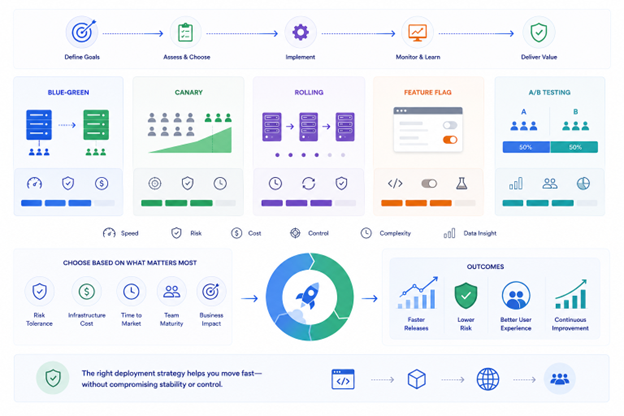
This guide walks through the four most widely used software deployment strategies, identifies the scenarios each handles best and provides a decision framework for matching the right approach to the right situation.
The Four Strategies and What They Are Actually For
Before getting into scenarios, it helps to be precise about what each strategy does and does not provide.
- Rolling Deployments: These replace instances of the old version incrementally with the new version. At any given moment during the rollout, some instances are running the old version, and some are running the new one. The transition happens gradually rather than all at once.
- Rolling deployments work well for stateless services where backward compatibility between versions is guaranteed. They work poorly for schema changes, stateful applications or situations where having two versions running simultaneously creates behavioral inconsistencies that affect users.
- Blue-Green Deployments: These maintain two identical environments — one live, one idle. The new version deploys to the idle environment, gets verified there and traffic switches over completely. The old environment stays available as an immediate rollback target.
- Blue-green deployments eliminate the mixed-version problem rolling deployments create. The switch is instant and the rollback is instant. The cost is running two full environments simultaneously, which has infrastructure implications for large-scale systems.
- Canary Releases: These route a small percentage of traffic to the new version while the majority continues hitting the old version. The canary percentage increases gradually as confidence grows.
- Canary releases give teams something blue-green cannot: Real production signal at controlled scale before full rollout. They are significantly more complex to implement and monitor than blue-green, which makes them most valuable when the additional complexity is justified by genuine uncertainty about how the new version will behave under real traffic.
- Feature Flags: These decouple deployment from release. Code ships to production in a disabled state and gets enabled for users through a configuration change rather than another deployment. Multiple feature flags can exist simultaneously, enabling gradual exposure, A/B testing and instant rollback without a full redeployment.
- Feature flags add a layer of operational complexity — flag states need to be managed, old code paths need to be cleaned up and flag logic can accumulate technical debt if not actively maintained. They are most valuable when release timing needs to be decoupled from deployment timing.
Scenario-Based Decision Framework
Scenario 1: Routine Service Update With High Test Confidence
Profile: A service update that has undergone thorough staging validation. No schema changes. Backward-compatible API contract. Team has high confidence in the release based on test results.
Best Approach: Rolling deployment
For well-tested, backward-compatible changes, rolling deployment provides a good balance of simplicity and risk management. The gradual replacement of instances means that if something unexpected appears, the impact is limited to the percentage of traffic hitting new instances before the issue is caught.
The key requirement is genuine backward compatibility. If the new version introduces any behavioral change that breaks consumers of the old version — even temporarily during the transition — rolling deployment is the wrong choice.
Watch For: Teams that classify releases as backward-compatible without verifying the API contract. A response schema change that removes a field developers assumed would always be present is not backward-compatible, regardless of how minor it appears internally.
Scenario 2: High-Stakes Release With Low Tolerance for Production Incidents
Profile: A significant change to a critical service — payment processing, authentication, core data pipeline. The cost of a production incident is high. Rollback speed matters more than software deployment simplicity.
Best Approach: Blue-green deployment
When rollback speed is the primary requirement, blue-green deployment is the right choice. The old environment stays live and fully warmed until the team is confident that the new version is stable. If something goes wrong after the traffic switch, flipping back takes seconds rather than minutes.
The verification step between deploying to the idle environment and switching traffic is where blue-green deployments earn their value. Teams that run smoke tests, integration checks and behavioral validation against the idle environment before switching traffic turn the idle period into a genuine safety gate rather than just an infrastructure formality.
Watch For: Teams that run blue-green deployments but flip traffic immediately after deployment without meaningful verification in the idle environment. Blue-green without a verification step is just a more expensive rolling deployment.
Scenario 3: Significant Change With Uncertain Production Behavior
Profile: A change that has been validated in staging, but where staging does not fully replicate production — different traffic patterns, different data distributions, different third-party integration behavior. The team has moderate confidence but genuine uncertainty about how the change will behave under real production load.
Best Approach: Canary release
Canary releases exist for exactly this scenario. When staging validation cannot answer the question of how the new version behaves under real production conditions, graduated exposure gives teams real signal before committing to full rollout.
The canary percentage progression matters significantly. Starting at 1% or 2%, monitoring for 10–15 minutes, then moving to 10%, then 25%, then 50%, then 100% — with genuine monitoring review at each step — is categorically different from running a canary at 5% for 30 seconds and then going to full rollout because nothing immediately broke.
Watch For: Canary releases where the monitoring is insufficient to detect the failures the canary is supposed to surface. A canary that is not being actively watched provides false confidence rather than genuine signal. Define the specific metrics to monitor before starting the rollout, not after something goes wrong.
Scenario 4: Feature With Complex Stakeholder Dependencies
Profile: A new capability that is technically ready but needs to be released to specific user segments first — internal users, beta customers or a geographic region — before broader availability. Release timing is driven by business readiness rather than technical readiness.
Best Approach: Feature flags
When business stakeholders need control over who sees a feature and when, feature flags provide a release mechanism that does not require coordination with the deployment pipeline. The code ships when it is technically ready. The feature becomes visible when business stakeholders decide the conditions for release are met.
Feature flags also handle the scenario where a release needs to be instantly reversible without a full redeployment. Disabling a flag is faster and lower-risk than rolling back a deployment, particularly for user-facing changes where the rollback itself can create a disruptive experience.
Watch For: Flag accumulation. Every feature flag that ships needs to be cleaned up after it is no longer needed. Teams that add flags without a plan for removing them end up with codebases full of dead flag logic that adds complexity without providing value.
Scenario 5: Database Schema Change Accompanying a Service Update
Profile: A service update that requires a database schema change — adding a column, modifying a data type, dropping a field. The schema change affects both the old and new versions of the service.
Best Approach: Expand-contract pattern with blue-green deployment
Schema changes require a specific sequencing approach regardless of which deployment strategy is used for the application layer. The expand-contract pattern addresses this by separating schema changes from application changes across multiple deployments.
In the expand phase, the schema change is deployed in a backward-compatible way — a new column is added as nullable, a new field appears alongside the old one. Both the old and new application versions can function correctly with the expanded schema.
In the contract phase, after the old application version has been fully retired, the schema is cleaned up — nullable becomes required, old fields are removed.
Blue-green deployment works well alongside expand-contract because the old environment serves as a functional validation target during the transition. If the expanded schema causes unexpected behavior, the old environment is still available for comparison.
Watch For: Teams that attempt to combine schema changes and application changes in a single deployment without the expand-contract sequencing. This creates a window where neither the old nor the new application version can function correctly, which is the exact scenario deployment strategies are supposed to prevent.
Building a Decision Framework for Your Organization
The scenario examples above are starting points rather than rules. Most enterprise environments have specific constraints — compliance requirements, SLA commitments, infrastructure limitations, team capabilities — that modify which strategy is appropriate in any given situation.
A useful organizational decision framework incorporates three inputs alongside the scenario analysis.
Risk Tolerance for This Specific Release: Not all releases carry the same risk. A change to a non-critical internal service justifies a simpler strategy than a change to customer-facing infrastructure. Calibrating strategy complexity to actual release risk prevents teams from over-engineering routine deployments and under-engineering consequential ones.
Rollback Requirements: How quickly does the team need to be able to recover if the deployment introduces a problem? Rolling deployments offer slower rollback than blue-green. Feature flags offer faster rollback than either. The rollback requirement should be established before selecting a strategy, not after the deployment reveals a problem.
Verification Capability: The value of any software deployment strategy depends on the team’s ability to verify that the new version is behaving correctly before and after the traffic transition. Teams with strong verification capabilities — comprehensive behavioral testing, meaningful monitoring, clear success metrics — can use more aggressive deployment strategies than teams without them. Choosing a deployment strategy that exceeds your verification capability produces the appearance of control without the reality of it.
Final Thoughts
The teams that handle software deployment well across all these scenarios share a common characteristic: They think about deployment strategy as a risk management decision rather than a technical default. Which strategy provides the right balance of speed, reversibility and production signal for this specific release, given what the team knows and does not know about how it will behave in production?
That question, asked consistently before every significant release, is what separates deployment programs that build confidence over time from those that accumulate incidents.

Frequently Asked Questions
What are the four main software deployment strategies?
The article focuses on rolling deployments, blue-green deployments, canary releases and feature flags. Each is suited to a different combination of release risk, traffic exposure and rollback requirements.
How should database schema changes be deployed safely?
The article recommends the expand-contract pattern, where backward-compatible schema additions are introduced first and old fields are removed only after older application versions have been retired.
What should organizations consider when choosing a deployment strategy?
The three main factors are the specific release’s risk tolerance, required rollback speed and the team’s ability to verify that the new version is behaving correctly.