

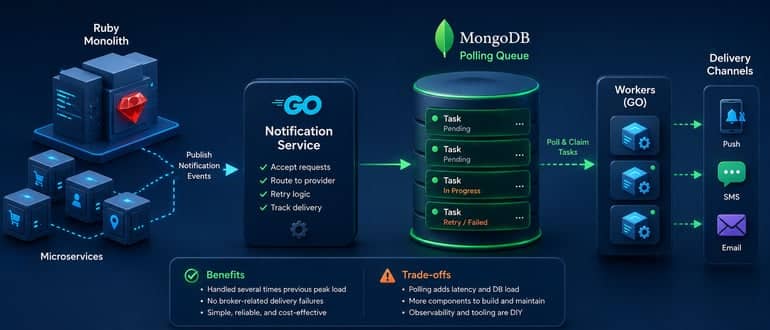
When the Message Broker Becomes the Bottleneck: Scaling Push and SMS With MongoDB Polling
A back-end team extracted notification delivery from a large Ruby monolith into a centralized Go service, only to discover that their shared RabbitMQ cluster could not reliably support the new workload. Here’s how they solved the problem using MongoDB as a polling queue and the trade-offs that came with it. The Scaling Problem Inside the […]
AI-Native Testing Is Now a Core Quality Engineering Discipline
Predictions from some of the most prominent voices in the technology industry suggest that software engineering could become increasingly obsolete within a year, jolting the developer community in ways that are still unfolding. The ripple effect spreads further across social media and news outlets, with some leaders urging developers to start seriously considering alternative career […]

Building Reliable EMR Pipelines With Custom AMIs and Step Functions
The goal is not custom AMIs for every workload. It is to make dependency management, patching and recovery explicit platform responsibilities rather than repeated job-level tasks.

The Trust Graph: Why Infrastructure Diagrams No Longer Describe Modern Systems
Traditional architecture diagrams miss the identity relationships that now drive breaches and outages. Platform teams need trust graphs that map who and what can act across modern systems.

Signed, Attested, and Malicious: The Software Supply Chain Has a Deepfake Problem
A developer pulls a package from a reliable repo. It is signed, has provenance, and has been scanned. And then…it contains malware. That is no longer hypothetical. When the Miasma worm tore through the @redhat-cloud-services npm namespace in June, its malicious releases carried real SLSA provenance, because they were built in Red Hat’s own GitHub […]
Zero Trust Starts at the Code: Building Secure Systems with PKI and DevOps Automation
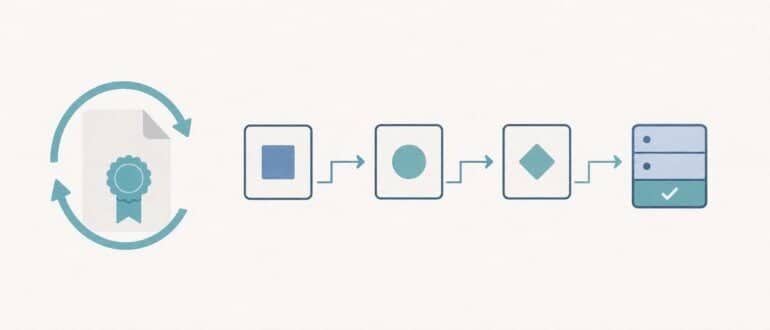
When a certificate expires, it can take down a production system, and teams usually only find out after something goes wrong. These issues are hard to catch because they rarely trigger alerts. Expired certificates often remain unnoticed in a config file or an old key until they cause trouble. Enterprise apps are no longer single, […]

AI Moved the Bottleneck From Writing Code to Understanding and Trusting It
AI coding boosts velocity, but without stronger review, governance and codebase visibility, teams risk higher costs, security gaps and production failures. TL;DR
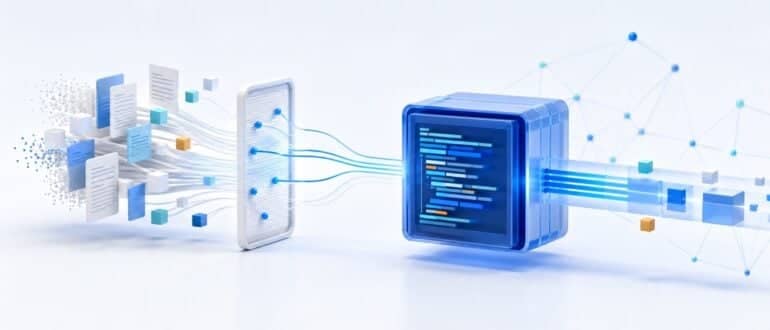
AI-Generated Code Is Cheap But the Context Infrastructure Behind It Is Not
The cost curve for generating code with AI has moved in one direction, and it has moved fast. What used to require a senior engineer’s full attention for an afternoon can now be scaffolded in minutes, and the price per token for the models doing it keeps falling. By the metric that dominated every early […]
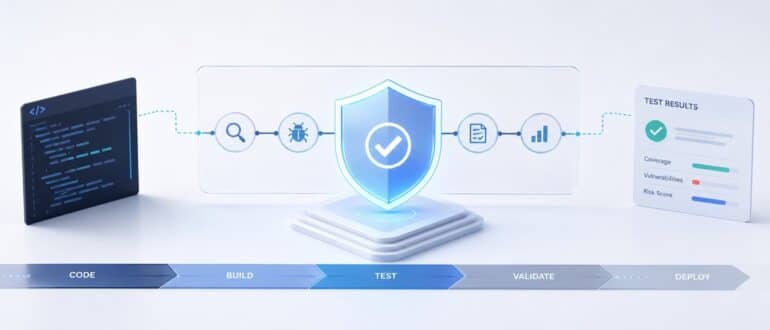
Why You Need AI Agent Security Validation in Software Testing
Engineering teams have been racing for the last two years to deploy AI agents that can find bugs faster than any QA team ever could. Autonomous testing agents can crawl through codebases, identify vulnerabilities, and generate test coverage reports while developers finally get to take a breath. The irony is that while development teams enjoy […]
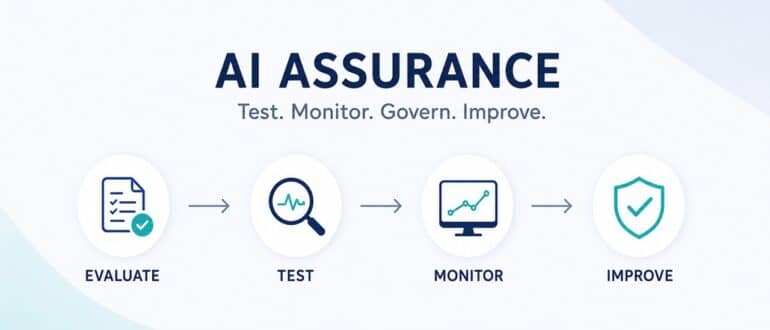
From AI Hype to AI Assurance: How Engineering Teams Can Safely Ship AI-Enabled Software
AI has moved very quickly from experimentation to production. A few years ago, many organizations were still asking whether AI could improve their products or internal workflows. Today, the question is different: how can teams ship AI-enabled software safely, reliably, and responsibly? That shift matters because AI is no longer just a research project or […]
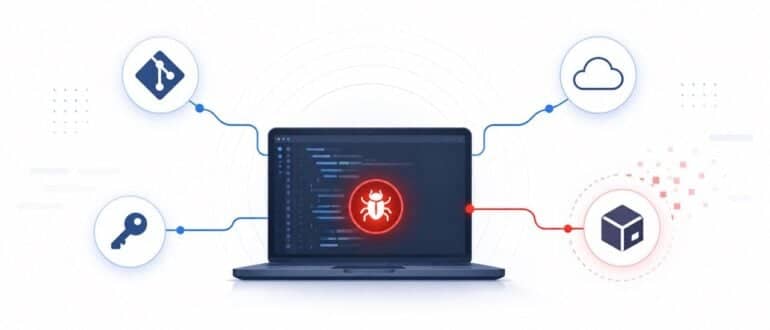
Why Developer Workstations Have Become a Critical Part of the Software Supply Chain
For years, software supply-chain security discussions focused on centralized infrastructure such as build servers, package registries, and CI/CD systems. Recent attacks suggest that this view is incomplete. The Megalodon campaign injected malicious GitHub Actions workflows into thousands of repositories, while a separate incident involving a malicious Visual Studio Code extension demonstrated how a single compromised […]

Multi-Model AI Debate: The New Way to Design Software Systems
How agentic workflows can automate architecture debates, compare tradeoffs and produce stronger software designs

How to Build a DevSecOps CI/CD Pipeline on Azure With GitHub Actions
Fix security problems when they’re cheap to fix, which is before the code is deployed. A pipeline that enforces this automatically is what makes that principle real.

Shadow Mode Continuous Integration: The Missing Test Layer for AI Agents
Autonomous agents require CI/CD pipelines that evaluate behavior, not just artifacts. Containerized shadow mode gives platform teams a practical control point: Run the agent in an isolated Docker environment, replay realistic workflows, capture structured traces and evaluate behavior against statistical and policy baselines.

From Alerts to Intelligence: Building a Production Self-Healing System for Port-Down Failures
Big, distributed computing systems seldom have visible failures. Most of them start without any bang, frequently with a health-check disconnection, a failed TCP connection or a service port that is no longer listening. Such signals are not too big when considered in isolation. However, in the scenario where systems are running with several hundreds of […]

Self-Healing Infrastructure With Cognitive Automation: How LLMs and Ansible Transform Middleware Reliability
Infrastructure reliability has always been central to enterprise success, yet traditional automation methods often fall short in handling complex, dynamic environments. With the rise of large language models (LLMs), a new paradigm of cognitive automation is emerging — where intelligent agents help infrastructure not only detect failures but also recommend or implement remediations in real-time. […]

Building CI/CD Pipelines for On-Prem Azure DevOps: What the Cloud Docs Don’t Tell You
The engineering that makes on-prem CI/CD reliable is invisible when it works. When it does not work, the failures are subtle and the documentation is thin.

Why AI-Driven Devops is Exposing the Limits of Traditional Toolchains and What Comes Next for Engineering Teams in 2026
The future belongs to adaptive systems that can learn, adjust and self-correct in real-time. Teams that invest in observability, modularity and AI-aware governance today will be positioned to thrive in this new operational reality.

Developing Real-Time Event Processing With Micronaut and Kafka Streams: A Step-by-Step Guide
Learn how to develop lightweight, high-performance stream processing applications in Java with contemporary frameworks
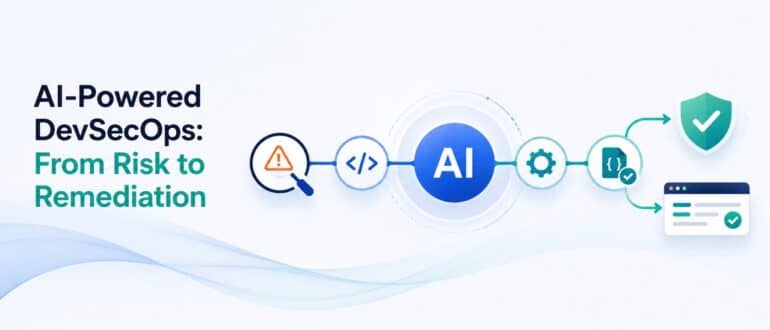
How AI is Revamping DevSecOps Processes
Artificial Intelligence is pushing DevSecOps into a new phase where security is no longer just about detecting vulnerabilities, but increasingly about resolving them automatically within the flow of software delivery. As many organizations are discovering, DevSecOps historically gave teams visibility into risk. AI is now turning that visibility into automated remediation. This evolution has taken […]
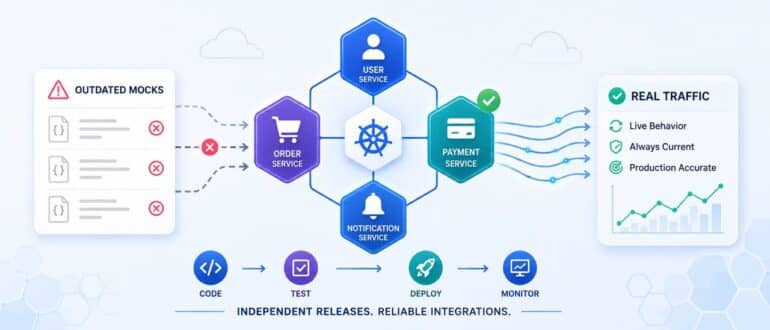
How Independent Service Deployments Expose the Limits of Conventional Regression Testing Tools
The architectural shift to independently deployable services was supposed to make software delivery faster and less risky. In many aspects, it has. Teams can ship a change to one service without coordinating a release across the entire system. A bug fix in the payment service does not require a synchronized deployment with the notification service, […]
A Beginner’s Guide to CI/CD and CI/CD Pipelines
Modern software development moves at a pace that would have been unthinkable a decade ago. Organizations push updates on demand, respond to vulnerabilities within minutes, and integrate new features at a relentless pace. This acceleration is driven by continuous integration and continuous delivery (CI/CD). To understand how CI/CD reshapes the security posture of modern organizations, […]
Beyond Automation: Building Accountability for AI Agents
The conversation around AI agents has evolved remarkably quickly. Not long ago, most organisations were still experimenting with prototypes and controlled use cases, trying to understand where these systems might fit within existing operations. Today, that conversation has changed. Agents are increasingly being deployed into production environments where they can write code, interact with customers, […]