

Dynatrace, this week, detailed its plans to add support for the latest agentic artificial intelligence tools and platforms being provided by Google Cloud.
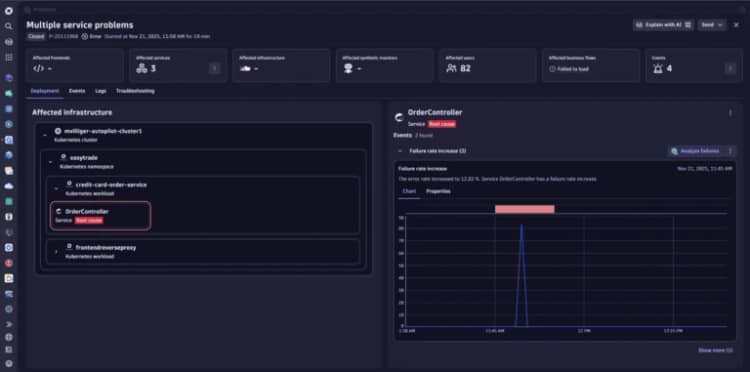
Raj Ramanujam, regional vice president for global alliances at Dynatrace, said the provider of an observability platform will provide integrations for Gemini Command Line Interface (CLI) extensions and Gemini Enterprise, the agentic AI platform that Google unfurled earlier this year.
Support for Gemini Enterprise will be enabled via Agent-to-Agent (A2A) protocol, now being advanced under the auspices of the Linux Foundation, while the Dynatrace Gemini CLI Extension provides developers instant access to observability and root-cause analysis directly within their terminal.
At the core of those capabilities are a set of Model Context Protocol (MCP) servers that expose Dynatrace telemetry data to an AI agent, noted Ramanujam. MCP is now being advanced under the auspices of the Agentic AI Foundation, another arm of the Linux Foundation.
The overall goal is to make it simpler for DevOps teams to take advantage of the Dynatrace observability platform to identify the root cause of any disruption to an agentic AI workflow in a way that spans the entire software development lifecycle (SDLC). That capability is crucial because, as AI agents assume more responsibility for tasks, pinpointing which events led to a disruption is going to be a significant challenge, he added.
Mitch Ashley, vice president and practice lead for software lifecycle engineering at The Futurum Group, noted that as AI workloads move from static models and short-running agents to long-running agents and adaptive services, telemetry becomes an essential visibility and control surface, more than just a reporting layer. Accelerating AI across the enterprise requires a visibility that connects developer innovation directly with operational resilience,” he added.
Dynatrace’s Gemini CLI Extension, combined with Dynatrace’s Agent-to-Agent (A2A) integration into Gemini Enterprise, removes friction and increases velocity for operations to keep the enterprise in the flow of utilizing agentic AI as a scalable core business driver,” noted Ashley. It begins to reposition where observability becomes part of the runtime fabric for AI applications, enabling teams to govern, optimize, and trust systems that increasingly act on their behalf, said Ashley.
In effect, observability platforms, in addition to helping to manage AI agents, will become a source of validation. The telemetry data they collect provides the context they will require to adjust the way they perform tasks as the runtime environment continues to be updated.
While observability has always been a core tenet of best DevOps practices, the depth to which observability platforms have been historically relied on has tended to vary widely from one organization to the next. However, with the rise of AI agents, the need to continuously govern and orchestrate them will require access to a platform that enables DevOps engineers to quickly understand the relationships between AI agents and the services they are invoking.
As such, the need for an observability platform is quickly shifting from a nice-to-have to an absolute necessity. The only issue that remains to be determined now is how quickly DevOps teams can deploy an observability platform before the sheer number of AI agents that are deployed becomes too overwhelming to effectively manage.


Mike Vizard is a veteran IT journalist with more than 25 years of experience covering the technology industry, having previously served as Editor-in-Chief of both CRN and InfoWorld and as editorial director for Ziff-Davis Enterprise, where he oversaw titles including eWEEK, CIO Insight and Baseline. Over his career he has also edited or contributed to a wide range of enterprise technology publications, including IT Business Edge, Channel Insider, ComputerWorld, TMCNet and Digital Review, and he later led editorial for CTOEdge.com. His reporting and analysis span software development, cloud computing, cybersecurity, IT channel strategy and, more recently, artificial intelligence and DevOps practices. A recognized voice in enterprise IT journalism, Vizard is known for tracking emerging technology trends as they move from early adoption into mainstream enterprise use. He now serves as Chief Content Officer for Techstrong Group, where he oversees editorial strategy across the full network — devopsy.kinsta.cloud, Security Boulevard, Cloud Native Now, Digital CxO, Techstrong.ai, TechStrong.IT, Techstrong Semi and PlatformEngineering.com — in addition to writing and hosting content for Techstrong TV and the Techstrong Gang podcast.