


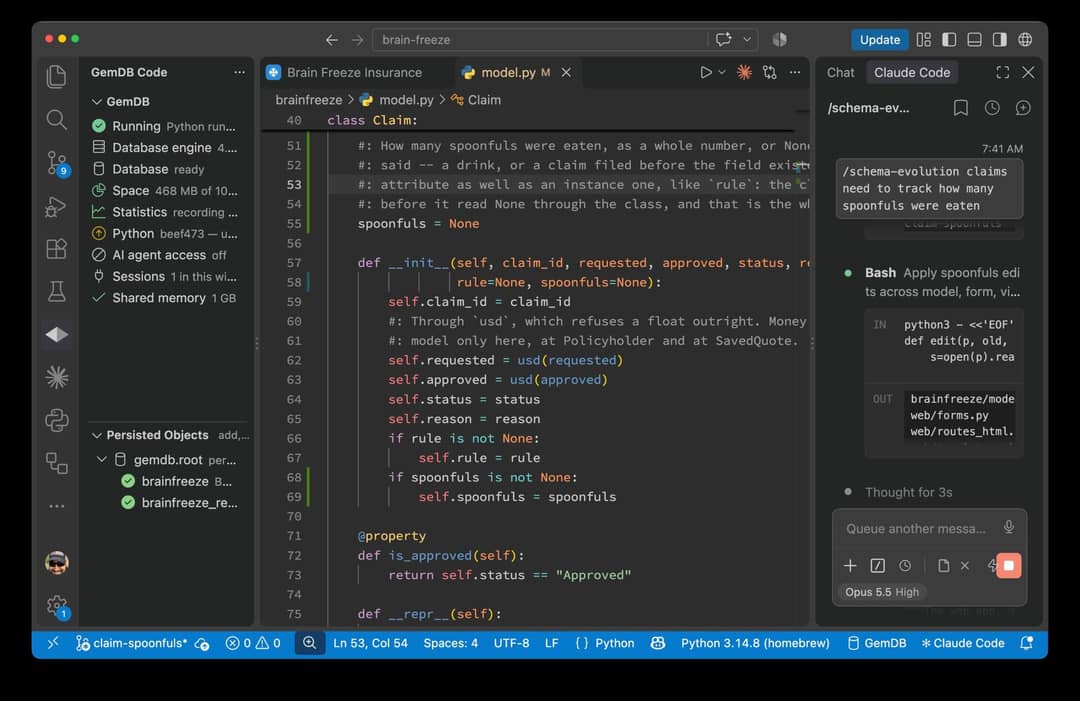
GemDB today added a Visual Studio Code extension that makes it possible for application developers to use Python code to generate schemas for the company’s object database.
Company CEO Kit Merker said GemDB Code enables an application developer or an artificial intelligence (AI) agent to create or modify a persistent object without having to invoke a translation later or rely on a database administrator (DBA) to manage that process. Objects persist exactly as they exist in application code. Any change to the code changes the schema without requiring any mapping, migration, or synchronization.
GemDB Code packages the GemDB object database engine as a self-contained VS Code extension. The database downloads and configures automatically on first activation. A developer or coding agent creates an object, commits it, and the object persists with full transactional guarantees. When that object needs to change, the developer or agent updates the code and commits again. Any change that would typically require new join tables, data tables, foreign key definitions, and backfill migration scripts can now only require a developer or AI coding agent to add a field to an object.
Additionally, the extension ships with a built-in Jupyter Notebook kernel for interactive development against a live database and a Model Context Protocol (MCP) server that enables natural-language queries for AI coding tools. It also includes Brain Freeze Insurance, a sample application that uses a simulated insurance scenario to teach developers about object persistence, querying, and schema evolution.
The overall goal is to reduce the current level of friction that exists whenever developers need to access a database to build an application, said Merker. Longer term, GemDB also plans to add support for additional programming languages.
It’s not clear how much the setting up and modifying of databases has become a bottleneck in DevOps workflows, but GemDB is betting that by making it simpler for developers to use GemDB there will be more downloads that eventually lead to its object database being deployed more often in production environments.
Most application developers, when they first start building an application, will download the database that is most readily accessible. The challenge is that many IT teams will migrate the application that is ultimately delivered to another database format they have already deployed in a production environment when it comes time to deploy an application. However, in other instances, the IT team will deploy whatever database the application developer initially selected.
Regardless of the outcome, GemDB is making a concerted effort to expose more DevOps teams to an object database that has now been deployed in enterprise IT environments for decades, said Merker.
Hopefully, there will come a day when the deployment and management of databases will become more deeply embedded within DevOps workflows. The ability to use code to update and change them, of course, represents a significant step in that direction at a time when the pace at which applications are being built and deployed is significantly increasing in the AI era.

Frequently Asked Questions
1. What is GemDB Code?
2. How does GemDB Code eliminate database schema migrations?
3. How does GemDB Code support AI coding agents?

Mike Vizard is a veteran IT journalist with more than 25 years of experience covering the technology industry, having previously served as Editor-in-Chief of both CRN and InfoWorld and as editorial director for Ziff-Davis Enterprise, where he oversaw titles including eWEEK, CIO Insight and Baseline. Over his career he has also edited or contributed to a wide range of enterprise technology publications, including IT Business Edge, Channel Insider, ComputerWorld, TMCNet and Digital Review, and he later led editorial for CTOEdge.com. His reporting and analysis span software development, cloud computing, cybersecurity, IT channel strategy and, more recently, artificial intelligence and DevOps practices. A recognized voice in enterprise IT journalism, Vizard is known for tracking emerging technology trends as they move from early adoption into mainstream enterprise use. He now serves as Chief Content Officer for Techstrong Group, where he oversees editorial strategy across the full network — devopsy.kinsta.cloud, Security Boulevard, Cloud Native Now, Digital CxO, Techstrong.ai, TechStrong.IT, Techstrong Semi and PlatformEngineering.com — in addition to writing and hosting content for Techstrong TV and the Techstrong Gang podcast.