

Teams running AI agents in production have learned an expensive lesson this year. The smartest model is not always the right one. A coding agent that burns frontier-model tokens to rename a variable or rerun a failed test wastes money and time. And when an agent chains 15 or 20 steps together, small delays stack up fast.
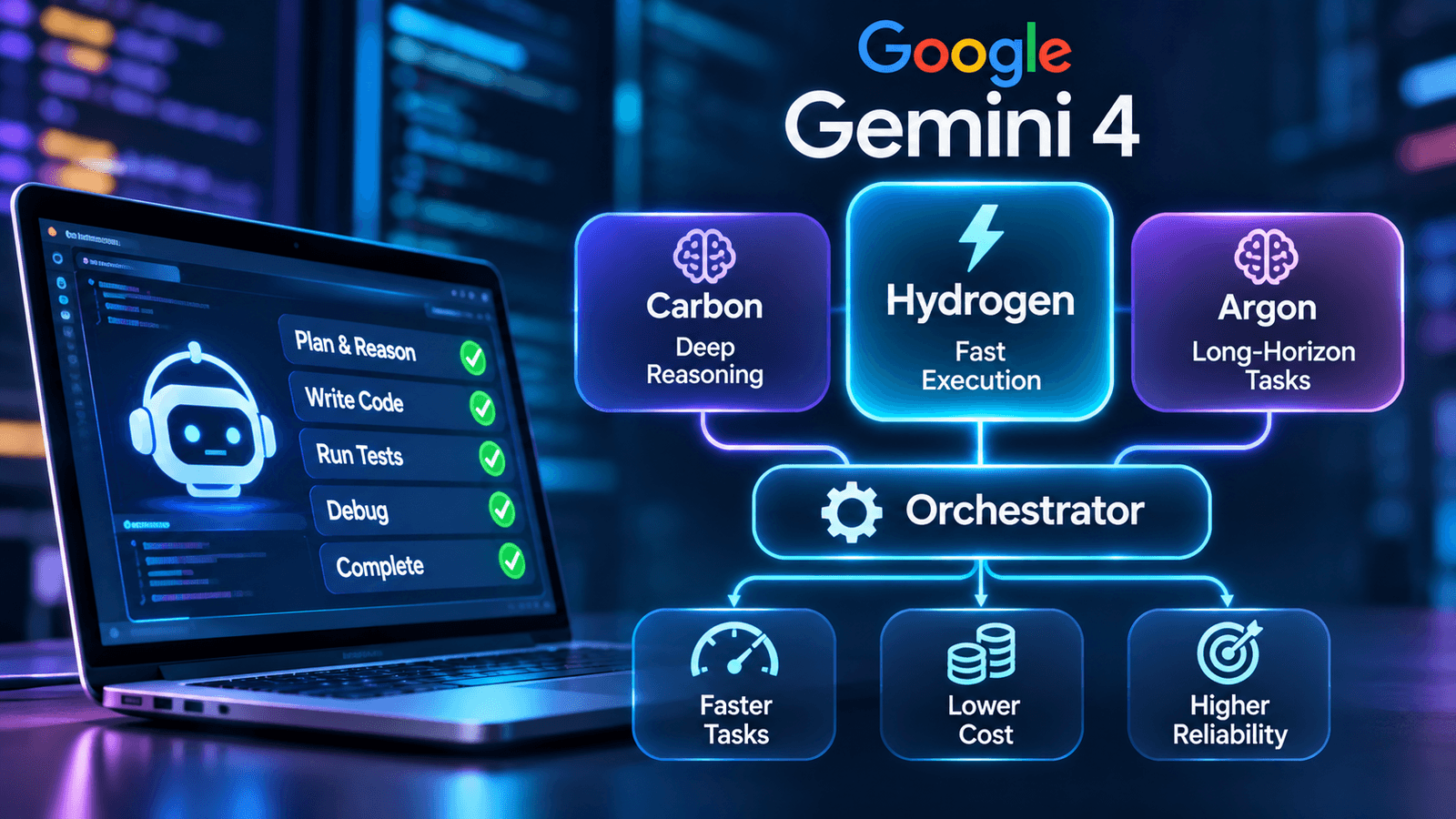
Google is betting the answer is a lineup, not a single model. On Nov. 12, the company released Gemini 4 Hydrogen, a speed-focused model it calls its “daily driver for agentic workflows.” Hydrogen joins Gemini 4 Carbon and Gemini 4 Argon, the frontier models Google built for deep, long-horizon reasoning. Hydrogen is built for execution: debugging, repository-level coding, web development and multi-step agent tasks. It also replaces Gemini 3.8 Flash and retires the Flash brand.
What Google is Claiming
The numbers are big, and they all come from Google. The company says Hydrogen finishes tasks 2.5 times faster than Gemini 3.8 Flash at its default high thinking level. It more than triples Flash’s score on Terminal-Bench 4.1, from 18.2% to 57%, and cuts fabricated claims by more than 5x. On the Artificial Analysis Intelligence Index, Hydrogen scores 51 at its default setting, one point ahead of Argon. At its new xhigh thinking level, it reaches 54.
Developers get four thinking levels (low, medium, high and xhigh) and a one-million-token context window for both input and output.
One claim stands out for anyone who has debugged an agent at 2 a.m. Google says Hydrogen adapts cleanly when a tool call fails, or a search comes back empty. Agents rarely fail because they can’t reason. They fail because an API times out or a file isn’t where they expected, and they spin in circles or make something up. If Hydrogen recovers from those moments the way Google says, that alone is worth testing.
The Real Story is the Orchestrator
Alongside Hydrogen, Google introduced Orchestrator, a feature in its Google Antigravity development platform. Orchestrator switches between models such as Carbon and Hydrogen within the same session. Carbon handles the hard reasoning. Hydrogen handles the fast execution. Google says that setup came close to Carbon’s task success rate on Terminal-Bench while using 24% less quota and finishing 19% faster.
This is how good engineering teams already work. A senior architect sets the plan. Others carry out the steps. Nobody asks the principal engineer to fix every lint error. Model routing applies the same logic to agents, and it adds a new question for the platform team: which model handles which step, and who decides?
Mitch Ashley, vice president and practice lead for CIO & Technology Buyers and Software Lifecycle Engineering at The Futurum Group, says that question carries real weight. “Whoever controls model routing now controls the cost and reliability of agent work,” he said. “When an orchestrator picks which model handles each step, that routing policy decides what a pipeline spends and how it behaves when a tool call fails.”
Watch the Bill
Hydrogen costs $1.50 per million input tokens and $7.50 per million output tokens, flat across the full context window. That’s well below Carbon and Argon, which list at $2 and $10 through Nov. 30 before rising to $4 and $20. But it’s double what Gemini 3.8 Flash costs today, and Google plans to raise Flash to Hydrogen’s price after Dec. 31.
FinOps teams should flag one detail. Output pricing includes thinking tokens, and Hydrogen defaults to the high thinking level. A team that swaps model IDs in a pipeline without touching its configuration could see costs climb even as tasks finish faster.
Where it Still Trails
Google’s own benchmark table shows Hydrogen isn’t the leader everywhere. Anthropic’s Claude Sonnet 5.5 scores 63.9% on Terminal-Bench 4.1 to Hydrogen’s 57%, and it also leads on an OSWorld subset that measures computer use. Independent testing reported by The Decoder found Hydrogen rarely hallucinates but lags on terminal work. For DevOps teams, terminal work is a big part of the job. Benchmark tables are a starting point, not a buying decision.
What DevOps Teams Should Do Now
Hydrogen is available today through the Gemini API, Google AI Studio, Android Studio, Gemini for business, and Vertex AI. Paid Google AI Pro and Ultra subscribers can use it in Antigravity.
Test it against your own pipelines, not vendor benchmarks. Set thinking levels per task type instead of accepting the default. And build routing and fallback into your agent platform so you can swap models without rewriting workflows.
Ashley says the routing policy itself deserves the same discipline as any other production system. “Platform teams should own that policy and run it like any production control, versioned and measured on cost and success per completed task,” he said. “Watch whether the model provider or the enterprise’s own agent platform ends up holding the router.”
That’s the question this launch raises. Google built its Gemini 4 lineup around the idea that agents will use more than one model, and Orchestrator puts the router inside Google’s platform. Teams that keep that decision in their own hands will have an easier time when the next model shows up. At this pace, that could be a matter of weeks.

Frequently Asked Questions
1. What is Google Gemini 4 Hydrogen designed to do?
2. How does Google's Orchestrator improve AI agent performance?
3. What should DevOps teams consider before adopting Gemini 4 Hydrogen?

Tom Smith (C. Thomas Smith III) is a veteran digital analyst and content strategist who spent more than four years as a Research Analyst at DZone.com (part of Devada), where he conducted thousands of interviews with technology executives and authored roughly 1,500 articles that generated more than 10 million page views across topics including AI/ML, Agile, APIs, cloud computing, DevOps, IoT, Java, Kubernetes, microservices, and security. He holds an MBA in Marketing from Duke University's Fuqua School of Business and a B.A. in Political Science from Duke. Smith later worked as a content strategist and technical writer at Cognizant, including stints on Google's Bard (now Gemini) and Meta's AI Business Assistant (MAIBA) "seed" content teams, where he helped train and evaluate large language models. Over his career, he has interviewed more than 4,000 technology executives across AI, cloud, data, security, and storage sectors. He now writes independently through Insights From Analytics and is a contributing writer across multiple Techstrong Group properties, including DevOps.com, Digital CxO, Cloud Native Now, PlatformEngineering.com, and Techstrong.ai, where he covers AI agents, enterprise AI infrastructure, and emerging developer tools.