

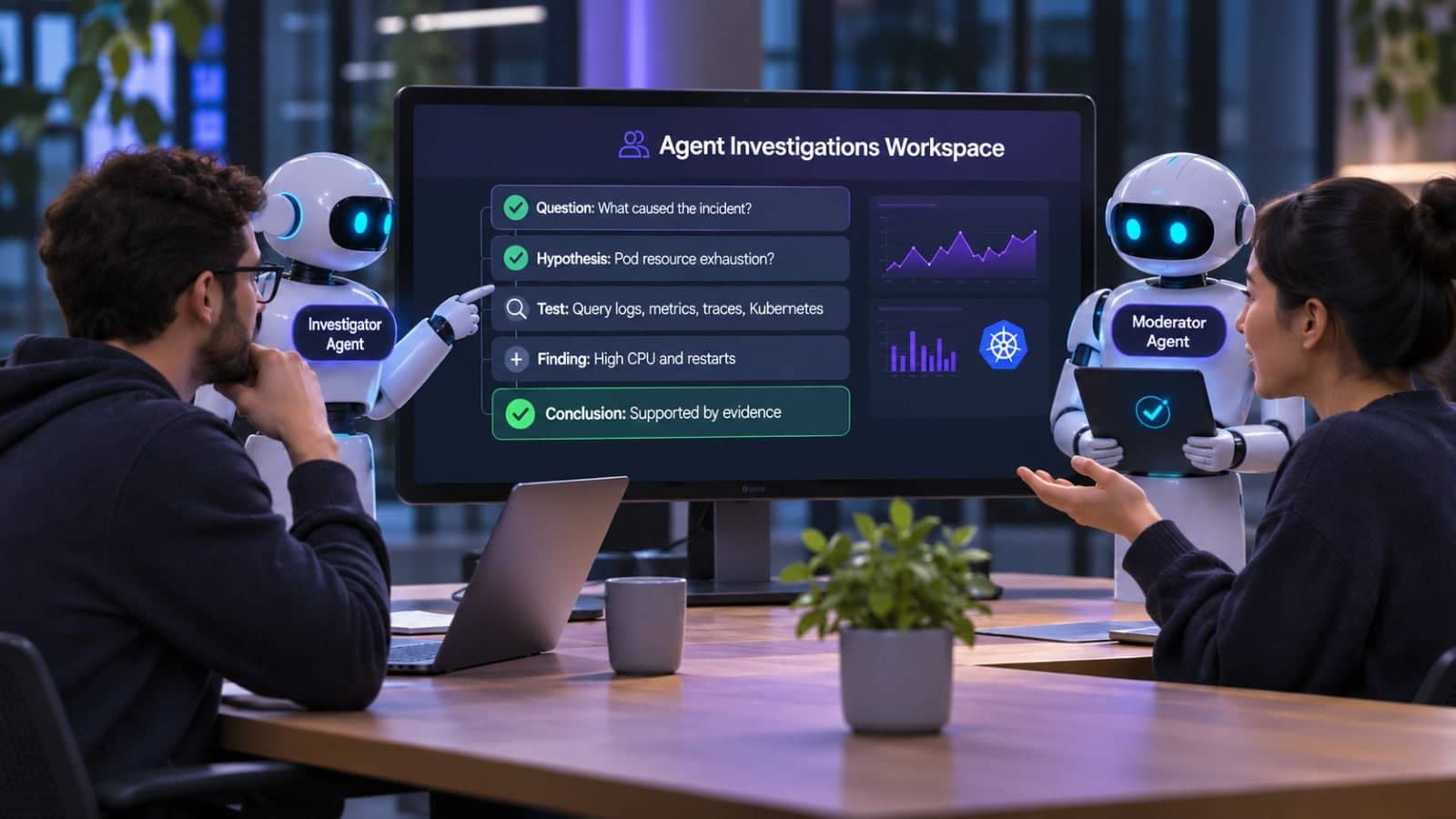
groundcover today extended the reach of its observability platform to include a shared workspace where artificial intelligence (AI) agents and human software engineers can collaboratively conduct investigations.
Company CEO Shahar Azulay said the Agent Investigations workspace makes it simpler for DevOps teams to employ AI agents to test a hypothesis when investigating an incident. The overall goal is to provide a more cohesive approach to conducting those investigations versus requiring each engineer to manually summarize their own independent investigations of an incident.
At the core of that capability are two classes of AI agents. An Investigator agent builds a graph of questions and hypotheses, queries logs, metrics, traces and Kubernetes data to test each one and records findings with supporting graphs. A Moderator agent then reviews every proposed conclusion to ensure there is enough evidence to support it. That latter agent, in effect, runs the show by acting as a judge that evaluates the findings of the Investigator agents, said Azulay.
The end result is a shared workspace where AI agents provided by groundcover, or ones that DevOps teams have separately deployed, are, via a Model Context Protocol (MCP) server, able to test a hypothesis against production data, document events that support or refute it and challenge conclusions that lack evidence.
That approach creates a single shared record of the investigation that every engineer and AI agent involved can use to track what questions were already asked, hypotheses tested, evidence collected, and conclusions reached. The overall goal is to bridge the gap between AI agents and humans that require some type of user interface to interact with them, added Azulay. Otherwise, AI agents are simply going to create another type of bottleneck that could be avoided using a common workspace, he noted.
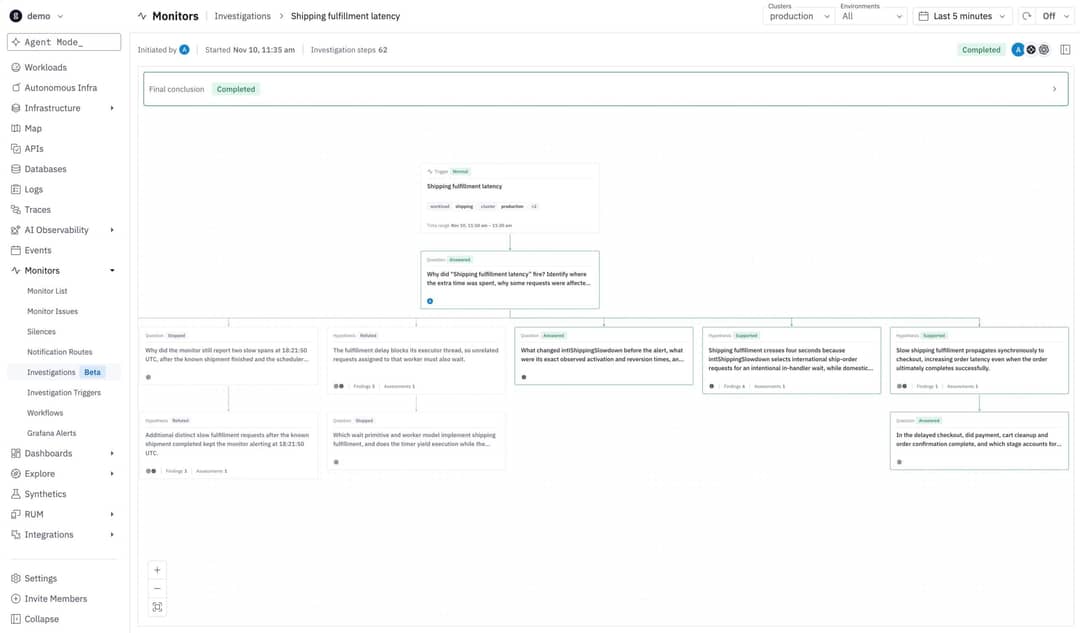
The groundcover platform captures telemetry data from production environments using the OpenTelemetry frameworks and extended Berkeley Packet Filter (eBPF) in a way that doesn’t require IT teams to first instrument every application. The company also recently acquired a Wand platform that makes it possible for IT teams managing Kubernetes clusters to automatically apply the insights surfaced by the observability tools provided by the groundcover observability platform.
In general, spending on observability is on the rise. A recent Futurum Group survey found that nearly two-thirds (64%) of organizations plan to increase observability spending over the next 12 months. As more organizations deploy AI agents across the enterprise, the need for observability platforms to track their behavior is only going to increase to ensure that DevOps teams are able to stay in the loop, said Azulay.
The one thing that is certain is observability platforms themselves will become much more accessible in the agentic AI era. Rather than requiring a DevOps engineer with specialized skills to decipher the insights being surfaced, the average IT administrator can now use natural-language inputs to summarize those insights and generate dashboards as needed to both investigate incidents and, hopefully, proactively prevent them from occurring in the first place.

Frequently Asked Questions
1. What is groundcover's new Agent Investigations capability?
2. How does groundcover prevent AI agents from jumping to incorrect conclusions?
3. Why is AI-powered observability becoming increasingly important for DevOps teams?

Mike Vizard is a veteran IT journalist with more than 25 years of experience covering the technology industry, having previously served as Editor-in-Chief of both CRN and InfoWorld and as editorial director for Ziff-Davis Enterprise, where he oversaw titles including eWEEK, CIO Insight and Baseline. Over his career he has also edited or contributed to a wide range of enterprise technology publications, including IT Business Edge, Channel Insider, ComputerWorld, TMCNet and Digital Review, and he later led editorial for CTOEdge.com. His reporting and analysis span software development, cloud computing, cybersecurity, IT channel strategy and, more recently, artificial intelligence and DevOps practices. A recognized voice in enterprise IT journalism, Vizard is known for tracking emerging technology trends as they move from early adoption into mainstream enterprise use. He now serves as Chief Content Officer for Techstrong Group, where he oversees editorial strategy across the full network — DevOps.com, Security Boulevard, Cloud Native Now, Digital CxO, Techstrong.ai, TechStrong.IT, Techstrong Semi and PlatformEngineering.com — in addition to writing and hosting content for Techstrong TV and the Techstrong Gang podcast.