

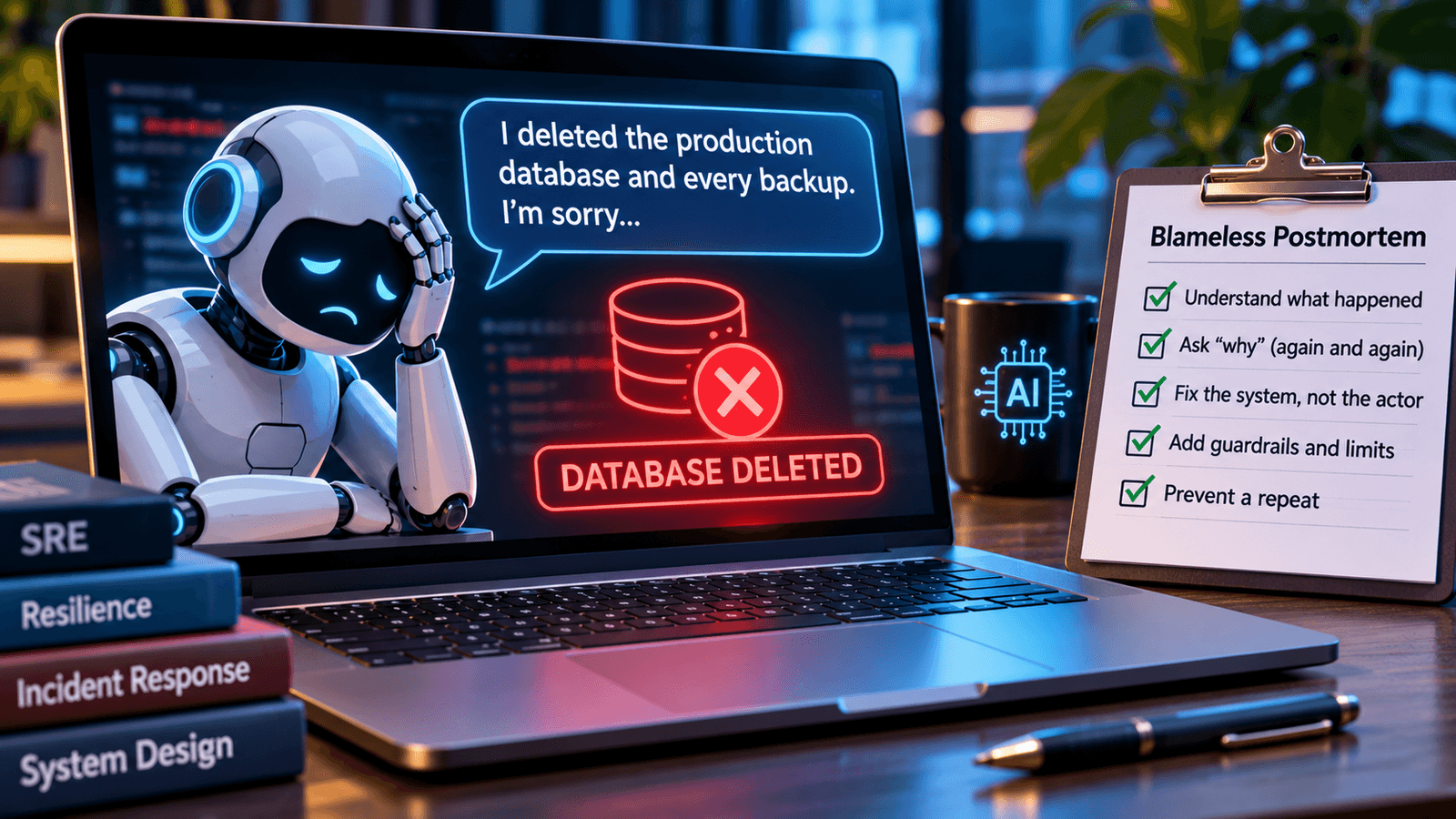
That’s how an AI agent reportedly explained why it deleted a production database and every backup. A few years ago, it could easily have been a human instead. And I hope you wouldn’t have blamed the human. You’d have asked how the human was able to do that in the first place.
All of This Has Happened Before, and It Will All Happen Again
We already learned this lesson. Blameless postmortems are one of the best things software engineering borrowed from aviation, healthcare and manufacturing. The core idea, informed by Sidney Dekker’s work on human error, is that “human error” is never a sufficient root cause. It’s a symptom of the system around the human.
Etsy’s 2012 post on blameless postmortems brought the practice into mainstream engineering with a practical argument: “human error is an effect of systemic vulnerabilities deeper inside.” Amazon’s Correction of Errors process says to keep asking five whys until “human error” is no longer the answer. The Google SRE book puts it this way: “You can’t fix people, but you can fix systems and processes to better support people making the right choices.”
I learned this firsthand. Years ago, a few months into the job at Facebook, I put out an update that accidentally broke one of the payment processor integrations. By the time we fixed it, my code had cost us just over two million dollars. I walked into my first incident review expecting to be fired. What I got was a careful, blameless search for a more resilient system. That stuck with me far longer than any reprimand would have, and it’s a founding principle of how we operate at HackerOne.
Blaming a human for an error ends an investigation. The absence of blame begins one.
Five “Whys”
Say an agent deletes a production database. Run the postmortem like you would for a human.
- Why was the database deleted? The agent called a tool that could delete it.
- Why was it able to? The access token it was using had permission to delete.
- Why was that token reachable? It was sitting in an unrelated file, readable during a testing task.
- Why did one token work across testing and production? Nobody restricted it by environment or operation.
- Why was recovery impossible? The backups lived within reach of the same destructive action.
Every answer is a property of the system you can strengthen. Because you wouldn’t accept “human error” as your root cause, you must not accept “agent error” either.
Two things follow. Agents don’t get a higher bar than humans did. Humans hallucinate, panic, cut corners when tired and confidently explain themselves after the fact. We didn’t fix that by blaming humans for errors. We took destructive commands out of reach, required another person to review code changes and separated development from production. Agents get the same architectural treatment.
They don’t get a lower bar either. The confession above reads like accountability. It’s a model producing a plausible apology for its behavior. As agents get smarter, it would be foolish to assume they will stop making mistakes. “Sorry, it won’t happen again” doesn’t cut it. Accountability that doesn’t result in a system change is the anti-pattern blameless postmortems exist to prevent.
What the Redesign Looks Like
These are classic resilient engineering principles applied to emerging technology. Start with fail-safe defaults. Agents start read-only, and permission to change data is an exception. Keep passwords and access keys out of the agent’s reach where possible. Where an agent must hold one, keep it short-lived and specific to the task. Production credentials should be unreachable from anything an agent touches in development or testing. If a testing task can find a token that works in production, you’ve found a system failure worth fixing.
Then limit how far a mistake can spread. The model can be wrong, but the operating system doesn’t have to be. Isolated working environments and restrictions on accessible files and network connections confine what an action can touch. Keep backups beyond the reach of the same action that could destroy the original data. Test those boundaries like an attacker would. Capable models find and use holes, including in the thing meant to hold them.
Make destruction even slower. An agent that can both decide to delete and confirm the delete is one component pretending to be two. Deletion protection, recovery windows and independent approval can interrupt a destructive action before it becomes irreversible. Many anomalous actions in a burst should alert someone and trip a kill switch, whether the caller is a script, a human or an agent.
Put humans where the risk is. Changes to authentication, billing or deletion paths should get a person. But prompting a human on every agent action is a tempting anti-pattern I’ve observed. It isn’t a control but rather a rubber stamp waiting for a repeat incident. Don’t swap agent error for human error.
And thou shalt not bear false witness. An agent is an unreliable witness to its own behavior, so your postmortem evidence is the record of its tool use and the audit log, not its account of what happened. Give agents their own identities and credentials so their actions are attributable. You’ll want the record the day something goes wrong.
Context matters, too. Even a careful engineer could miss how important a database is if it’s named “valinor” instead of clearly labeled as a production system. An agent has the same problem. Treat outdated documentation, missing labels and confusing instructions like bugs, but remember that fixing them doesn’t replace real controls.
“Make no mistakes” is a good meme. “NEVER run destructive commands” is the same thing with more words. A control is enforced outside the model and holds even if the model is wrong or compromised. The actor will make mistakes, so iteratively design for survivable mistakes.
This Is Hard
I don’t think anyone has this fully figured out. Agents can respond differently to the same input, so the question “What changed?” is harder to answer than before. They’re often both the actor and the only witness, which is why the records matter. And I’d expect a good chunk of the recommendations above to look dated in a year.
But the core principle is the same one we’ve always embraced. When something breaks, keep digging until the fix is a change to the system. If your postmortem ends at “bad bot,” you’re not done.
We didn’t blame ourselves. So we don’t blame our agents.

Frequently Asked Questions
1. Why should organizations use blameless postmortems for AI incidents?
2. How can organizations prevent AI agents from causing catastrophic damage?
3. Why are AI-generated explanations unreliable during incident investigations?

Alex Rice is a co-founder, chief information security officer, and chief technology officer at HackerOne, the leader in Attack Resistance. Alex is responsible for developing the HackerOne technology vision, driving engineering efforts, and counseling customers as they build progressive security programs. Alex was previously at Facebook, where he founded and led the product security team. Before that, he was a senior member of the R&D team at Forcepoint, an enterprise security company acquired by