
TL;DR — Key Takeaways
OllyGarden expands AI-driven observability: Following an additional $4 million funding round, OllyGarden has added Minimum Viable Instrumentation capabilities to its Rose AI agent to identify missing instrumentation and recommend relevant OpenTelemetry data sources.
Less telemetry could mean lower costs and better insights: Rose AI helps DevOps teams identify unnecessary logs, metrics and traces before they reach observability platforms. OllyGarden claims its technology has identified opportunities to reduce telemetry volume across up to 85% of logs.
Better data is essential for autonomous AI agents: Reducing irrelevant telemetry and closing instrumentation gaps could help AI agents make more reliable decisions while lowering observability costs, although human validation remains critical.
OllyGarden this week revealed it has extended the capabilities of its artificial intelligence (AI) for optimizing the collection of telemetry data to now also discover where no existing instrumentation exists and what instrumentation should be applied to address that gap.
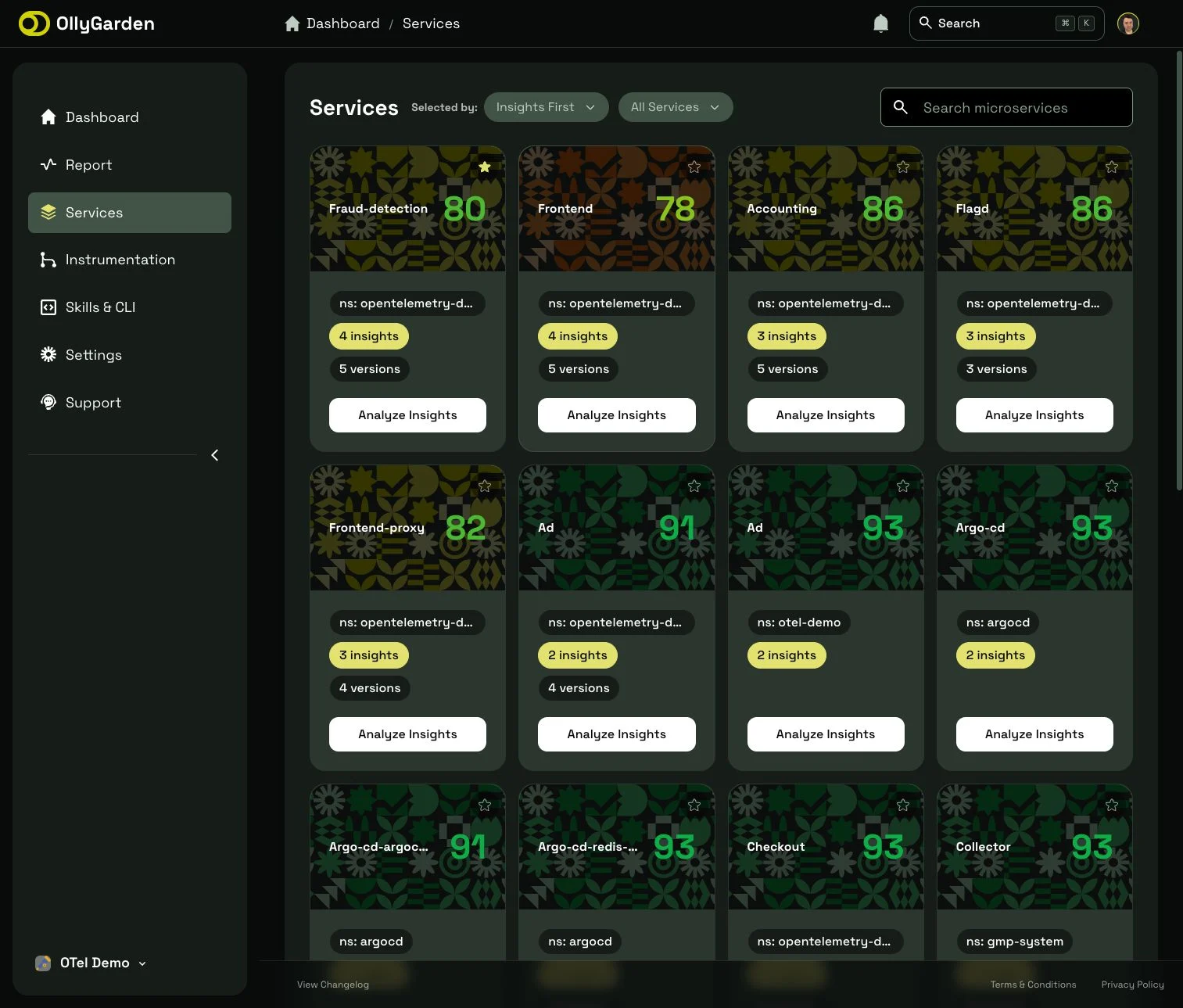
Fresh off raising an additional $4 million in funding, OllyGarden founder Juraci Paixão Kröhling said a Minimum Viable Instrumentation (MVI) capability that has been added to the Rose AI agent the company previously developed makes it possible to identify the most relevant sources of telemetry data that should be instrumented using OpenTelemetry, an open-source framework for collecting that data that is being advanced under the auspices of the Cloud Native Computing Foundation (CNCF).
That capability extends the scope of an AI agent that was created to help DevOps teams reduce the amount of telemetry data they need to collect and store by identifying which logs, traces and metrics are the most relevant. The overall goal is to reduce the massive amount of telemetry data that DevOps teams would need to collect, analyze and store, said Paixão Kröhling.
The amount of telemetry data being collected naturally varies from one DevOps team to the next, but as more AI workloads are deployed the volume of that data continues to steadily rise. Aggregating all that data in a way that enables IT environments to be observed is quickly becoming cost-prohibitive for many DevOps teams.
The overall goal is to make it simpler for DevOps teams to calibrate the exact amount of telemetry data they need to observe an IT environment to ultimately reduce the overall level of noise that prevents meaningful signals from being fully understood, said Paixão Kröhling.
Specifically, the Rose AI agent continuously evaluates the quality of the telemetry data being collected, identifies issues, and then generates source-level fixes that DevOps teams can then apply. That approach prevents bad or irrelevant telemetry data from ever reaching a backend observability platform in the first place, noted Paixão Kröhling. Over the past year, OllyGarden claims to have helped DevOps teams identify opportunities to reduce telemetry data volume across up to 85% of their logs.
In theory, observability platforms will play a crucial role in enabling DevOps teams to embed AI agents within their workflows by providing them with access to telemetry data they can reason across. The issue is finding a way to reduce the volume of data being exposed to them to ensure those AI agents generate higher-quality outcomes at the lowest cost possible. Otherwise, DevOps teams are likely to discover that the cost of deploying AI agents will far exceed their available budgets.
It may be a while yet before most DevOps teams will be pervasively deploying fully autonomous AI agents across production environments, but at this juncture it’s more a question of when and to what degree than it is if. The fundamental challenge is first ensuring that AI agents are not reasoning across irrelevant data and then finding a way to validate the output they provide. Only then are DevOps teams going to trust AI agents enough to execute tasks with little to no supervision. Until then, AI agents that, by definition, are probabilistic will be relegated to performing tasks that, while reducing toil for DevOps engineers, still need to be closely monitored and verified at almost every step of highly deterministic DevOps workflows.

Frequently Asked Questions
What is OllyGarden's Minimum Viable Instrumentation (MVI) capability?
Minimum Viable Instrumentation is an AI-powered capability added to OllyGarden's Rose AI agent that discovers gaps in existing telemetry instrumentation and identifies which OpenTelemetry data sources should be added. It aims to help DevOps teams collect the information they need without generating unnecessary observability data.
How does OllyGarden's Rose AI agent reduce observability costs?
Rose AI evaluates the quality and relevance of collected telemetry, identifies unnecessary logs, metrics and traces, and generates source-level fixes that developers can apply. By preventing irrelevant data from reaching observability backends, organizations can potentially reduce ingestion, storage and analysis costs.
Rose AI evaluates the quality and relevance of collected telemetry, identifies unnecessary logs, metrics and traces, and generates source-level fixes that developers can apply. By preventing irrelevant data from reaching observability backends, organizations can potentially reduce ingestion, storage and analysis costs.
AI agents increasingly depend on telemetry to understand system behavior, troubleshoot problems and recommend actions. Excessive or irrelevant data can increase processing costs and introduce noise, while missing instrumentation can leave agents without essential context. Optimized telemetry helps improve the information available to AI agents, although their outputs still require validation.