

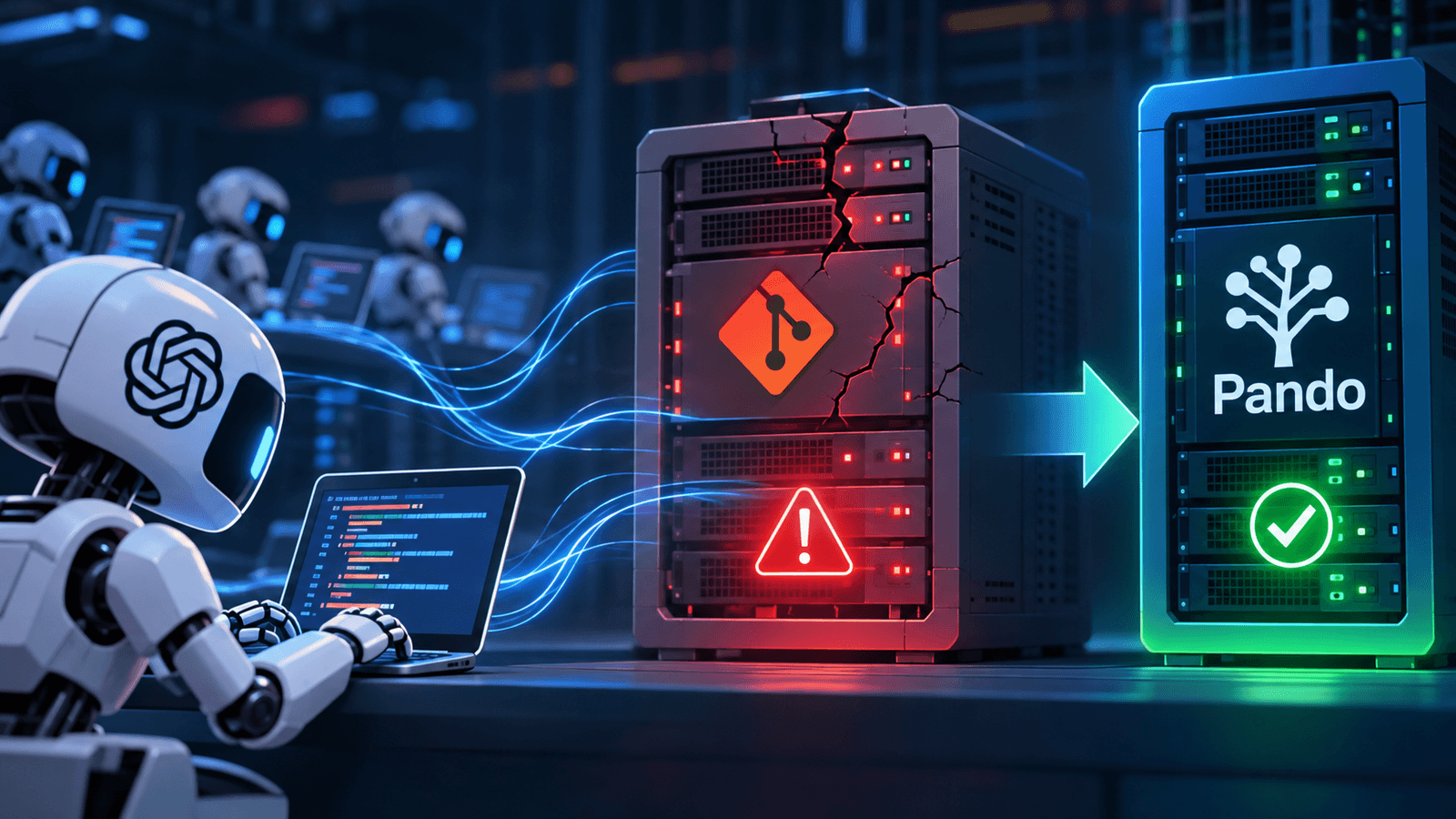
Coding agents keep finding the weak spots in infrastructure built for people. At OpenAI, that weak spot was the server behind its monorepo.
In a November 2 engineering post, OpenAI’s Aaron Friel, Taylor Blau, and Ted Nyman explained how Codex changed the load on the company’s source control. Each engineer now runs many tasks at once. That multiplied branches, pushes, and merges. It also multiplied fetches and clones from laptops, research jobs, and CI, since each push can kick off several jobs that fetch the same commit.
Starting around the end of 2025, the old setup couldn’t keep up. Fetches and pushes slowed down. Merges failed. At times, reliability dropped below 90%.
OpenAI’s answer was a new Git backend called Pando. It now handles all development in the monorepo. And the engineers and agents using it didn’t have to change a thing. They still run ordinary git push and git fetch commands against the same Git client.
The team first asked whether they had hit a limit in Git itself or in how they served it. The answer was the serving layer.
The biggest change is how Pando handles consistency. A conventional Git server treats the repository as one unit, so pushes to unrelated branches can end up waiting on each other. Pando coordinates each branch independently. Two agents pushing to different branches never contend. Updates to a single branch stay strictly ordered. OpenAI calls this causal consistency. The trade-off is that a client reading several branches can’t assume those reads reflect one point in time. OpenAI argues that people and agents care about the order of updates on a branch, not a global order.
Pando also changes what the server tells clients. A standard Git server advertises every branch it holds each time a client connects. With millions of branches, that list alone gets heavy. By default, Pando advertises only a designated trunk branch.
The third change is how Pando moves data. Incoming packfiles go straight into blob storage without being unpacked on the server. Metadata storage records the new branch versions. When a client fetches, Pando checks what history the client already has, picks the packfiles it needs, and points the client to a download location. A delivery service called Express serves those files from regional caches. Pando reuses existing packfiles instead of building a fresh one for every client. Background workers merge small packfiles into larger ones, much like compaction in a log-structured merge tree. Pando is written in Rust and runs on commodity hardware.
The results, as OpenAI reports them, are large. Median push latency dropped by about 80%, close to 5x faster. Pando sends nearly a petabyte of Git data to clients each day. In its peak hour, it served more than 57 TB of packfiles, with over 99% of those bytes coming from local disk cache. These are OpenAI-reported figures from its own environment.
The way OpenAI built Pando is part of the story. The company says Codex built it in about 10 weeks. One engineer designed the core architecture, teams of agents implemented it, and a small group handled deployment. Agents using GPT-6 Astra wrote Lean and TLA+ specifications to formalize a “theory of Pando,” which the team used to find and fix bugs. Agents also red-team Git and Pando around the clock.
The migration avoided a hard cutover. Pando first ran as a read-write proxy in front of the legacy system, and traffic moved over in stages with no downtime. It began serving production traffic in April. Developers then used Codex to move their environments, services, and integrations.
OpenAI isn’t alone here. GitHub said in October that it is separating Git storage from compute to absorb agent-driven commit growth. Anthropic built its own source control system, Scion, for its monorepo, and Cursor has introduced Origin, a code forge aimed at agents. OpenAI’s approach stands out because it stays compatible with Git. For platform teams, that means no retraining and no tooling changes for the people and agents on the other end. Some of its packfile-uri improvements are already merged upstream, and other changes are public. Pando itself remains internal, though OpenAI says it is exploring ways to share the technology.
Most organizations won’t build their own Git backend. The more useful lesson is where the pressure showed up. Agents didn’t break Git. They broke a service built on the assumption that people push code a few times a day. Self-hosted Git servers, CI runners, artifact stores, and anything that clones on every push were sized for that same rhythm.
DevOps teams running agents in parallel worktrees or CI should start tracking fetch latency, push latency, and failure rates now. Those numbers will show where the next bottleneck sits, ideally before it shows up as a stalled merge queue.

Frequently Asked Questions
1. Why did OpenAI build Pando instead of scaling its existing Git servers?
2. How much faster is OpenAI's Pando Git backend?
3. What should DevOps teams learn from OpenAI's Git infrastructure overhaul?

Tom Smith (C. Thomas Smith III) is a veteran digital analyst and content strategist who spent more than four years as a Research Analyst at DZone.com (part of Devada), where he conducted thousands of interviews with technology executives and authored roughly 1,500 articles that generated more than 10 million page views across topics including AI/ML, Agile, APIs, cloud computing, DevOps, IoT, Java, Kubernetes, microservices, and security. He holds an MBA in Marketing from Duke University's Fuqua School of Business and a B.A. in Political Science from Duke. Smith later worked as a content strategist and technical writer at Cognizant, including stints on Google's Bard (now Gemini) and Meta's AI Business Assistant (MAIBA) "seed" content teams, where he helped train and evaluate large language models. Over his career, he has interviewed more than 4,000 technology executives across AI, cloud, data, security, and storage sectors. He now writes independently through Insights From Analytics and is a contributing writer across multiple Techstrong Group properties, including DevOps.com, Digital CxO, Cloud Native Now, PlatformEngineering.com, and Techstrong.ai, where he covers AI agents, enterprise AI infrastructure, and emerging developer tools.