

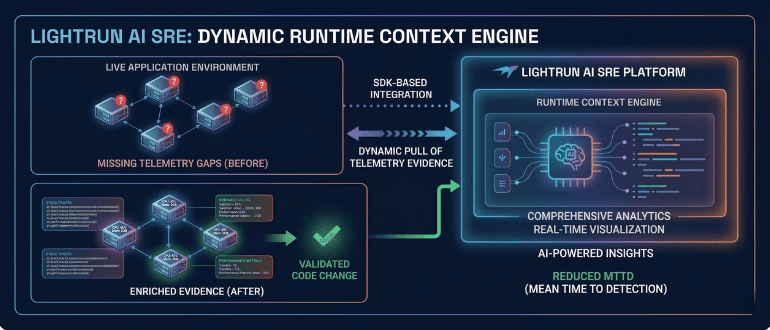
Lightrun Adds Ability to Dynamically Pull Telemetry Data from Live Apps
Lightrun has added an ability to dynamically pull missing telemetry evidence from live application environments without having to deploy additional instrumentation to its namesake site reliability engineering (SRE) platform that is based on artificial intelligence (AI). Company CEO Ilan Peleg said the Lightrun AI SRE platform includes a sandbox deployed via a software development kit […]
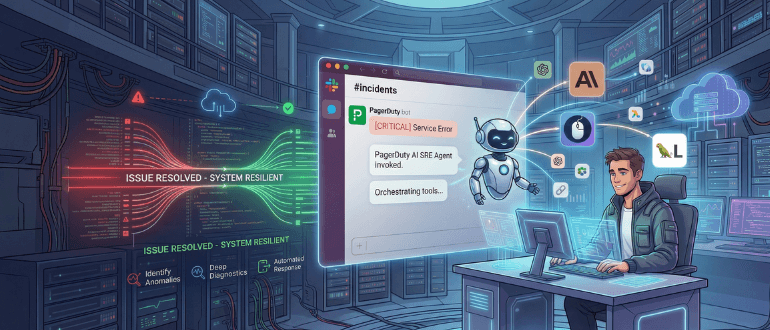
PagerDuty Extends Scope and Reach of AI SRE Platform
PagerDuty has extended the capabilities and reach of its artificial intelligence (AI) agents to enable them to be invoked directly from within the Slack messaging platform. Additionally, the AI SRE Agent that is embedded within the PagerDuty Operations Cloud platform can now also leverage the Model Context Protocol (MCP) and an expanded library of application […]
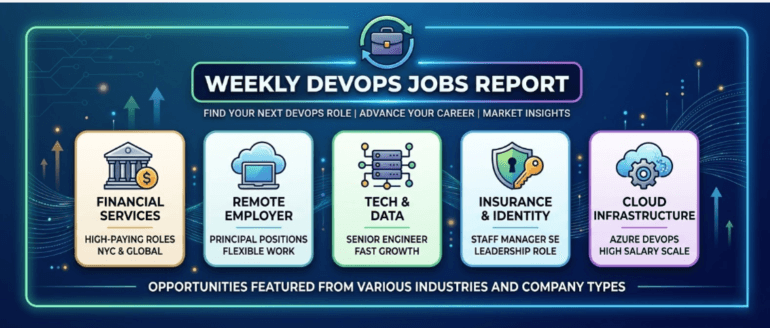
Five Great DevOps Job Opportunities
Explore the latest DevOps.com weekly jobs report. Highlighting premier opportunities at Bank of America, Microsoft, and GEICO, with salary insights up to $300,000 for senior engineering and platform leadership roles.
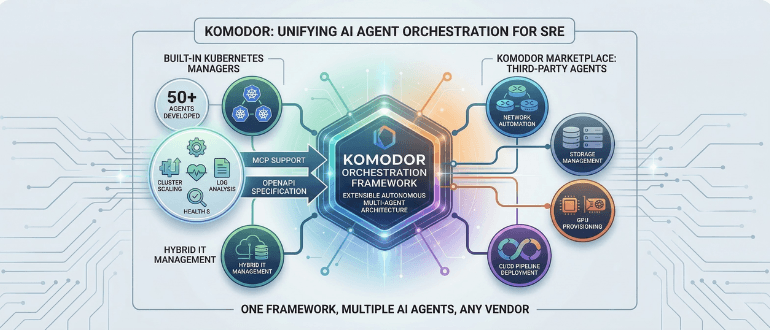
Komodor Extends Reach of AI SRE Orchestration Framework
Komodor today extended the reach of its orchestration framework for artificial intelligence (AI) agents by adding support for Model Context Protocol (MCP) servers and the OpenAPI specification. Company CTO Itiel Shwartz said those capabilities will make it possible for IT teams to more broadly orchestrate AI agents that are being used to investigate and remediate […]
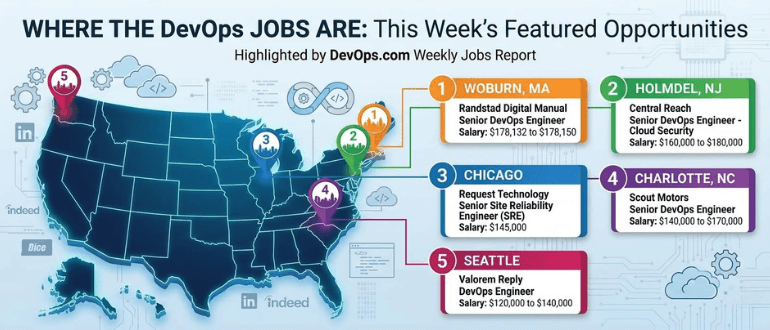
Five Great DevOps Job Opportunities
Weekly DevOps jobs roundup, this week highlighting top roles in Massachusetts, New Jersey, Chicago, Charlotte and Seattle, with pay ranges and hiring trends to help DevOps pros advance careers.
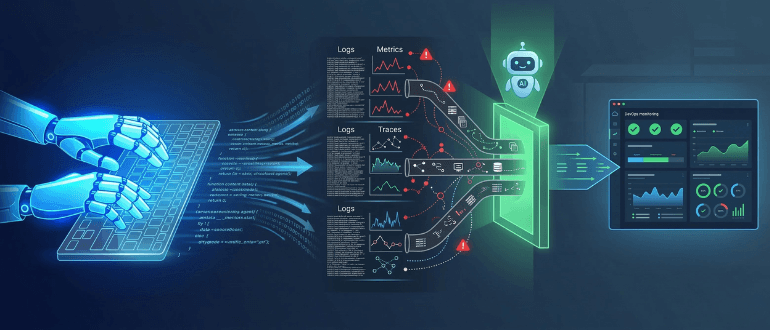
AI Is Forcing DevOps Teams to Rethink Observability Data Management
As AI coding tools accelerate software delivery, they are also intensifying a problem DevOps and SRE teams have been dealing with for years: the unchecked growth of observability data. In this conversation, the founders of Sawmills argue that telemetry volume is no longer just a cost issue. It is becoming a data quality problem that […]
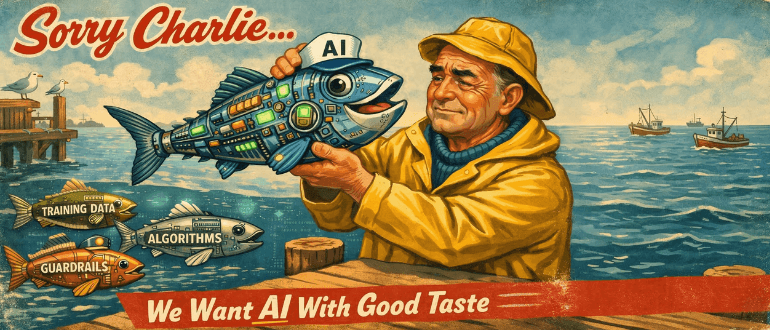
Sorry, Charlie, StarKist Wants AI With Good Taste
A surprising AI experiment showed that feeding a model sloppy code didn’t just produce bad programming, it produced bad behavior. The result points to something philosophers and DevOps engineers have long understood: Character, culture and incentives shape systems far more than rules alone.

How We Got Here: Alert Fatigue to Decision Fatigue
AI and observability reduced alert fatigue, but decision fatigue remains. Decision architecture helps DevOps teams scale operational judgment.

On-Call Rotation Best Practices: Reducing Burnout and Improving Response
Practical SRE on‑call guide covering rotation models, alert hygiene, runbooks, metrics, compensation, shadowing, and automation to cut pager load and prevent engineer burnout.
What to do About AI’s Forced Rethink of Reliability in Modern DevOps
As systems become more distributed and AI-driven, traditional uptime metrics are no longer enough. The 2026 SRE Report shows how reliability is shifting toward user experience, speed, and business impact, and how AI is reshaping monitoring, incident response, and the role of SRE and DevOps leaders.
SRE vs. DevOps is a False Choice: Here’s the Unified Model That Works
DevOps and site reliability engineering (SRE) are complementary strategies that enhance both speed and reliability in software development. While DevOps focuses on collaboration and automation to break down silos between development and operations, SRE emphasizes engineering reliability through metrics and accountability. By integrating both approaches, organizations can foster high-quality software delivery that meets reliability standards, streamline incident response, and utilize data-driven decision-making to maintain system performance.
Secure DevOps at Scale: Integrating SRE, DevSecOps and Compliance
Enterprises developing SaaS products face the challenge of balancing innovation, security, and compliance. By adopting Secure DevOps practices—integrating security into every stage of development—and implementing site reliability engineering (SRE), organizations can enhance agility while ensuring resilience and adherence to regulatory standards. Automating compliance within DevOps pipelines allows teams to maintain high-speed execution without compromising security, creating a robust framework for scalable and secure cloud-native applications.

Five Great DevOps Job Opportunities
This week’s report features top employers including Capital One, Google, CLS US Services, Thrive Market, and Cisco Systems, providing insights into the job market and salaries for crucial roles in DevOps.

MCP-Powered Agentic AI in DevOps: Building Secure, Scalable Multi-Agent Pipelines for Autonomous SRE and Observability
Discover how model context protocol (MCP) powered agentic AI is transforming DevOps by enhancing resilience and efficiency in cloud-native environments. Learn about the challenges, benefits, and real-world applications of autonomous multi-agent systems.

Stop Worshipping ‘Global Availability’: A Practical SLI/SLO Bucketing Playbook
Global availability hides real failures. Learn why bucketed SLIs give a truer picture of reliability—and how SRE teams can align alerts with real business impact.
Part 2: From Reactive to Predictive: Training LLMs on Your Incident History
Part 2: Discover how to harness incident history and AI to predict and prevent operational issues before they escalate, improving efficiency in Site Reliability Engineering.

Part 1: Death of the Toil: How AI Agents Are Replacing Traditional Runbooks
Part one of a three-part series: Discover how AI-driven reasoning agents are revolutionizing SRE practices by eliminating traditional toil and enhancing incident management.

Observability, SRE and Uptime in Telehealth Platforms: A DevOps Playbook
Virtual care went from nice to have to must have during the COVID-19 pandemic and while in-person visits are starting to pick up again, telemedicine is here to stay. Its growth will continue: health-tech companies are predicting the telemedicine market will be $143.49 billion by 2025 (it will be $167.74 billion in 2025 and $584.99 […]
Observability, SRE and Uptime in Telehealth Platforms: A DevOps Playbook
Virtual care went from a nice-to-have to a must-have during the COVID-19 pandemic and while in-person visits are starting to pick up again, telemedicine is here to stay. Its growth will continue: According to Health-tech companies, the telemedicine market was valued at $143.49 billion in 2024. It is predicted to be $167.74 billion in 2025 and reach $584.99 billion by 2033 at a growth rate of 16.9%. Telehealth platforms handle sensitive health information, manage appointments, stream live […]

New Relic AWS Integrations Go Deep on Root Cause Observability Analysis
New Relic expands its observability platform with deep AWS integrations to speed incident resolution and support AI-driven DevOps workflows.

The Cloud Scout Model Delivers Reliability As An Embedded Capability
Organizations today face a structural problem that is slowing down their move to cloud-native maturity. They’ve adopted modern DevOps tools, yes. They’re running Kubernetes. They’re using sophisticated observability platforms. But the people-and-process piece often remains stuck in the traditional enterprise IT paradigm. The rift is simple: developers are tasked with delivering features, and operational staff […]
Why Up to 70% of SRE Initiatives Stall Before They Scale — and How to Break the Plateau
Many SRE initiatives stall because organizations adopt the title without the principles. True SRE success requires leadership vision, cultural change, shared KPIs and continuous maturity measurement—not tools alone.
SRE in the Age of AI: What Reliability Looks Like When Systems Learn
As AI and ML become core production components, SRE is evolving from managing deterministic systems to ensuring the reliability of dynamic, learning systems. New metrics, workflows, guardrails and cross-disciplinary practices are redefining reliability in the age of adaptive software.