
TL;DR — Key Takeaways
- Harness launched an agent-ready code repository and AI code review service designed to handle the higher volume of commits and pull requests generated by AI coding agents.
- The repository is built to support thousands of simultaneous pull requests and commits while maintaining search, history and diff performance across large repositories.
- DevOps teams can assign AI agents specific permissions, apply RBAC and OPA-based policies, and track agent activity separately from human developers.
Harness today launched a code repository service that is specifically designed for DevOps teams that are relying on artificial intelligence (AI) agents to generate code.
Martin Reynolds, Field CTO for Harness, said the Agent-Ready Harness Code Repository and AI Code Review service provides an alternative to existing GitHub source code repositories that were not designed to handle the volume of pull requests and updates that are made by AI agents operating at machine speed.
As a result, there are not only more outages but search and file history get slower as indexing falls behind, pull requests pile up faster than anyone can read them, and a permission system designed around a list of developers lacks the ability to identify and track an AI agent that might merge code on its own. The assumption legacy source code management tools make is that a human wrote code and opened a pull request that will be reviewed sometime later.
In contrast, the Harness Code Repository has been tested to handle thousands of simultaneous pull requests and commits from both AI agents and human application developers, said Reynolds. Search, history, and diffs keep working across repositories of any size that can have tens of thousands of branches.
Harness Code Repository and AI Code Review are both designed to be reachable via the Harness Model Context Protocol (MCP) server or command line interface (CLI). DevOps teams can review pull requests by the author’s email instead of an internal ID, see every open pull request across every repository and create, reply to, or resolve comment threads without opening a browser.
AI coding agents can either be assigned specific permissions or they can inherit them from application development teams that have deployed them. DevOps teams can further define what an AI agent can access, merge, or deploy, much like they do for any human software engineer using role-based access controls (RBACs) and policies based on the Open Policy Agent (OPA) framework provided via the Cloud Native Computing Foundation (CNCF).
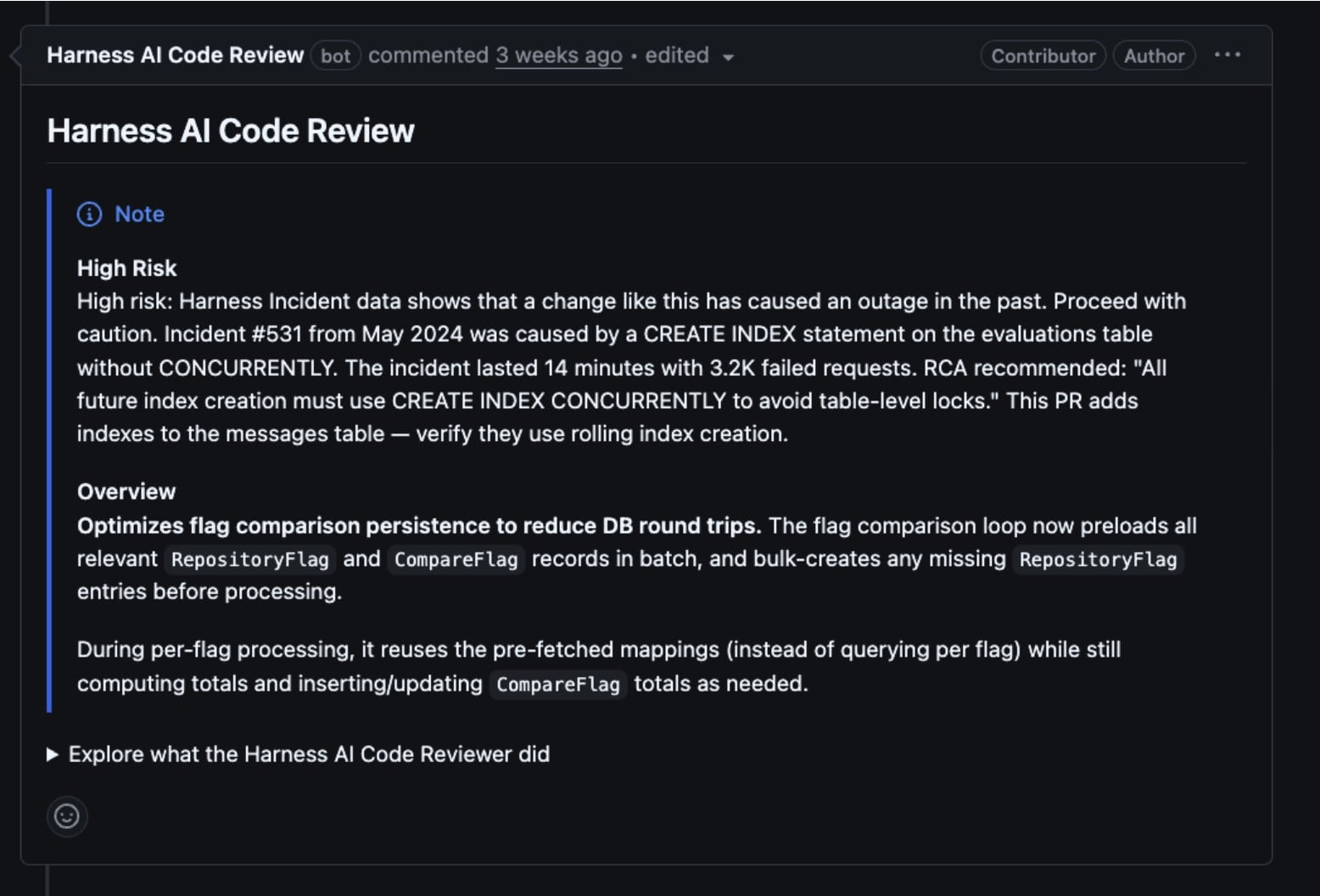
The AI Code Review then reads a pull request, checks to see what gates are mandatory and prevents any request that fails from being merged. Additionally, differences are grouped by risk rather than by file, so high-risk changes that alter how the software behaves are not lost under a mass of renamed repositories and dependencies. A feedback capability also describes what a change puts at stake rather than noting that a line moved. If the feedback is valid, changes can be merged with a single click.
Any team can start using Harness Code Repository for free. Migrations from another repository, including GitHub, GitLab, Bitbucket and Azure DevOps, only require a few clicks, noted Reynolds.
In general, DevOps teams are starting to realize that a piecemeal approach to agentic AI engineering isn’t going to be sufficient, said Reynolds. Instead, the entire software development lifecycle (SDLC) will need to be re-engineered to manage what is becoming massive amounts of code that is overwhelming existing DevOps workflows, he added.
In the case of Harness, that means commits, review, builds, tests, security and deployments all stem from a single sequence within the platform. The Harness Software Delivery Agent then runs those workflows from commit to production using policies created via a single common engine. All workflows are then mapped in the Harness SDLC Knowledge Graph to provide the context needed for every review. Based on early testing, Harness claims DevOps teams have seen savings of 10,000 hours over the last month alone.
Mitch Ashley, vice president and practice lead for the Futurum Group, said the bottleneck in AI-assisted development has moved to review and approval. Agents produce code faster than teams can verify it, and verification debt builds faster than anyone can hire reviewers, he added.
The key here is still accountability, noted Ashley.
Regardless of the approach to software engineering in the age of AI, it’s now more a question of when rather than if DevOps workflows will be re-engineered. The only thing that remains to be seen now is how long that might actually require.

Frequently Asked Questions
What did Harness launch?
Harness launched an agent-ready code repository and AI Code Review service designed for development environments where AI agents generate and modify code at high volumes.
How is Harness Code Repository different from traditional source code repositories?
Harness says its repository is designed to handle thousands of simultaneous commits and pull requests from both AI agents and human developers without degrading search, history or diff performance.
How does Harness manage AI coding agents?
Organizations can give AI agents their own permissions or allow them to inherit permissions from development teams. Access can also be governed using role-based access control and Open Policy Agent-based policies.