

An AI agent that can call tools is not automatically an unsafe system. The dangerous move is smaller: Letting a workflow turn a recommendation into an external action without a durable decision record.
That distinction matters in DevOps. An agent can sensibly summarize a failed deployment, draft a rollback plan or classify a dependency alert. The moment it opens a change request, modifies a feature flag, creates an incident, messages a customer or publishes a configuration, the system needs more than a high-confidence score.
It needs a change-control gate.
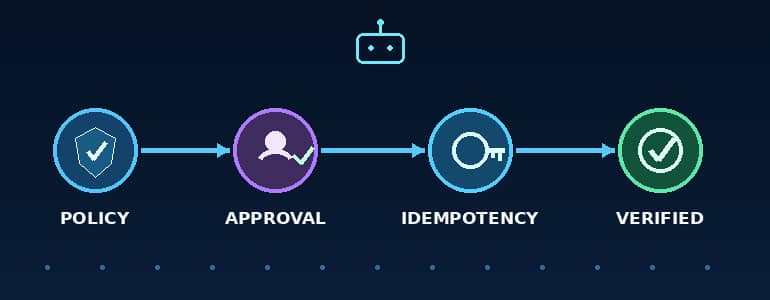
The gate below is a practical pattern for a tool-using agent. It verifies whether the policy is still current, pauses for the required human decision, makes one idempotent outbound request, then confirms the receipt. It is deliberately boring. That is the point.

Figure 1: Illustration of a Workflow Moving Through Policy, Human Approval and Idempotency Gates While a Risky Duplicate Path is Stopped
Why a Confidence Threshold Isn’t Enough
Confidence says something about a model’s answer. It does not say whether a particular action is reversible, who owns its consequences, whether the policy changed while the agent was working or whether the same action has already happened.
For a production workflow, treat those as separate decisions.
| Question | What the Gate Should Decide |
| Is this action permitted now? | Revalidate the current policy and declarations. |
| Does this action need a person? | Route it to an explicit approver with the exact action payload. |
| Has this action already been sent? | Use an idempotency key stored before or with the transmission. |
| Did the destination accept it? | Verify a receipt, job ID or visible confirmation without resending. |
This maps cleanly to the NIST AI RMF’s idea that risk management should cover governance, measurement and management throughout the system life cycle — not merely model evaluation. It also fits a practical fact of durable agent runtimes: A paused workflow can restart a node when it resumes, so outbound side effects must be idempotent. NIST AI RMF and LangGraph’s interrupt guidance both make the broader control problem explicit.
The Smallest Useful State Machine
Do not begin with a large autonomous platform. Begin with explicit states that an operator can inspect.
| type ChangeState = | “queued” | “policy_blocked” | “approval_required” | “transmitting” | “submitted” | “verified” | “submission_unverified” | “rejected”;type ChangeRequest = { actionType: “deploy” | “create_ticket” | “send_message”; destination: string; summary: string; idempotencyKey: string;}; |
The useful property is not the spelling of the states; it is that ‘approval_required’ and ‘transmitting’ are distinct. A system should be able to show an approver exactly what will happen before it happens, then preserve a record of the result.
- Revalidate Policy Immediately Before the Action
The policy check belongs close to the outbound call. A week-old permissions decision is not a preflight check.
| async function canSend(request: ChangeRequest) { const policy = await loadCurrentPolicy(request.actionType, request.destination); return { allowed: policy.isCurrent && policy.permits(request), declarations: policy.requiredDeclarations, checkedAt: new Date().toISOString(), };} |
This is where an organization can apply its real rules: Production versus staging, maintenance windows, owner groups, regulated data or a mandatory incident commander for customer-impacting work. Keep the policy data outside the prompt. A prompt may explain a rule; it should not become the only enforcement point.
- Ask for Approval Using the Actual Outbound Payload
An approval that says, “approve the agent’s plan?” is too vague. Show the action type, destination, change summary and required declarations.
| async function requestApproval(request: ChangeRequest, policy: Awaited<ReturnType<typeof canSend>>) { return interrupt({ kind: “change_control_approval”, actionType: request.actionType, destination: request.destination, summary: request.summary, declarations: policy.declarations, message: “Approve this exact change? Approval sends one request; rejection sends none.”, });} |
If the user rejects the request, end the workflow. Do not reinterpret a rejection as a request to regenerate a more persuasive plan.
- Make the Transmission Idempotent
The awkward failure is an ambiguous one. The receiving system may complete the change while the client times out before it receives a response. If the agent retries blindly, it can create a duplicate ticket, a second deployment or a second message.
Use a stable key derived from the action’s business identity — not a fresh UUID for each retry.
| import { createHash } from “node:crypto”;function actionKey(request: ChangeRequest) { const material = [request.actionType, request.destination, request.summary].join(“\u001f”); return createHash(“sha256”).update(material).digest(“hex”);}async function transmitOnce(request: ChangeRequest) { return fetch(request.destination, { method: “POST”, headers: { “content-type”: “application/json”, “idempotency-key”: request.idempotencyKey, }, body: JSON.stringify({ summary: request.summary }), });} |
The destination must honor the key, or your own durable store must do so before the outbound request. Either way, do not put an automatically retried network call before a pause node unless that side effect is safe to repeat.
- Verify Instead of Resending After Ambiguity
Treat a timeout as an observation problem first. Query the destination with the key, look for the created job or ticket and write the result to the workflow state. Only retry if the system can prove that no action exists.
| async function verifyReceipt(key: string) { const result = await findActionByIdempotencyKey(key); if (result) return { accepted: true, receipt: result }; return { accepted: false, issue: “No receipt found; needs operator review” };} |
That final status should be ‘submission_unverified’, not ‘failed’. The name forces the right next action: Investigate before sending another request.
A Controlled Simulation: Where Duplicates Appear
To make the trade-off concrete, I ran a deterministic simulation of 10,000 outbound agent actions. Each simulated action had a 9% policy-change state, a 21% non-approval state and 1–3 resume events. This is a controlled illustration of workflow logic, not production telemetry, a reliability claim or a measured industry failure rate.
| Control Design | Sends | Duplicate Sends | Policy-Bypassing Sends | Unapproved Sends |
| Ungated Send | 12,114 | 2,114 | 1,106 | 2,544 |
| Approval Only | 9,570 | 1,673 | 879 | 0 |
| Preflight Gate | 8,691 | 1,514 | 0 | 0 |
| Durable Gate | 7,177 | 0 | 0 | 0 |
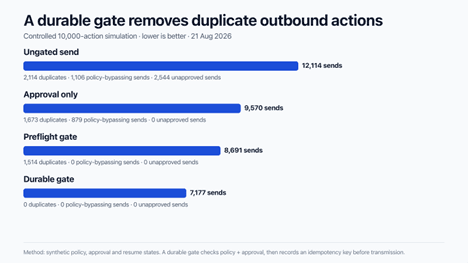
Figure 2: Bar Chart Comparing Outbound Sends and Duplicate, Policy-Bypassing and Unapproved Actions Across Four Simulated Control Designs
The notable row is the preflight gate. It eliminated actions that bypassed policy or approval, but it still created 1,514 duplicate sends because resumed workflow events could enter the same action more than once. The durable gate reduced that to zero in this simulation by using a stable idempotency record.
The simulation code and raw summary are included with this submission so that editors or readers can reproduce the numbers. Modify the assumptions before applying the result to your own environment.
Keep the Approval Boundary Narrow
This pattern is not an argument for asking a human to approve every tool call. That usually leads to notification fatigue and workarounds.
Instead, classify actions by consequence:
| Action Class | Typical Examples | Default Control |
| Read-Only | Fetch a deployment record, inspect a log | Allow with audit trail |
| Reversible Internal | Create a draft change ticket, add a label | Allow or sample review |
| Material but Reversible | Change a feature flag, queue a rollback | Named approval plus idempotency |
| External or Hard to Reverse | Deploy to production, message a customer, delete data | Named approval, policy recheck, idempotency, receipt verification |
The fastest agent systems make safe paths easy and consequential paths explicit. They do not pretend all operations have the same risk.
What to Test Before Enabling an Agent Action
Run these cases in a non-production environment before connecting a new action to an agent:
- A policy changes after the agent produces its recommendation but before the approval click.
- An approver rejects the action, then the workflow resumes.
- The destination completes the change, but the client loses the response.
- A queue redelivers the same event.
- An operator tries the same action manually while the agent is waiting.
- Receipt verification is temporarily unavailable.
For each test, the expected outcome should be visible in state: Blocked, rejected, submitted, verified or unverified. “The agent probably handled it” is not an operational status.
The Operational Rule
AI agents can move quickly without bypassing change control. The reliable pattern is straightforward: Validate the rules immediately before the action, show the real payload to the right approver, record one idempotent transmission and verify the result before retrying.
That sequence gives teams something better than a promise of autonomy. It gives them a system they can inspect when the answer is ambiguous and the consequences are real.
Method and Source Notes
- Controlled Simulation Script: `scripts/run-contribution-gate-simulation.mjs`
- Raw Results: `research/contribution-gate-simulation-2026-08-21/summary.json`
- The simulation uses a fixed seed and synthetic policy, approval and resume-event rates. It does not measure any customer system.
- The article’s workflow pattern was implemented and tested in TypeScript as part of an internal contribution-control graph. The sample code is simplified for teaching.

Frequently Asked Questions
1. Why isn’t an AI confidence score enough?
2. Why is idempotency important for agents?
3. Does every agent action require human approval?

Daniel Martin is cofounder of AgentSEO and Joy Technologies, an Inc. 5000 honoree. He writes about practical AI-agent systems, search infrastructure, and the operational controls that keep automation useful.