

As artificial intelligence (AI) assistants become integral to software development workflows, their ability to interact with cloud infrastructure is becoming increasingly crucial. This article introduces AWS Sage, an open-source Model Context Protocol (MCP) server that provides unified, intelligent access to AWS. Unlike existing solutions that fragment AWS services across multiple servers, AWS Sage offers cross-service intelligence, including dependency mapping, impact analysis, and automated incident investigation — capabilities previously unavailable in the MCP ecosystem.
1. Introduction: The Rise of AI-Assisted Cloud Operations
MCP, introduced by Anthropic in late 2024, has rapidly transformed how AI assistants interact with external tools and data sources. By providing a standardized interface between AI models and software systems, MCP enables assistants such as Claude and ChatGPT to perform real-world tasks rather than merely generating text.
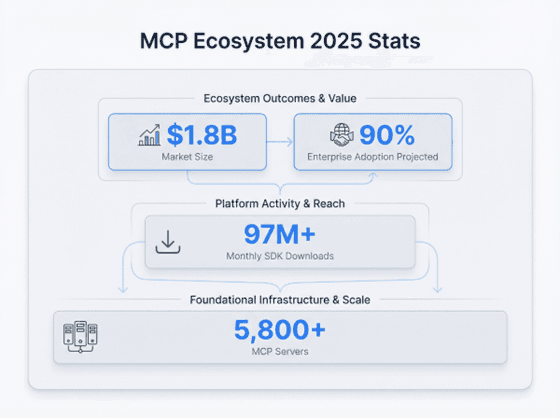
Figure 1: MCP Ecosystem Stats (2025)
Note: The MCP ecosystem has grown to over 5,800 servers with 97 million monthly SDK downloads, representing a $1.8 billion market in 2025.
The numbers tell a compelling story: Over 5,800 MCP servers exist today, with 97 million monthly SDK downloads. Major technology companies, including Block, Apollo, Replit, Codeium and Sourcegraph have adopted MCP for their AI integrations. Additionally, industry analysts project 90% enterprise adoption by 2026.
AWS integration remains one of the most sought-after capabilities within this ecosystem. AWS powers approximately 32% of global cloud infrastructure, and engineers working with AWS spend considerable time on routine tasks: Discovering resources, understanding dependencies, investigating incidents and optimizing costs. AI assistants capable of performing these tasks intelligently could dramatically improve productivity.
Yet, existing AWS MCP solutions present significant limitations.
2. The Problem: Fragmentation and Limited Intelligence
2.1 The Official Approach: 15 Servers for 15 Services
AWS Labs, Amazon’s official open-source organization, offers MCP integration through a distributed model: Separate servers for S3, EC2, Lambda, RDS, CloudWatch, Cost Analysis and 10 other services. Each server requires individual configuration of AI assistant settings.
{
“mcpServers”: {
“aws-s3”: { “command”: “uvx”, “args”: [“awslabs.s3-mcp-server@latest”] },
“aws-ec2”: { “command”: “uvx”, “args”: [“awslabs.ec2-mcp-server@latest”] },
“aws-lambda”: { “command”: “uvx”, “args”: [“awslabs.lambda-mcp-server@latest”] },
“aws-rds”: { “command”: “uvx”, “args”: [“awslabs.rds-mcp-server@latest”] }
}
}
This approach creates several challenges:
- Configuration Complexity: All services require separate setups and maintenance.
- No Cross-Service Queries: Finding all resources tagged ‘production’ requires querying multiple servers and correlating results manually.
- No Relationship Awareness: The EC2 server doesn’t know which Lambda functions connect to which instances.
- Duplication of Efforts: Common patterns like pagination handling must be implemented per server.
2.2 Community Alternatives
Community-developed solutions attempt to address fragmentation but introduce other limitations:
alexei-led/aws-mcp-server wraps AWS CLI commands in Docker containers, providing security isolation but limiting functionality to CLI capabilities and introducing shell-execution overhead.
RafalWilinski/aws-mcp offers a TypeScript implementation with broader service coverage but relies on the deprecated AWS SDK v2 (end-of-life 2025) and lacks advanced features.
Neither solution provides the intelligence layer that modern cloud operations demand.
3. AWS Sage: A Unified Intelligence Layer
AWS Sage takes a fundamentally different approach: Rather than wrapping individual AWS APIs, it provides an intelligence layer that understands AWS as a connected system.
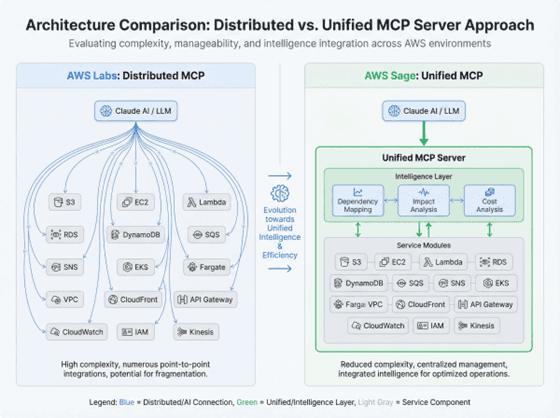
Figure 2: Architecture Comparison — Distributed vs. Unified MCP Server Approach
Note: AWS Labs distributes functionality across 15 separate servers, while AWS Sage consolidates everything into a single unified server with a cross-service intelligence layer.
3.1 Architecture
The unified architecture centers on a single FastMCP server exposing 30 tools across 10 categories.
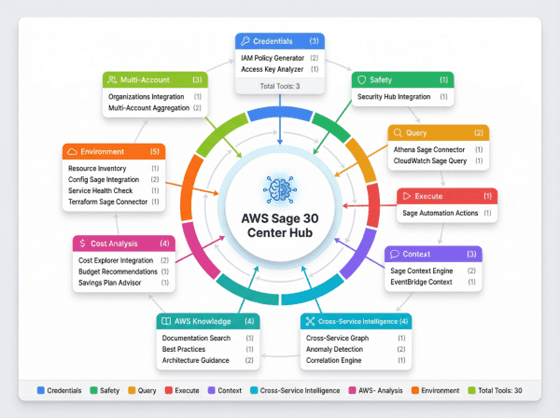
Figure 3: AWS Sage Tools
Note: AWS Sage’s 30 tools are organized across 10 functional categories, from credential management to cost analysis.
| Category | Tools | Purpose |
| Credential Management | 3 | Profile and SSO authentication |
| Safety Controls | 1 | Three-tier safety mode-switching |
| Query Operations | 2 | Natural language queries with validation |
| Execute Operations | 1 | Confirmed write operations |
| Context and Memory | 3 | Aliases and conversation history |
| Cross-Service Intelligence | 4 | Discovery, dependencies, impact, incidents |
| AWS Knowledge | 4 | Documentation and best practices |
| Cost Analysis | 4 | Idle resources, rightsizing, projections |
| Environment Management | 5 | LocalStack integration |
| Multi-Account | 3 | Cross-account operations |
3.2 Natural Language Interface
Rather than requiring precise API-call specifications, users interact through natural language:
“List all S3 buckets.”
“Show EC2 instances tagged Environment=production in us-west-2”
“Describe the payment-processor Lambda function.”
“Find resources owned by team-platform.”
The parser classifies intent, maps to appropriate AWS operations, handles pagination automatically and formats results appropriately (tables for lists and detailed JSON for single resources).
4. Cross-Service Intelligence: The Key Differentiator
The most significant innovation in AWS Sage lies in its cross-service intelligence capabilities — features unavailable in any competing solution.
4.1 Resource Discovery
Traditional Approach
Query S3 server for buckets with tag — query EC2 server for instances with tag — query Lambda server for functions with tag — manually correlate results
AWS Sage Approach
“Find all resources tagged Environment=production”
A single query searches across EC2, RDS, Lambda, S3, DynamoDB, ECS and more, returning a unified inventory.
4.2 Dependency-Mapping
Understanding resource relationships is critical for operations:
“What does my payment-processor Lambda depend on?”
Response
VPC subnet and security group — IAM execution role with attached policies — S3 buckets accessed — DynamoDB tables queried — Secrets Manager secrets referenced — KMS keys used for encryption
This information, previously requiring manual investigation across multiple consoles, arrives in seconds.
4.3 Impact Analysis
Understanding downstream effects before modifying or deleting resources prevents outages:
“What breaks if I delete sg-abc123?”
AWS Sage traces all resources using the security group: 3 EC2 instances (i-xxx, i-yyy, i-zzz) — 2 Lambda functions in VPC (payment-processor, order-validator) — 1 RDS instance (production-db)
The response explicitly warns: “Deletion will immediately terminate network connectivity for these resources.”
4.4 Automated Incident Investigation
When production issues occur, manual investigations follow a predictable pattern: Check logs, review metrics, examine configuration and trace dependencies. AWS Sage automates this workflow.
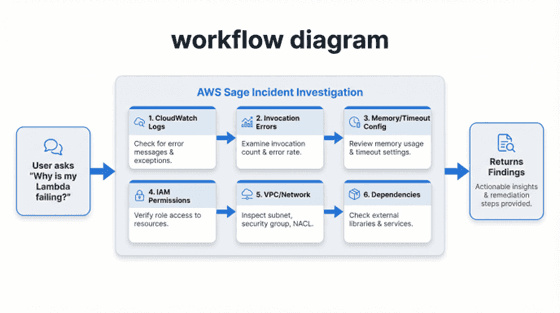
Figure 4: Workflow Diagram
Note: AWS Sage’s automated incident investigation workflow consolidates multiple investigation steps into a single query response.
“Investigate why my order-processor Lambda is failing”
The server automatically:
- Retrieves recent CloudWatch Logs for errors.
- Checks invocation success/failure metrics.
- Reviews memoryutilizationand timeout configuration.
- Examines IAM role permissions.
- Tests VPC connectivity and security group rules.
- Traces downstream service dependencies.
Findings arrive consolidated, replacing what previously required 20–30 minutes of manual investigation.
5. Enterprise Safety Controls
Operating against production AWS accounts requires robust safety mechanisms. AWS Sage implements a three-tier safety system.
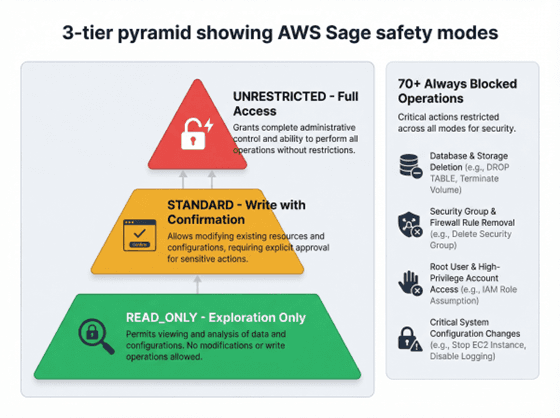
Figure 5: AWS Sage Safety Modes
Note: AWS Sage’s three-tier safety system has 70+ always-blocked critical operations.
5.1 Safety Modes
|
Mode |
Description | Use Case |
| READ_ONLY | No write operations permitted | Investigation, audits, exploration |
| STANDARD | Writes require explicit confirmation | Normal daily operations |
| UNRESTRICTED | Full access (except denylist) | CI/CD automation |
5.2 Operation Denylist
Regardless of the safety mode, 70+ critical operations remain permanently blocked:
- cloudtrail.delete_trail / stop_logging: Audit trail protection
- iam.delete_account_password_policy: Security policy protection
- organizations.leave_organization: Organization integrity
- guardduty.delete_detector: Threat detection protection
- kms.schedule_key_deletion: Encryption key protection
- rds.delete_db_cluster_snapshot: Backup protection
This defense-in-depth approach ensures that even with UNRESTRICTED mode enabled for automation, catastrophic operations cannot execute.
6. Development and Testing: Local Stack Integration
Production safety extends beyond access controls. AWS Sage integrates natively with LocalStack, enabling complete local development workflows:
“Switch to localstack environment”
“Create test bucket my-test-bucket”
“Verify DynamoDB table schema”
“Compare Lambda functions between localstack and production”
The environment-comparison feature particularly aids deployment verification:
“Compare S3 buckets between localstack and production”
Response
Buckets only in LocalStack (test artifacts) — buckets only in production (missing from local setup) — configuration differences between matching buckets
7. Multi-Account Support
Enterprise AWS deployments span multiple accounts: Development, staging, production, security and logging. AWS Sage manages these natively:
“Assume role arn:aws:iam::123456789012:role/AdminRole”
“Switch to production account”
“List EC2 instances in staging”
Cross-account operations include: Clear visual indicators of active account — explicit warnings when switching to production — automatic credential refresh for assumed roles — audit logging for account transitions
8. Competitive Analysis
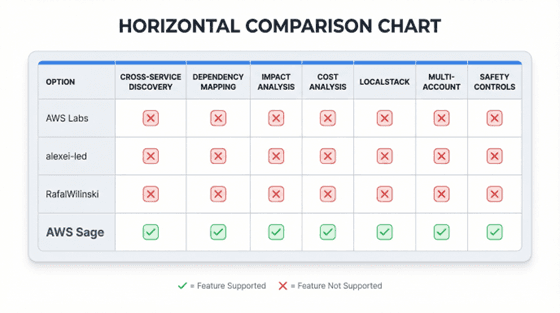
Figure 6: Horizontal Comparison Chart
Note: Feature comparison between AWS MCP solutions shows AWS Sage’s comprehensive coverage.
| Capability | AWS Labs | alexei-led | RafalWilinski | AWS Sage |
| Architecture | 15 servers | 1 server | 1 server | 1 server |
| Cross-Service Discovery | No | No | No | Yes |
| Dependency-Mapping | No | No | No | Yes |
| Impact Analysis | No | No | No | Yes |
| Incident Investigation | No | No | No | Yes |
| Cost Analysis | Separate server | No | No | Built-in |
| LocalStack Integration | No | No | No | Yes |
| Multi-Account | No | No | No | Yes |
| Safety Controls | Basic | Container | Basic | 3-tier + denylist |
| Natural Language | Limited | No | Limited | Full NLP |
| Test Coverage | Varies | Unknown | Unknown | 145 tests |
9. Technical Implementation
9.1 Technology Stack
- Language: Python 3.11+
- Framework: FastMCP (MCP SDK)
- AWS SDK: boto3/botocore (current, maintained)
- Transport: stdio (standard MCP transport)
- Container: Docker (optional, recommended)
9.2 Quality Metrics
| Metric | Value |
| Unit Tests | 145 passing |
| Tools | 30 across 10 categories |
| Module Coverage | 29 modules |
| Code Quality | Ruff-verified |
9.3 Installation
Docker (Recommended):
{
“mcpServers”: {
“aws-sage”: {
“command”: “docker”,
“args”: [
“run”, “-i”, “–rm”,
“-v”, “~/.aws:/home/appuser/.aws:ro”,
“-e”, “AWS_PROFILE=default”,
“aws-sage:latest”
]
}
}
}
Direct Installation:
pip install aws-sage
10. Use Cases and Examples
10.1 Daily Operations
“List all running EC2 instances”
“Show S3 buckets larger than 100GB”
“Get IAM users without MFA enabled”
10.2 Cost Optimization
“Find idle resources in us-east-1”
“Get rightsizing recommendations for EC2”
“Project monthly cost for 5 t3.large instances”
10.3 Security Investigation
“Show security groups with 0.0.0.0/0 ingress”
“Find Lambda functions with admin IAM policies”
“List resources not encrypted with KMS”
10.4 Incident Response
“Investigate high latency on alb-production”
“Debug Lambda timeout errors for payment-processor”
“Analyze CloudWatch alarms triggered in last hour”
11. Future Directions
The roadmap for AWS Sage includes:
- CloudFormation Drift Detection: Compare deployed resources against template definitions
- Custom Workflow Definitions: User-defined investigation and automation workflows
- Terraform State Integration: Cross-reference with infrastructure-as-code state
- Cost Anomaly Detection: Proactive alerts for unexpected spending patterns
- Compliance Scanning: Check resources against CIS benchmarks and custom policies
12. Conclusion
MCP represents a fundamental shift in how AI assistants interact with software systems. For cloud operations — where engineers spend considerable time on routine discovery, investigation and optimization tasks — intelligent MCP servers offer substantial productivity improvements.
AWS Sage demonstrates that MCP servers can be more than API wrappers. By understanding AWS as a connected system rather than isolated services, it provides capabilities impossible with distributed architectures: Cross-service discovery, dependency-mapping, impact analysis and automated incident investigation.
For teams managing non-trivial AWS infrastructure, these capabilities transform “show me the instances” queries into “help me understand and operate my infrastructure” conversations.


Arun Sanna serves as Enterprise AI Solutions Architect at Precise Software Solution, where he architects AI and cloud modernization strategies for federal agencies including the Centers for Medicare & Medicaid Services and the Food and Drug Administration. His work directly impacts how hundreds of millions of Americans access critical government services. Previously, as Chief Architect at VivSoft Technologies and Principal Architect for the Department of Defense, Arun led some of the most significant federal technology transformations in recent history. He spearheaded the development of PlatformOne PartyBus, the DoD's largest Platform-as-a-Service supporting over 300 mission-critical applications and 20,000+ containers. During Operation Allies Refuge, his platform enabled the coordination of the largest airlift evacuation in U.S. history, helping save 120,000+ lives in just 72 hours. At CMS, Arun shattered federal modernization records by compressing the typical 18-month Authority to Operate certification process into just 90 days while simultaneously modernizing five applications with 50+ microservices. He pioneered AI/ML integration in federal healthcare, enabling secure deployment of large language models for fraud detection and advanced analytics. Arun holds a Master's degree in Electrical Engineering from California State University, Los Angeles, and maintains elite certifications including Certified Kubernetes Administrator, AWS Solutions Architect Professional, Google Cloud Professional Architect, Azure Solutions Architect Expert, and NVIDIA Certified AI Infrastructure and Operations.