


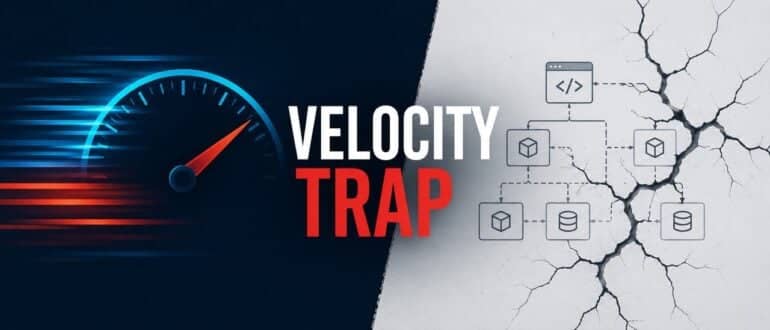
The Velocity Trap: Why Shipping Faster Is Making Systems Worse
There is a particular flavour of engineering dysfunction that looks, from the outside, like peak performance. Deployments are frequent. Sprint velocity is high. The feature backlog is shrinking. Leadership is pleased. And underneath all of it, the system is quietly rotting. Technical debt compounds with every rushed deployment. Observability gaps widen because nobody has time […]

Documentation is Dead. Long Live Documentation.
Why traditional documentation fails and how capturing knowledge during work creates a living, scalable system of record.
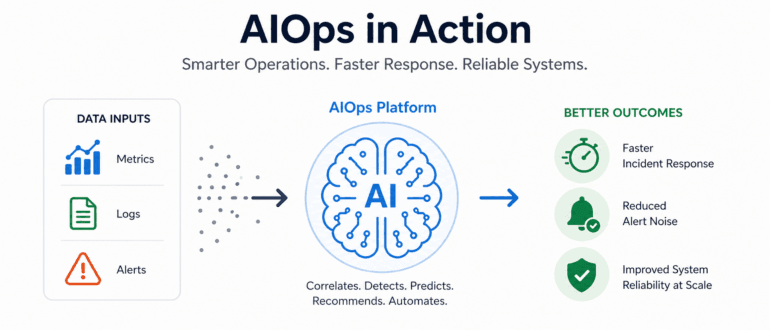
AIOps Isn’t Optional Anymore: What Modern DevOps Teams Must Adapt To
AIOps is becoming essential for DevOps teams, enabling faster incident response, less alert noise and improved reliability at scale.

The Vibing Continuum: How Software Will Vibe its Way Through Agentic Engineering
Explore the philosophical and practical shift from traditional programming to “vibe coding” and agentic engineering, where software is increasingly spoken into existence rather than written line-by-line.
5 Facts About AI Coding Agents from Comprehensive Benchmarking
AI coding agents are becoming more capable, but evaluating them is harder than it looks. Most benchmarks focus on a single dimension of agent capabilities; for instance, the popular SWE-Bench benchmark only focuses on fixing issues on open source Python repositories. Real-world software engineering involves fixing bugs of course, but it is a lot more […]
The Next AI Breakthrough Isn’t Generative, It’s Agentic
Generative AI first captured the world’s attention by producing content at an unprecedented speed. From lines of code and documentation to frameworks and designs, content creation is now readily available at the click of a button. But the initial excitement around generative AI’s capabilities has given way to a new enterprise reality. As organizations move […]

The Code Doesn’t Care Who Wrote It: Why Context, Not AI Fear, Will Define Modern Application Security
AI has already arrived in the software development lifecycle, not as a pilot program or controlled experiment, but as an everyday reality.

Why Contact Enrichment Belongs in Your Application Architecture, Not Your Sales Workflow
Most B2B applications collect incomplete data by design. A lead form captures a name and company. A recruiting tool surfaces a LinkedIn profile. An event registration system logs an email address and job title. The record enters your system and sits there, half-formed, waiting for someone to manually fill in the gaps before it can […]

How to Manage Operations in DevOps Using Modern Technology
How modern DevOps teams manage operations using automation, observability, AIOps and self-service to reduce toil and improve reliability.
AI Agents in DevOps: Hype vs. Reality in Production Pipelines
The demos look super cool! An AI agent detects a failing deployment, rolls it back, opens a GitHub issue, and notifies Slack — all before the on-call engineer has finished reading the alert. If you’ve been following the DevOps tooling space over the last 18 months, you’ve probably seen some version of this pitch. But […]
Can Claude Agents Replace DevOps Teams? A Practical Reality Check
Are AI agents replacing DevOps engineers? Explore how tools like Claude are shifting DevOps from rigid automation to autonomous, adaptive systems, and why human judgment remains the critical link in managing system complexity and risk.
From Code to Cloud: How Full-Stack Developers are Taking Over DevOps
Full-stack developers are taking on DevOps, using CI/CD, Docker and Terraform to own the software lifecycle from code to cloud.

FinOps Isn’t Slowing You Down — It’s Fixing Your Pipeline
Stop firefighting cloud costs weeks after deployment. Learn how to “shift cost left” by integrating cost estimates and policy-as-code directly into your DevOps workflows using tools like Terraform and GitHub.

Agentic CI/CD is Not Automation: Why the Distinction Will Define DevOps in 2026
There is a dangerous conflation happening across our industry right now. Teams are plugging LLM-powered agents into their deployment pipelines, calling it “agentic CI/CD,” and treating it as the next logical step after shell scripts and Terraform modules. It is not. Automation executes predefined instructions. An agent reasons about context, makes decisions, and takes actions […]

Why Most DevSecOps Pipelines Fail at Runtime Security (not Build Time)
Runtime risk refers to security exposure caused by configuration, identity or infrastructure changes after deployment.

VibeCode Meets DevOps: Accelerating Low-Code Innovation
AI-assisted low-code tools like VibeCode speed app development, but DevOps teams must ensure security, quality and CI/CD integration.

If it Isn’t Code, it’s Just Advice
In the world of AI coding, success hinges on code-native solutions that integrate and verify changes directly in the codebase. Many AI tools fail by relying on external dashboards, lacking the reproducibility and testability that code provides. To truly harness AI, solutions must automate and validate changes within the existing code ecosystem, ensuring reliability and efficiency.
AI Won’t Replace Developers—But it is Changing How They Work
AI is reshaping software development by accelerating coding, testing and reviews while reinforcing the need for human judgment and oversight.
How AI is Shaping Modern DevOps and DevSecOps
AI is reshaping DevOps and DevSecOps by improving CI/CD workflows, DORA metrics and security without adding unnecessary complexity.

The Trust Tax Framework: Measuring Developer Confidence in CI/CD Systems
Is your re-run rate over 30%? Discover the “Trust Tax” killing your DevOps ROI. Learn to manage flaky tests through automatic quarantine, contextual reporting, and cultural shifts.
Why Governance Determines Whether Agentic AI Accelerates or Stalls Engineering
AI coding tools offer rapid productivity gains, but “governance debt” often slows delivery. Learn how to embed risk-based controls and auditability into agentic AI workflows to scale engineering capacity.

When Customer-Facing Systems Fail: How Incident Response and Observability Reduce MTTR
In a world of microservices and real-time interactions, MTTR is the ultimate metric for brand protection. Learn how observability and resilient architecture drive faster incident response.
GraphQL at Scale: Lessons From Building APIs That Thousands of Developers Actually Use
GraphQL adoption is set to double by 2027. Explore the operational shifts required for enterprise scale, including query complexity analysis, persisted queries, and Apollo-style federation.