

Most coding agents still wait their turn. A developer types a request, the agent does the work, and then it sits idle until someone tells it what to do next. That works fine for one task. It falls apart when a developer is juggling five.
DeepSeek thinks that’s the problem worth solving. Over the weekend, the Chinese AI company’s Harness team released a research prototype called Super-Agent, outlined in a WeChat post and an accompanying technical article. The argument is simple. Models keep getting more capable, but the human attention needed to direct them hasn’t kept pace. By DeepSeek’s estimate, one person can realistically track only three to five active agent sessions at once. Past that point, the developer, not the model, limits how much work gets done.
Super-Agent tries to take that coordination work off the developer’s plate.
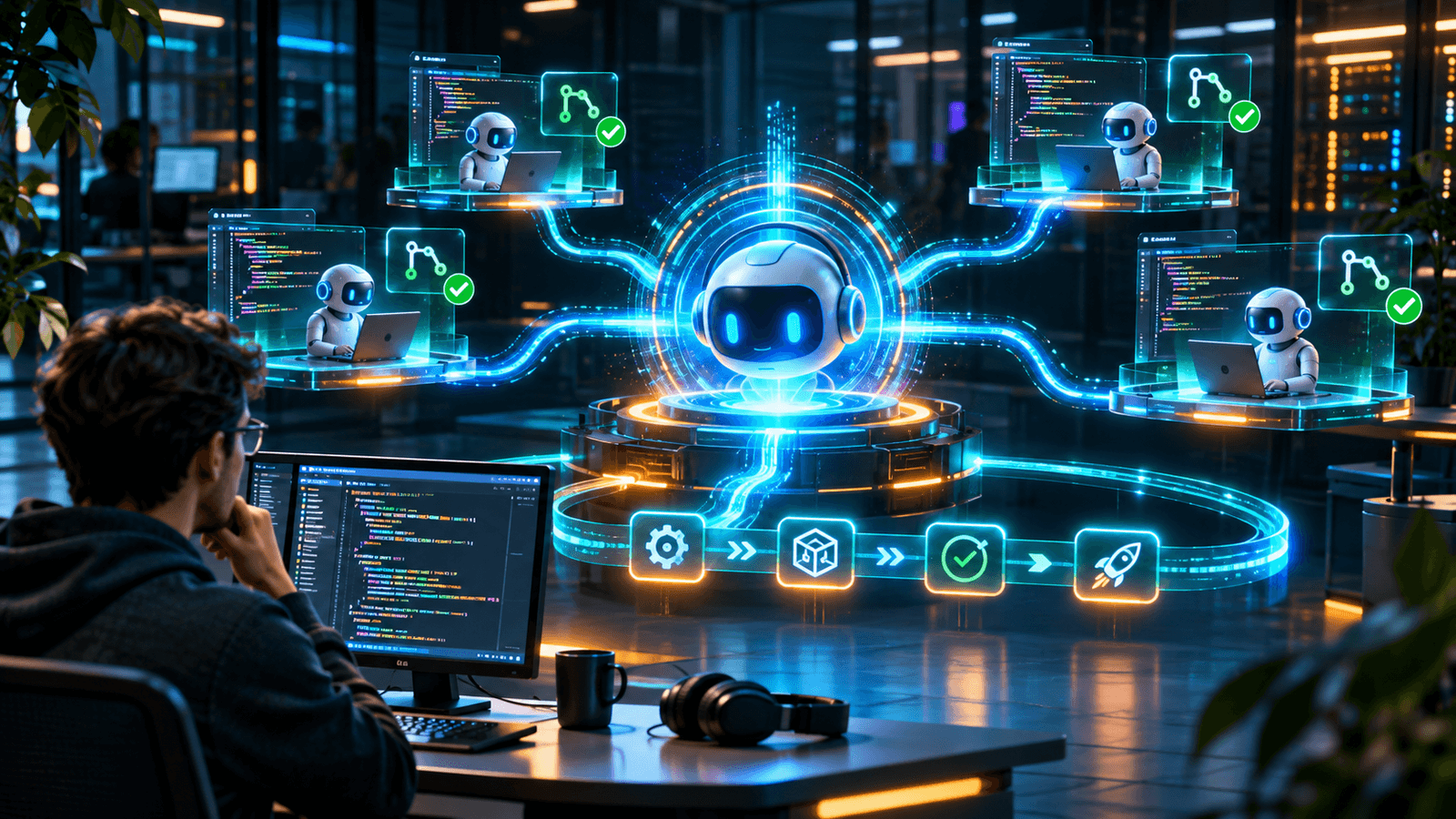
The design splits the agent into two layers. A Router handles communication with the user, maintains shared context, and assigns work. Multiple Worker sessions take those assignments, run them in parallel, and report back with progress and results. The system runs on event-driven, asynchronous interactions, and an external monitor, DeepSeek calls Watchdog, keeps it running and helps it recover from interruptions. The developer talks to one agent. Several are doing the work underneath.
DeepSeek frames the design around four properties: continuity, efficiency, proactivity, and persistence. Continuity means the same agent follows a developer across messaging and coding platforms. Efficiency is parallel execution. Persistence means the system stays up for long stretches and recovers when something breaks.
Proactivity is what will get DevOps teams’ attention. According to DeepSeek, if someone reports a bug in a group chat, the agent can pick it up, try to reproduce it, and open a pull request if it finds a fix. Nobody has to tag it or ask. DeepSeek says an internal version is already running this way, reproducing and fixing bugs, responding to code reviews, following issues from chat into GitHub, and improving the Harness framework itself.
DeepSeek is also candid about the limits. The company describes the public release as a research prototype, not an official product or production-ready software, and says it differs from the internal system. Its technical write-up lists open problems in scaling, long-term memory, communication between agents, and security and privacy, especially when cloud-based agents reach into local devices. DeepSeek also says the architecture isn’t built on new theory. It borrows established ideas from computing systems design and applies them to agents.
Router-and-worker patterns, event queues and watchdog processes are familiar to anyone who has run distributed systems. What’s new is pointing them at agents that write code.
The release builds on DeepSeek Harness, an open-source framework for tool use and task execution that the company put out as a developer preview in August. It puts DeepSeek squarely in the coding agent race alongside Anthropic’s Claude Code and OpenAI’s Codex, which are also moving from one-off sessions toward agents that work longer and with less supervision.
For DevOps and platform teams, the more useful question isn’t whether Super-Agent beats Claude Code. It’s what happens to the delivery pipeline when agents stop waiting to be asked.
An agent that listens to team chat and opens pull requests on its own is, in practice, a new contributor. It needs the same scrutiny as any contributor. What channels can it monitor? What credentials does it hold? Which repositories can it push to? Where does it run code when it tries to reproduce a bug? Team chat also carries plenty of information that was never meant for an automated system, from customer details to internal credentials pasted in a hurry.
Then there’s the review queue. If agents open a steady stream of pull requests, the attention Super-Agent saves doesn’t vanish. It moves somewhere else.
“Proactive agents move the human bottleneck from dispatching work to verifying it. This creates the next bottleneck, because AI-generated code already piles up verification work faster than teams can hire reviewers,” said Mitch Ashley, vice president and practice lead for CIO & Technology Buyers and Software Lifecycle Engineering at The Futurum Group.
“How fast teams adopt proactive agents will depend on what they can observe, control, and trust about each change an agent makes,” Ashley added. “Watch for proactive agents that attach their evidence to every pull request: the trigger, the reproduction, and the test results.”
None of this is a reason to dismiss the idea. DeepSeek is right that session-based agents put the human in the middle of every handoff, and that doesn’t scale. The always-on model is where the whole category is heading. And because Super-Agent is open source, teams can study how the Router manages context and how Workers report results before a similar design shows up in a commercial tool.
For now, the practical step is to treat proactive agents like service accounts. Scope their permissions. Sandbox where they execute. Log what they see and what they change. Decide up front which events an agent may act on, and require every agent-opened pull request to show its work before a human looks at it. Teams that set those rules early will be ready when proactive agents move from prototype to production.

Frequently Asked Questions
1. What makes DeepSeek's Super-Agent different from traditional coding agents?
2. Can Super-Agent autonomously fix bugs and open pull requests?
3. What's the biggest DevOps risk with proactive coding agents?

Tom Smith (C. Thomas Smith III) is a veteran digital analyst and content strategist who spent more than four years as a Research Analyst at DZone.com (part of Devada), where he conducted thousands of interviews with technology executives and authored roughly 1,500 articles that generated more than 10 million page views across topics including AI/ML, Agile, APIs, cloud computing, DevOps, IoT, Java, Kubernetes, microservices, and security. He holds an MBA in Marketing from Duke University's Fuqua School of Business and a B.A. in Political Science from Duke. Smith later worked as a content strategist and technical writer at Cognizant, including stints on Google's Bard (now Gemini) and Meta's AI Business Assistant (MAIBA) "seed" content teams, where he helped train and evaluate large language models. Over his career, he has interviewed more than 4,000 technology executives across AI, cloud, data, security, and storage sectors. He now writes independently through Insights From Analytics and is a contributing writer across multiple Techstrong Group properties, including DevOps.com, Digital CxO, Cloud Native Now, PlatformEngineering.com, and Techstrong.ai, where he covers AI agents, enterprise AI infrastructure, and emerging developer tools.