Cloud environments have undergone great evolution, ensuring they can handle several thousands of microservices, telemetry streams and APIs meant to operate and serve several multi-cloud segments. This improvement has, however, impaired the ability of traditional monitoring tools to provide data, as they struggle to deliver real-time translation of large volumes of data.
The design framework for modern monitoring systems must consider AI-powered automation and the provision of cognitive reasoning capacities. This enables a unified approach to intelligent governance and observability within the same framework, ensuring rapid remediation, continued visibility and measurable reliability gains for SRE and DevOps teams.
I conceptualized and architected the Enterprise IntelliScope framework, a next-generation blueprint that integrates observability, AI-driven automation and human-in-the-loop governance to transform incident management across multi-cloud and hybrid environments.
Challenges of Using Traditional Observability
Traditional observability faces several operational blind spots. DevOps operations in contemporary companies generate log information and millions of metrics every second through several sources, making it difficult for teams to manually interpret data. The challenge arises from data overload, where teams cannot draw any actionable insights owing to the short time intervals. As a result, the response cycles are often delayed due to the manual effort required to analyze telemetry data and generate insights. Additionally, different skill sets make recovery slow and coordination difficult. The use of Siloed visibility across networks, infrastructure and applications reduces the capacity to maintain continued visibility of data points. To address such inconsistencies, Enterprise IntelliScope integrates AI reasoning and analytics into the traditional approach to investigate historical incidents, detect patterns and provide a channel for human judgment based on the contexts of incidents taking place.
Enterprise IntelliScope Framework
Enterprise IntelliScope works to ensure that observability data can be translated into operational wisdom within organizations. The data provides insights into remediation, anomalies and the steps needed to enable continuous learning from feedback. The framework ensures that there is a central telemetry platform, enabling data from all cloud services and applications to handle AI cognition, further transforming monitoring into a self-learning platform. This enables the human interface to have a role in enabling validation through ethical oversight and remediation provision, enhancing transparency and accountability in the platform.
System Architecture and AI-Orchestrated Flow
Enterprise IntelliScope has been modelled to have four primary layers, ensuring that its functionality is attuned to achieving an instrumental outcome in a designated functional point. As shown in Figure 1, data ingestion is the first layer, where data is collected in terms of metrics, logs and traces. It leverages OpenTelemetry agents and passes them for real-time tagging on the Kafka pipelines.
AI cognition layer is the second layer. It is designed to use graph neural networks (GNNs) for mapping dependencies and retrieval-augmented generation (RAG) for recalling historical incidents.
Decision and orchestration constitute the third layer, which ensures the deployment of LLM-powered agents. It enhances their crafting on Terraform or Kubernetes to ensure execution through AWS Lambda.
Governance and feedback make up the fourth layer, enabling the introduction of explainable AI tendencies in the human loop and ensuring validation of information.
The feedback loop from these activities ensures that models can be retrained and a better avenue for handling their demands is realized, as shown in Figure 2.
Additionally, these layers provide a particular pattern, enhancing the management of valuable information. It increases the capacity to observe, reason, act and learn, ensuring that an engineering approach to problem-solving mirrors within Enterprise IntelliScope.
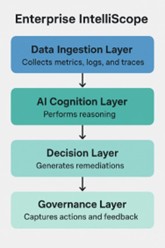
Figure 1: System Architecture

Figure 2: Data Flow Diagram
Architecture and Interfaces
Enterprise IntelliScope is designed to have two key interfaces. These intuitive interfaces include a unified console, which displays correlation graphs, MTTR trends and incident timelines. The domain-specific consoles support network, application and infrastructure teams, which have to share the same context. The central part is the AI recommender panel, which provides an explanation for each confidence score, lists scores and anomalies and enables root-cause identification, as shown in Figure 3. This allows engineers and the human interface to more easily manage situational awareness and control approaches.
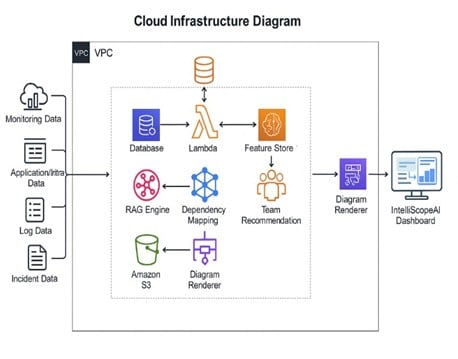
Figure 3: Core Architecture Components
Cloud-Native Implementation
Enterprise IntelliScope can be applied in different ways depending on the cloud service provider in question. This implies that there are different ways to cater for, advance and model the right categorization of marking their development in the required order. The framework can be put on AWS, with OpenTelemetry handling telemetry data through Kafka processors and Amazon Kinesis. Knowledge can be stored on Amazon S3, ensuring information accuracy and security.
Additionally, Amazon SageMaker can be used to run inferences, AWS Lambda helps with orchestration and IAM roles support policy enforcement. Google Operations Suite and Azure Monitor offer alternative approaches to ensure governance parity for the providers, always enabling successful implementation.
Influence on Organizations
In modern enterprises, a single downtime can result in thousands of dollars in losses. The use of Enterprise IntelliScope offers a chance to continually improve results, leading to an imperative capacity to advance, engage and achieve a suitable result. The use of Enterprise IntelliScope is expected to deliver up to a 40% reduction in MTTR, based on architectural reasoning and design intent that emphasize contextual correlation and predictive alerting to reduce incident occurrences. Nonetheless, predictive alerts help ensure that there are no grievous impacts on users whenever an incident occurs, as they are stopped before they escalate. There is also a higher incidence of cross-team collaboration, working with unified consoles to achieve a desirable result. Additionally, the use of explainable AI enhances ethical automation within systems, leading to improved framing for information systems. This framework, in turn, enhances sustainable observability across organizations.
OpenTelemetry vs. Enterprise IntelliScope
OpenTelemetry provides a standardized approach toward data collection, which provides visibility of the status of activities within the system. This implies that observability only remains a reactive activity within the enterprise. Enterprise IntelliScope, nonetheless, provides a GNN-based approach to ensure that data can be mapped to a proactive step, providing a way to prevent and offering more information on such incidents.
Steps Ahead for DevOps Teams
When using Enterprise IntelliScope, traditional DevOps must be remapped to shape their new working model through modern approaches. Notably, DevOps teams should enable consistency within the OpenTelemetry environment. They must also integrate both RAG and GNN models to achieve a cognitive correlation as desired by the elements. In addition, the teams should handle ethics and governance by ensuring that human approval loops can work flawlessly. Finally, post-incident data should be cultivated back into the system to support continuous learning.
Conclusion
To enable flawless administration of Enterprise IntelliScope, future research must focus on managing Digital Twins to simulate failures before they occur, advancing reinforcement learning and having federated learning advances, ensuring security for cross-cloud knowledge.
Organizations must also work toward building dependable systems with continued support and surveillance, achieving an even greater depiction of valuable engagement of visibility data from observability platforms. Enterprise IntelliScope empowers enterprises with reliability that offers proactive reaction and engagement approaches.