

Harness today added an artificial intelligence (AI) agent to its portfolio that has been specifically trained to help DevOps teams investigate events that occurred prior to an incident.
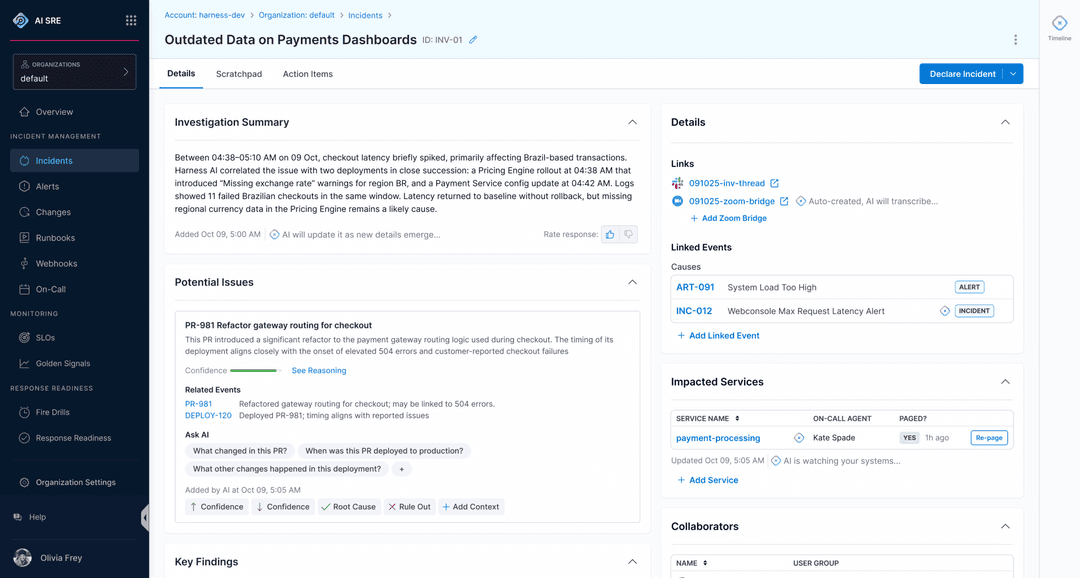
Tina Huang, vice president of product and engineering for AI SRE at Harness, said the Harness Human-Aware Change Agent leverages large language models (LLMs) to analyze comments and other insights about operational data that has been added to an unstructured document or found in a Slack, Zoom, Microsoft Teams discussion.
Armed with those insights, it then becomes possible for the Harness Human-Aware Change Agent to generate a hypothesis for resolving an incident that significantly reduces mean time to resolution, added Huang.
The agent is designed to be one of several that DevOps teams can invoke via the Harness AI SRE platform that Harness launched last year to automate tasks that would normally be assigned to a site reliability engineer. In fact, the Harness Human-Aware Change Agent relies on an AI Scribe agent that Harness developed to collect the signals that are used to generate a hypothesis. The Scribe agent filters unrelated chatter to capture only the decisions, actions, and timestamps related to a specific investigation.
Mitch Ashley, vice president and practice lead for software lifecycle engineering at the Futurum Group, said Harness is shifting incident response from machine signals alone to treating human observation as operational intelligence. The agent connects what responders see to the changes in systems, producing evidence-backed hypotheses rather than manual correlation, he noted.
Each organization will need to determine to what degree to automate their response to any given incident, but at the very least the amount of toil and burnout that DevOps teams currently experience responding to incidents should be significantly reduced. It’s not uncommon for DevOps teams to spend months looking for the source of an intermittent glitch that once discovered only requires a few minutes to resolve.
Additionally, AI agents should make it simpler for DevOps teams to identify recurring issues that they can create playbooks to address any time they are encountered.
While adoption of AI tools to write code is already pervasive, it’s still early days when it comes to embedding AI into DevOps workflows. As AI continues to evolve it will become more feasible for an existing DevOps team to manage what is readily becoming massive code bases that are subject to frequent change, noted Huang. Of course, the more changes that are made to those code bases the more likely it becomes there will be some type of incident that needs to be investigated in the wake of an update made to an application. The simple fact is that most incidents can be traced back to the latest update. The challenge is determining exactly which code added to the application might be the root cause of the issue given the overall size of the underlying codebase.
At this point, most DevOps teams are at the very least experimenting with AI. Before too long, each DevOps engineer is likely to be making use of as many as 10 AI agents to help automate tasks in addition to invoking AI agents that are autonomously performing tasks on behalf of a larger team. The challenge then becomes determining how best to orchestrate all those AI agents across the entire software development lifecycle (SDLC).


Mike Vizard is a veteran IT journalist with more than 25 years of experience covering the technology industry, having previously served as Editor-in-Chief of both CRN and InfoWorld and as editorial director for Ziff-Davis Enterprise, where he oversaw titles including eWEEK, CIO Insight and Baseline. Over his career he has also edited or contributed to a wide range of enterprise technology publications, including IT Business Edge, Channel Insider, ComputerWorld, TMCNet and Digital Review, and he later led editorial for CTOEdge.com. His reporting and analysis span software development, cloud computing, cybersecurity, IT channel strategy and, more recently, artificial intelligence and DevOps practices. A recognized voice in enterprise IT journalism, Vizard is known for tracking emerging technology trends as they move from early adoption into mainstream enterprise use. He now serves as Chief Content Officer for Techstrong Group, where he oversees editorial strategy across the full network — DevOps.com, Security Boulevard, Cloud Native Now, Digital CxO, Techstrong.ai, TechStrong.IT, Techstrong Semi and PlatformEngineering.com — in addition to writing and hosting content for Techstrong TV and the Techstrong Gang podcast.