
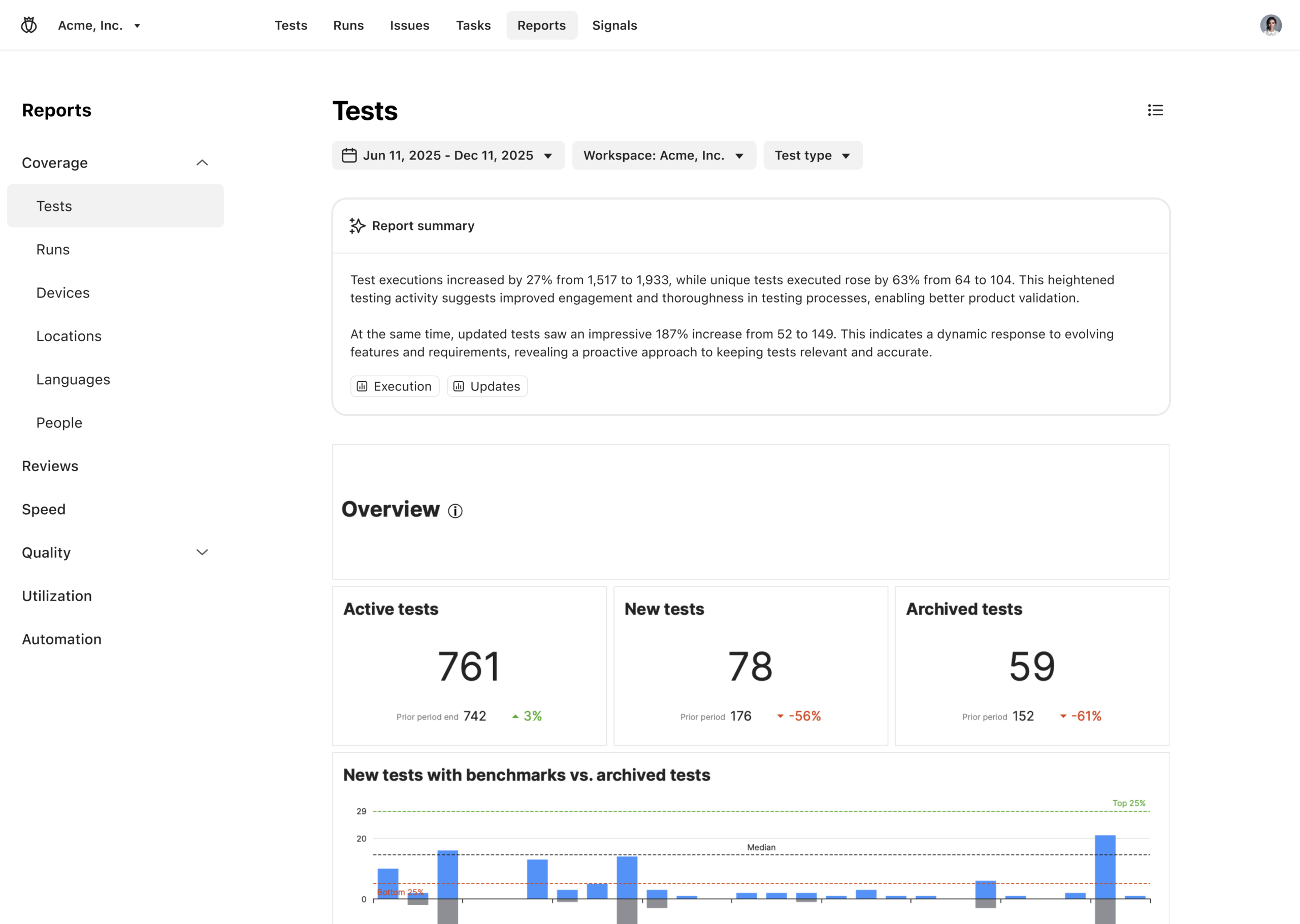
Testlio today extended its application testing capabilities to automatically correlate data with a dashboard that is now automatically generated using the artificial intelligence (AI) engine embedded in the platform.
Dean Hickman-Smith, chief revenue officer of Testlio, said LeoInsights automatically organizes testing results in a way that makes it much simpler for both software development teams and business leaders to analyze more than 100 signals within seconds.
In addition to being able to automatically generate, for example, an executive summary that highlights cost savings or efficiency gains, LeoInsights can be configured to analyze sentiment and send alerts any time unusual trends and anomalies are surfaced.
Based on the LeoAI Engine that has been trained using more than 13 years of testing data collected from 2.6 million test cases that involved in excess of 600,000 devices, Testlio provides a managed testing service through which it provides access to a network of more than 80,000 professional software testers that it has vetted. Those testers are members of the Testlio Academy and, at the very least, have completed a foundational “Introduction to Testing AI-Powered Systems” course.
As more organizations increase the pace at which code is being generated in the age of AI, there is a clear need to leverage more humans augmented by AI to vet the quality of the applications being developed, said Hickman-Smith. In fact, a Testlio report finds 82% of AI issues identified in testing involve some type of misinformation or hallucinations generated by an AI tool. A full 79% of those AI issues discovered are rated medium or high severity because they directly impact user experience, brand reputation or factual accuracy.
It’s now only a matter of time before quality assurance issues that can be traced back to too much reliance on AI tools and platforms become a larger issue for organizations that are using these applications to engage with customers and partners, said Hickman-Smith.
It’s not clear how much of the code being generated by AI tools is making it into production environments, but there is little doubt that more vulnerabilities are being generated. Additionally, AI coding tools tend to generate more verbose code than an experienced human developer would, which can, in tim,e significantly increase the cost of running an application.
All of these issues, of course, should be surfaced as part of an application testing review. However, far too many organizations are still overly focused on the speed at which code is being generated versus the quality of the applications being deployed. DevOps teams need to ensure that a set of testing guardrails is in place that makes it possible for humans to review the code being generated as early as possible, noted Hickman-Smith.
Inevitably, there will come a time when business leaders and product development teams start to correlate customer engagement and success with the quality of the applications being deployed by their DevOps teams. In the meantime, DevOps teams would be well advised to get ahead of that issue now, rather than focusing solely on how often the code they needed to create was delivered on time.