

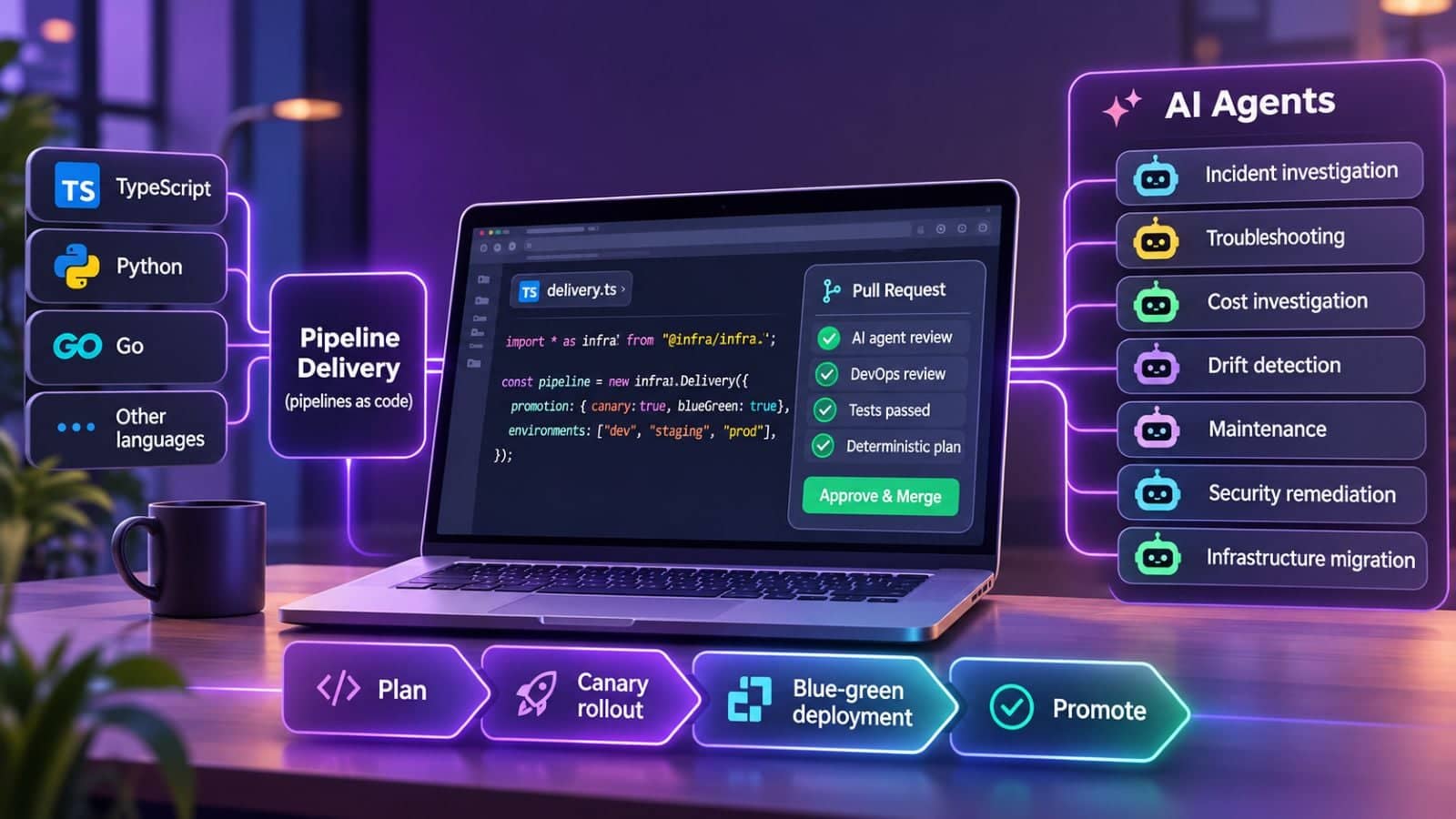
Pulumi today made available in public preview both an ability to enable DevOps teams to define delivery pipelines in code and a series of artificial intelligence (AI) agents that have been trained to perform specific tasks.
A Pulumi Delivery capability makes it possible to use TypeScript, Python, Go, and other languages to create pipelines for provisioning and configuring IT environments.
At the same time, Pulumi is adding multiple AI agents that each have a unique identity and are narrowly scoped to perform specific tasks such as incident investigation, troubleshooting, cost investigation, drift, maintenance, security remediation, and infrastructure migration.
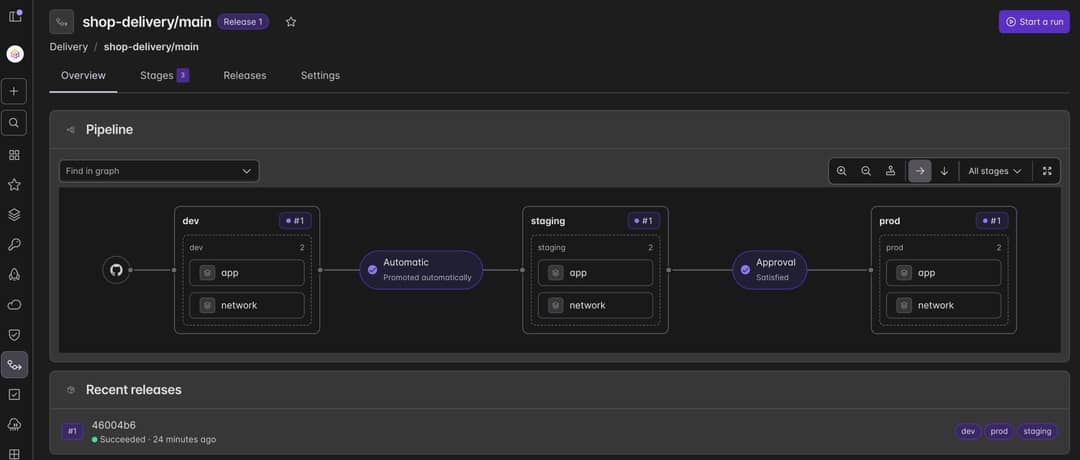
Collectively these capabilities make it possible for DevOps teams to express promotion logic, conduct canary rollouts and make blue-green deployments using composable code that can be reviewed and tested via a pull request (PR) by both AI agents and DevOps engineers as needed. Additionally, AI agents can be assigned tasks based on signals collected via an observability platform that has been exposed to them.
Every action an agent takes becomes code that produces a deterministic plan that is reviewable. Each Pulumi Agent has its own identity that limits which stacks and environments it can reach that are managed via the Pulumi platform. Permissions granted AI agents are written in code, and widening them requires a reviewed pull request. In contrast, AI agents that call application programming interfaces (APIs) directly leave little record of what changed or why.
Pulumi CEO Joe Duffy said the overall goal is to reduce as much friction as possible to make it feasible to deploy applications and updates as fast at the rate at which code is now being created in the AI era. There is no single DevOps platform that provides that capability but as AI agents are able to programmatically automate tasks the entire software development lifecycle (SDLC) will need to be re-engineered, he added.
Pulumi data suggests that about 40% of the tasks being conducted by a DevOps team are now actually being assigned to an AI agent, noted Duffy. The challenge now is making it simpler for teams of AI agents to collaborate across those workflows with platforms such as Pulimi providing a system of record for tracking which tasks were completed by which AI agents, he added.
The challenge, of course, is that AI agents, by definition, are probabilistic in the sense they do not perform the same task the same way unless they can rely on a set of deterministic workflows for context, noted Duffy.
At this juncture, each DevOps team is going to need to decide to what degree they prefer to build and deploy AI agents using a harness they created or rely more on AI agents that are built and maintained by the providers of the tools and platforms they have adopted. While it may be relatively simple to build and deploy an AI agent, they generally need to be retrained every few months as the IT environment continues to evolve.


Mike Vizard is a veteran IT journalist with more than 25 years of experience covering the technology industry, having previously served as Editor-in-Chief of both CRN and InfoWorld and as editorial director for Ziff-Davis Enterprise, where he oversaw titles including eWEEK, CIO Insight and Baseline. Over his career he has also edited or contributed to a wide range of enterprise technology publications, including IT Business Edge, Channel Insider, ComputerWorld, TMCNet and Digital Review, and he later led editorial for CTOEdge.com. His reporting and analysis span software development, cloud computing, cybersecurity, IT channel strategy and, more recently, artificial intelligence and DevOps practices. A recognized voice in enterprise IT journalism, Vizard is known for tracking emerging technology trends as they move from early adoption into mainstream enterprise use. He now serves as Chief Content Officer for Techstrong Group, where he oversees editorial strategy across the full network — DevOps.com, Security Boulevard, Cloud Native Now, Digital CxO, Techstrong.ai, TechStrong.IT, Techstrong Semi and PlatformEngineering.com — in addition to writing and hosting content for Techstrong TV and the Techstrong Gang podcast.