


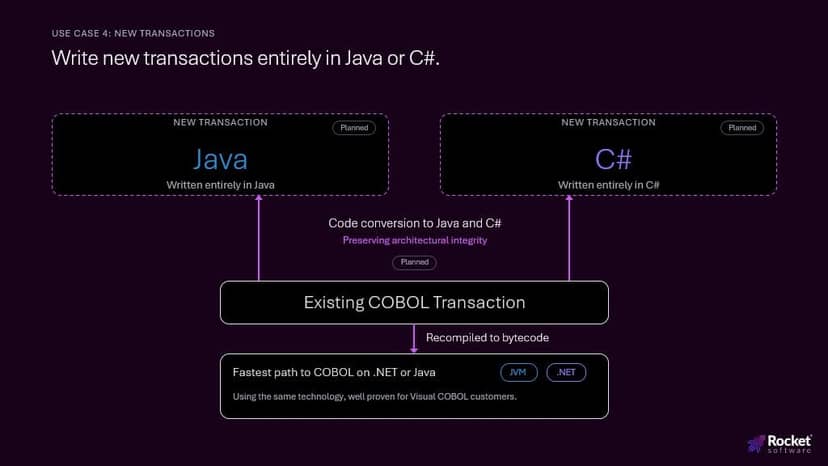
Rocket Software today added a platform that makes it simpler to move COBOL code from a mainframe to a cloud service or other type of distributed computing environment in a way that preserves existing business logic.
Phil Buckellew, president of the Infrastructure Modernization Business Unit at Rocket Software, said the Rocket Transaction Platform converts monolithic COBOL applications into a set of modular microservices that using a runtime developed by Rocket Software can run on another platform.
DevOps teams can then add code written in another language such as Java or Python to extend the capabilities of that reusable microservice that can be invoked via an application programming interface (API), he added.
The overall goal is to not convert COBOL code into another language but rather make it more extensible, noted Buckellew. The challenge, historically, has been finding a way to achieve that goal without requiring DevOps teams to rewrite business logic, he said.
It’s not clear how many DevOps teams are attempting to convert COBOL code into another programming language versus, more simply, trying to move it off a mainframe. The issue with converting COBOL code is that much of the functionality of the underlying platform is often undocumented, which makes converting the entire application often problematic, said Buckellew. Migrating modular sets of COBOL applications to other platforms provides an alternative approach to gradually reducing the cost of running that code, he added.
DevOps teams can either accomplish that goal themselves or invoke a set of artificial intelligence (AI) agents that Rocket Software gained last month by acquiring Geniez AI, a provider of platforms that provides a natural language interface to assign tasks to those AI agents.
While DevOps teams have been extending the reach of their workflows to the mainframe, there is a case for bringing the COBOL business logic that so many organizations still depend on to another platform. That approach makes it simpler for DevOps teams to incorporate that business logic within the workflows they are using to build and extend other applications at a higher velocity that doesn’t always require them to work with another platform team, noted Buckellew.
Regardless of approach, each organization will need to determine how much code still needs running on mainframe platforms that have been used in IT environments now for the better part of six decades. While the total cost of running those applications naturally varies from one organization to the next, the mainframe still provides capabilities that other platforms cannot match as cost effectively. However, it’s also true that DevOps teams are looking for a way to more flexibly extend the reach of those applications by offloading some elements of a monolithic application to another platform, especially if that capability needs to be programmatically invoked using APIs.
There is, of course, no one-size-fits-all approach to building and deploying applications. The one thing that is certain is that most DevOps teams would prefer to keep all their options open whenever feasible.

Frequently Asked Questions
1. What is the Rocket Transaction Platform?
2. Do teams have to rewrite their COBOL code?
3. Can teams move only part of a COBOL application?

Mike Vizard is a veteran IT journalist with more than 25 years of experience covering the technology industry, having previously served as Editor-in-Chief of both CRN and InfoWorld and as editorial director for Ziff-Davis Enterprise, where he oversaw titles including eWEEK, CIO Insight and Baseline. Over his career he has also edited or contributed to a wide range of enterprise technology publications, including IT Business Edge, Channel Insider, ComputerWorld, TMCNet and Digital Review, and he later led editorial for CTOEdge.com. His reporting and analysis span software development, cloud computing, cybersecurity, IT channel strategy and, more recently, artificial intelligence and DevOps practices. A recognized voice in enterprise IT journalism, Vizard is known for tracking emerging technology trends as they move from early adoption into mainstream enterprise use. He now serves as Chief Content Officer for Techstrong Group, where he oversees editorial strategy across the full network — DevOps.com, Security Boulevard, Cloud Native Now, Digital CxO, Techstrong.ai, TechStrong.IT, Techstrong Semi and PlatformEngineering.com — in addition to writing and hosting content for Techstrong TV and the Techstrong Gang podcast.