

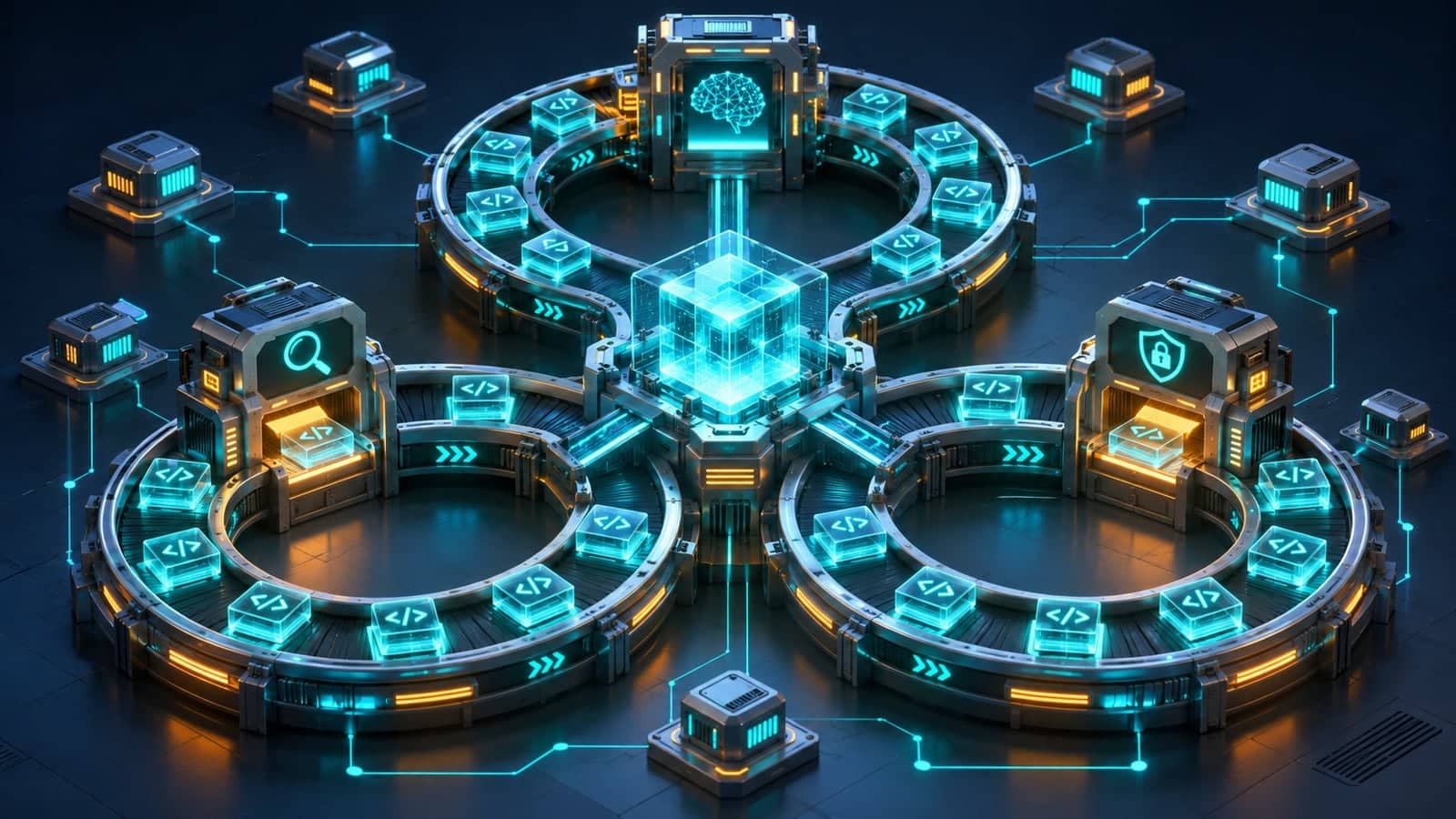
Tessl this week revealed it has added ready-to-use loops that DevOps teams can now invoke and customize to drive agentic engineering workflows.
Speaking at the company’s aiDevCon event, Tessl CEO Guy Podjarny told conference attendees that the company is moving to make it simpler to combine AI skills and self-optimizing loops to create a software factory using specifications defined in the Tessl platform.
Rather than a DevOps team having to build their own software factory, Tessl is making a case for a platform that makes it possible to build AI skills and loops or customize a set that Tessl now provides to address workflows such as ticket to pull request (PR), code review and vulnerability remediation. Those reusable loops are based on AI skills that are combined to create a software factory.
Rather than building a single software factory, however, each product team will deploy their own software factory because the requirements of various applications are fundamentally different from one another, said Podjarny.
It’s not clear how far down the path DevOps teams are toward building software factories in the AI era, but the overall pace at which software can be built and deployed is clearly accelerating. The challenge is that the cognitive load associated with managing agentic workflows is considerably higher. A software factory provides a means to manage those workflows more effectively in a way that ultimately reduces costs and improves security, noted Podjarny. That latter capability is critical as the number of vulnerabilities that DevOps teams are expected to fix continues to increase in the AI era, he added.
In the meantime, DevOps teams should continue to experiment in ways that continue to push the boundaries of what is possible using AI agents to build software. The concept of a software factory is, of course, hardly new, but the need for a more consistent approach to building software in the AI era has made the need for a software factory more apparent. The difference now is that a modern software factory can more flexibly adapt as additional AI skills and loops are continuously added, updated and more easily shared.
The issue, of course, is that every minute a DevOps team spends building and maintaining a software factory is often one less minute that could have been spent building a new application or generating the code needed to fix a legacy application. As such, more DevOps teams are likely to acquire a software factory rather than trying to build one themselves, noted Podjarny.
It’s difficult to predict how each of those AI agents will behave, but the more guardrails, skills and loops that are put in place, the more reliable the output being generated becomes. At this juncture, it’s not so much a question of whether DevOps teams will be using AI skills and loops to deploy software factories so much as it is how many of them might eventually be required as the pace of application development continues to exponentially accelerate.

Frequently Asked Questions
1. What is an AI software factory?
2. What are loops in Tessl’s platform?
3. Which workflows does the article identify?

Mike Vizard is a veteran IT journalist with more than 25 years of experience covering the technology industry, having previously served as Editor-in-Chief of both CRN and InfoWorld and as editorial director for Ziff-Davis Enterprise, where he oversaw titles including eWEEK, CIO Insight and Baseline. Over his career he has also edited or contributed to a wide range of enterprise technology publications, including IT Business Edge, Channel Insider, ComputerWorld, TMCNet and Digital Review, and he later led editorial for CTOEdge.com. His reporting and analysis span software development, cloud computing, cybersecurity, IT channel strategy and, more recently, artificial intelligence and DevOps practices. A recognized voice in enterprise IT journalism, Vizard is known for tracking emerging technology trends as they move from early adoption into mainstream enterprise use. He now serves as Chief Content Officer for Techstrong Group, where he oversees editorial strategy across the full network — DevOps.com, Security Boulevard, Cloud Native Now, Digital CxO, Techstrong.ai, TechStrong.IT, Techstrong Semi and PlatformEngineering.com — in addition to writing and hosting content for Techstrong TV and the Techstrong Gang podcast.