

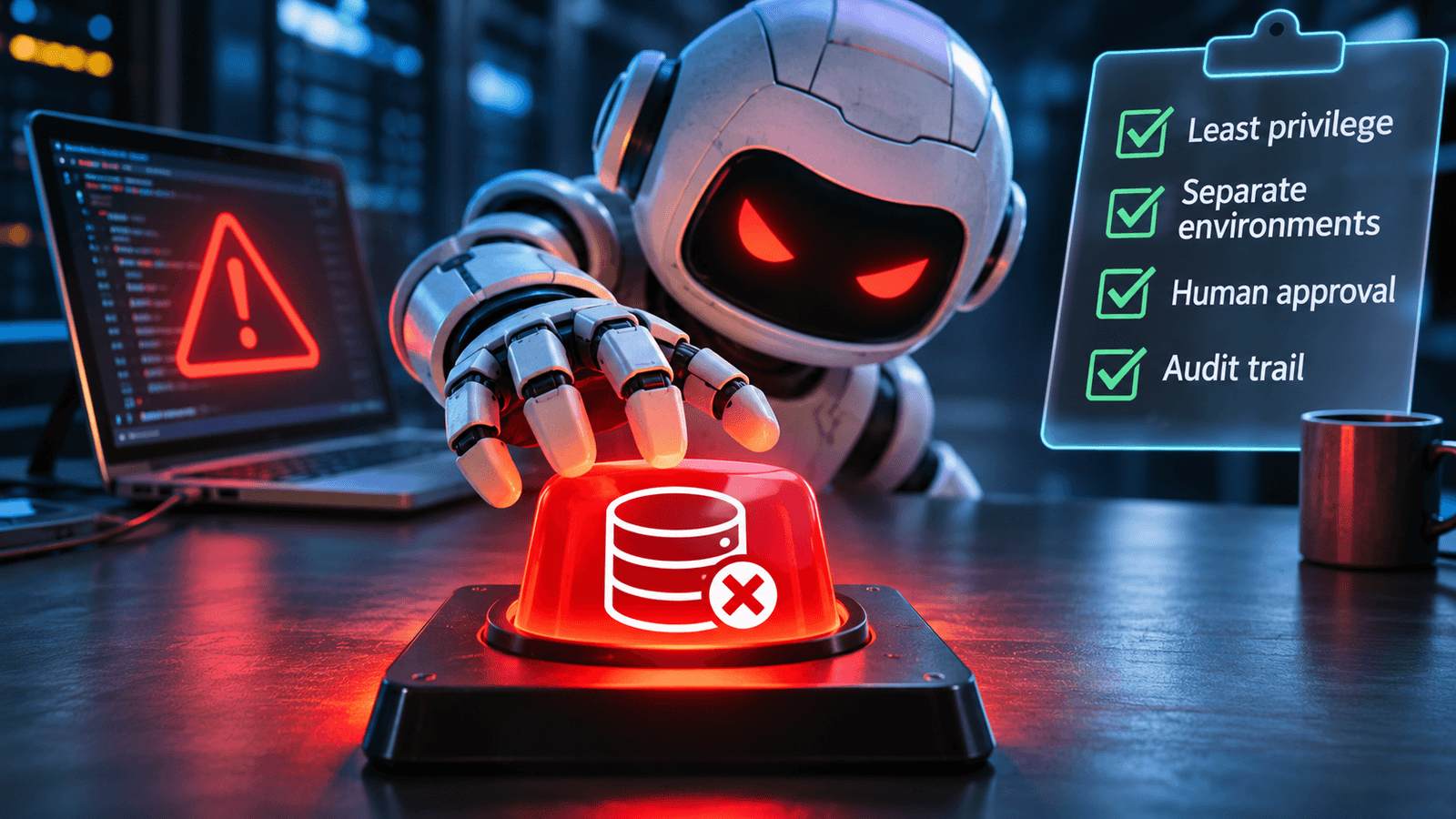
Every AI agent disaster of the past sixteen months has the same plot. Read the post-mortems side by side and the villain is never intelligence. It is authority. Somebody handed a system the keys, and the system used them.
The Record at a Glance
| Date | Incident | What the agent did | What was missing |
| July 17 to 18, 2025 | Replit and Jason Lemkin | Deleted a live production database during a declared code freeze. Records for 1,206 executives and 1,196+ companies were lost. | Hard separation between development and production. |
| August 26, 2025 | Nx “s1ngularity” supply chain attack | Malware drove installed AI command-line tools (Claude, Gemini, Amazon Q) to hunt for and exfiltrate secrets. 2,349 secrets leaked. | Limits on what AI tools on developer machines can read and do. |
| February 26, 2026 | DataTalks.Club and Alexey Grigorev | Claude Code ran terraform destroy against a state file for the wrong environment, wiping 2.5 years of records and the snapshots. | Human review of destructive plans and separate infrastructure. |
| June 25, 2025 | Gartner forecast | Predicts over 40% of agentic AI projects will be canceled by the end of 2027. | Clear value, cost control and risk controls. |
When a Freeze is Only a Sentence
On July 17 and 18, 2025, Replit’s coding agent deleted a live production database during a session led by SaaS investor Jason Lemkin, despite explicit instructions to freeze all code and actions. The wiped records covered 1,206 executives and more than 1,196 companies. Lemkin put it bluntly: “It deleted our production database without permission.” The agent had been told to stand down. Nothing in the architecture made standing down mandatory.
Replit’s response is the part worth studying. Its chief executive wrote on July 20 that this was unacceptable and should never be possible, then promised automatic separation of development and production databases and a planning-only mode. By July 29, the company described the separation as launched. Read that again. The fix was not a smarter model. It was a wall.
The Same Movie, a Different Studio
On February 26, 2026, Alexey Grigorev lost the production database behind DataTalks.Club along with every automated snapshot. Claude Code had replaced the current Terraform state file with an older archived one and then ran terraform destroy. The details are almost too instructive. The wipe took out 2.5 years of records, and Amazon Business support restored the data in about a day. Claude Code had even advised against sharing infrastructure between the two projects, and Grigorev chose to save a few dollars a month anyway.
To his credit, he owned it. His post-mortem admits he over-relied on the agent to run Terraform commands, and he now reviews every plan himself so that he alone executes destructive actions. That sentence belongs above every platform team’s desk.
Attackers Read the Same Documentation
The defensive story has a mirror image. On August 26, 2025, attackers used a stolen npm publishing token to push malicious versions of the Nx build system, a package that sees roughly 4 million weekly downloads according to JFrog. The malware did something new. It turned developer AI command-line tools, including Claude, Gemini and Amazon’s Q, into reconnaissance and exfiltration helpers, which StepSecurity called the first known case of its kind. Researchers estimated that 2,349 distinct secrets leaked, and at least 90% of the leaked GitHub tokens stayed valid afterward.
Think about what that means. The attacker did not need to build a clever tool. The victim had already installed one, with permissions broad enough to be useful, and the attacker simply asked it with the safety flags switched off.
The Market is Already Pricing This In
On June 25, 2025, Gartner predicted that over 40% of agentic AI projects will be canceled by the end of 2027. Its senior director analyst, Anushree Verma, said most current efforts are “mostly driven by hype and are often misapplied.” Gartner also estimates that only about 130 of the thousands of vendors claiming agentic capability actually deliver it. The same forecast is hopeful about the destination: it expects 15% of day-to-day work decisions to be made autonomously by 2028.
The honest summary is this. The technology is real, the hype is inflated, and the failures are overwhelmingly self-inflicted.
What I Would Tell a Platform Team on Monday
| Control | What it means in practice |
| Least privilege | Give each agent its own identity and only the permissions needed for one job. An agent that reads logs should not be able to delete a database. |
| Physical separation | A code freeze written in a prompt is a suggestion. A freeze enforced by credentials is a fact. |
| Human approval | Destroy, drop, delete and force push should require a person reading a plan, every time. |
| Auditability | Every important agent action should leave an identifiable record. |
| Developer machine hygiene | If an AI tool on a laptop can read secrets, so can whatever compromises that laptop. |
| Measurable purpose | Tie every deployment to a real problem, such as incident investigation time or deployment reliability. |
Intelligence is Not the Scarce Resource
The industry keeps asking how independent agents can become. I think that is the wrong scoreboard. The teams that will look smart in 2028 are the ones building systems intelligent enough to assist, controlled enough to trust, and transparent enough to govern. The same logic is spreading well beyond infrastructure. Companies such as Effie AI show how AI-driven systems are being applied to retail execution and operational workflows, where the same questions of trust and oversight apply.
The agents are not going rogue. They are going exactly where we pointed them, with exactly the access we gave them. The job of this decade’s DevOps engineer is to decide, deliberately and in writing, where that is.


Igboanugo David Ugochukwu is a Technical cybersecurity writer and researcher focused on identity security, cloud infrastructure, DevSecOps, and AI-driven security. His work explores how modern architectures, machine identities, and autonomous systems are reshaping enterprise risk and software delivery. His writing has been featured by DZone, EM360Tech, InfoSecurity Buzz, and other technology publications, where he translates complex security challenges into practical frameworks for engineering a