

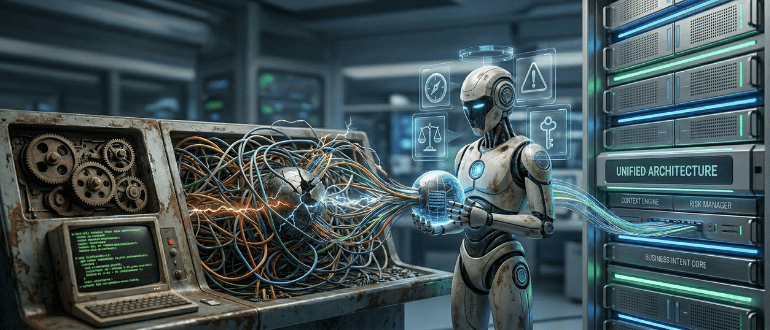
Every decade or so, something fundamental shifts in how we think about infrastructure. Not an upgrade, a rethinking.
Virtualization changed what infrastructure was. The cloud changed where it lived. Infrastructure as Code changed how it was defined. Each of those shifts felt incremental from the inside and transformative in hindsight. We’re at one of those moments again.
Automation has been the operating model of network infrastructure for the last decade. We scripted, we orchestrated, we built platforms to make repeatable things faster and more consistent. That work matters. It laid the foundation for everything that comes next.
But here’s what a decade of building automation for some of the world’s most complex networks makes clear: the hardest problems in infrastructure aren’t repeatable. They never were.
The Automation Gap Nobody Talks About
Walk into any network operations team that has invested heavily in automation and you’ll see the same dynamic. The well-understood tasks, provisioning, compliance checks, standard change management, are automated and running well. But the people who built those automations are still spending 60-70% of their time on everything else.
Incident response. Configuration drift that breaks in unexpected ways. Complex cross-domain changes that touch five teams. Day 2 operations that don’t fit the happy path.
These are the problems that consume the most labor, carry the most risk, and cause the most organizational friction. And they’re exactly the problems that traditional automation doesn’t solve well, because they require something automation can’t provide on its own: reasoning.
Traditional scripts and workflows are deterministic by design. If X, do Y. That rigidity is a feature when you know what X will look like. But real infrastructure doesn’t always fit the conditions we anticipate. Outages don’t follow a playbook. Brownfield environments don’t behave consistently. The operational context that determines the right course of action is distributed across systems, teams, and history that no single workflow can fully encode.
This is the gap. Not a gap in automation maturity, but a gap in what automation alone can do.
Reasoning Changes the Equation
AI reasoning agents introduce something qualitatively different. Not more automation, a different kind of intelligence.
Where automation executes, agentic AI reasons. It can interpret context, evaluate risk, weigh alternatives, and choose a path that aligns with business intent rather than just following a predefined sequence. That’s not a subtle difference. It’s the difference between a system that does what you told it to do and a system that understands what you’re trying to accomplish.
But reasoning without governance is just risk with better vocabulary. We’ve been here before. Every automation wave has required organizations to build trust before granting autonomy. You don’t hand over the keys to a system you can’t verify. You start read-only. You build confidence through evidence. You expand access incrementally, with governance at every layer.
Agentic AI should be no different, and the organizations that try to shortcut this will learn the same lessons the hard way.
The infrastructure industry is now mature enough to do this right. Automation platforms can serve as the governed execution layer. Standards like MCP give AI agents a structured, auditable interface to infrastructure. Domain-specific knowledge, built up over years of real-world deployments, can inform how agents reason about network-specific context. The foundation is there. What’s new is the intelligence layer on top of it.
What Agentic Orchestration Actually Looks Like
The term “agentic” is getting applied to everything right now, and like any category in early formation, that creates as much confusion as clarity.
Agentic orchestration is the combination of AI reasoning and deterministic automation in a governed architecture that can handle both well-understood tasks and complex, open-ended operations. The key insight is that these two types of work require different approaches, and conflating them is where most AI infrastructure initiatives go wrong.
For deterministic tasks, you don’t need an AI agent making decisions. You need a reliable, auditable workflow that executes consistently and can be trusted. Agentic AI applied to a task like standard VLAN provisioning is overhead, not value.
But for the complex, contextual problems, the ones that consume the most human effort, that’s where reasoning changes everything. An agent that can read the state of the network, pull relevant operational history, understand the change being requested, assess risk, and either recommend a path or execute within guardrails isn’t replacing automation. It’s handling the problems automation was never designed for.
The goal is a framework where those two worlds coexist and complement each other. Workflows that need to run consistently, run deterministically. Tasks that require judgment, reasoning, and context-awareness get the intelligence layer they need. The result isn’t just faster operations. It’s infrastructure that can actually keep pace with the rate of change the business is demanding.
The Question Every Infrastructure Leader Needs to Answer
Here’s what every network and infrastructure leader should ask right now: where are the problems in your environment that your automation can’t reach?
Not the tasks that are already running well. The ones where a human has to get involved every time, because the context is too variable, the risk is too hard to encode, or the coordination across teams is too complex to script. Those are the problems agentic orchestration is designed to solve.
The organizations that figure this out early will have a structural advantage. Not because they were aggressive about adopting AI, but because they were thoughtful about where reasoning belongs and where governance must hold.
That’s the inflection point we’re at. And having worked on the hard problems of network automation for over a decade, I don’t think it’s incremental. I think it changes the ceiling on what’s possible.


Chris co-founded Itential in 2014 to simplify and accelerate the adoption of network automation and to transform network operations practices. Using a model-based approach, Chris leads the innovation and development of the company’s flagship software portfolio of dynamic network automation applications.