


The transition from experimental AI prototypes to production-grade DevOps agents hinges on one critical discipline that most teams overlook: context engineering. While organizations rush to deploy large language models for infrastructure automation, the difference between agents that hallucinate and those that reliably execute production workflows lies not in model selection, but in how context is structured, retrieved, and maintained.
The Context Crisis in Production Agents
AI agents in DevOps environments face a unique challenge. Unlike conversational chatbots, these agents must process multi-step workflows spanning hours or days, provisioning infrastructure, analyzing logs, executing rollbacks, and coordinating across Kubernetes clusters, CI/CD pipelines, and monitoring systems. Each tool call generates output; every decision requires historical awareness. Without systematic context management, agents quickly hit the “lost in the middle” phenomenon, where critical details buried in lengthy contexts get ignored, leading to catastrophic automation errors.
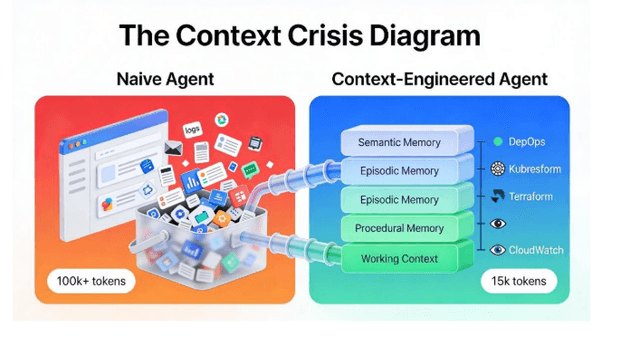
The problem intensifies with scale. A prototype agent handling five-tool workflows performs admirably. Deploy that same agent against production infrastructure with fifty concurrent operations, and context windows overflow. Latency spikes. Costs balloon. Most critically, accuracy degrades precisely when reliability matters most.
From Prompt Engineering to Context Architecture
Context engineering represents an architectural shift from viewing prompts as static strings to treating context as a dynamic, managed resource. This discipline encompasses three core competencies that separate production-grade agents from experimental toys.
Selective Context Injection moves beyond naive “send everything” approaches. Instead of flooding the model with entire log files or API responses, intelligent agents employ retrieval-augmented patterns that fetch only semantically relevant fragments. When diagnosing a failed deployment, the agent doesn’t need yesterday’s successful builds, it needs the specific error signatures, recent configuration changes, and dependency graphs matching the current failure mode. Dynamic context selection using embedding-based retrieval reduces token consumption by 60-80% while improving accuracy.
Structured Memory Architectures implement the 12-Factor Agent principles: semantic memory for infrastructure facts, episodic memory for past incident patterns, and procedural memory for runbook execution. Rather than maintaining monolithic conversation histories, production agents externalize state to vector stores and structured databases, injecting only necessary context at each decision point. This approach enables agents to maintain coherence across multi-hour remediation workflows without overwhelming context windows.
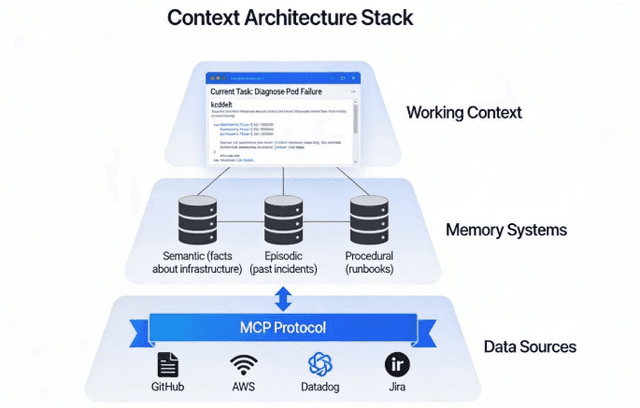
Context Compression and Compaction address the temporal challenge of long-running operations. As workflows progress, raw tool outputs accumulate, kubectl responses, Terraform plans, and CloudWatch metrics. Smart compaction strategies summarize historical tool results while preserving architectural decisions and unresolved issues. The most robust implementations employ hierarchical summarization: recent operations remain verbatim, older steps compress into structured summaries, and critical dependencies persist in external state objects.
The MCP Standard: Context Engineering at Scale
The Model Context Protocol (MCP) emerges as the critical infrastructure layer enabling systematic context engineering. By standardizing how agents discover, access, and utilize tools and data sources, MCP transforms context from an ad-hoc implementation detail into a governed system resource.
MCP servers expose capabilities through standardized primitives: Resources provide contextual data, Tools expose executable functionality, and Prompts define reusable workflows. This architecture enables DevOps teams to implement context engineering best practices without reinventing infrastructure for each agent. Authentication, access control, and audit logging become protocol-level concerns rather than agent-specific implementations.
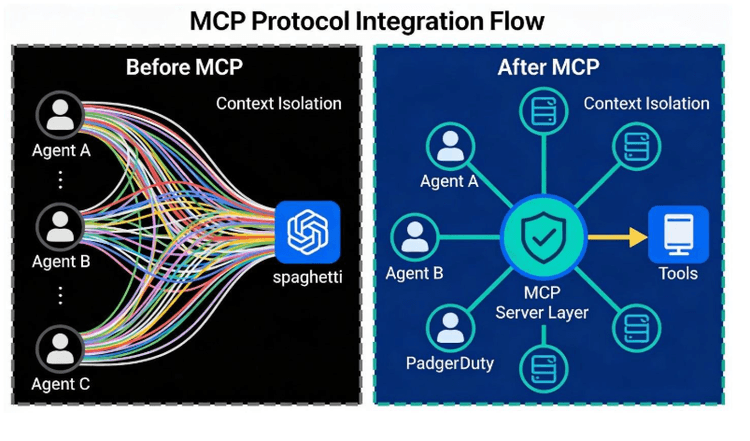
For platform teams, MCP offers something previously impossible: centralized governance of agent context. Security policies dictating which production data agents may access, compliance requirements for audit trails, and performance optimizations for context retrieval, all enforceable at the protocol layer rather than embedded in individual agent logic.
Implementation Pathways
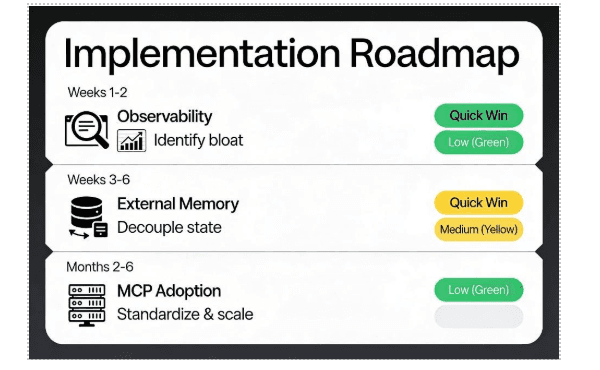
Organizations transitioning to context-engineered agents should begin with observability. Instrument existing agents to track context growth patterns, identifying which tool calls generate bloated outputs and which historical contexts prove irrelevant. This data drives selective context strategies.
Next, implement external memory architectures. Vector databases like Pinecone or Weaviate store semantic infrastructure knowledge; graph databases maintain dependency relationships; time-series databases track operational history. Agents query these systems contextually rather than maintaining monolithic state.
Finally, adopt MCP incrementally. Start with non-critical internal tools, exposing them through MCP servers to establish patterns for authentication, context isolation, and monitoring. As confidence grows, migrate production tooling to the protocol, gaining standardized context management across the agent ecosystem.
The Competitive Imperative
As DevOps evolves from human-driven automation to agent-driven operations, context engineering distinguishes reliable platforms from brittle experiments. Organizations that treat context as a first-class engineering concern, implementing selective injection, structured memory, and systematic compaction, will deploy agents that handle production complexity. Those that don’t will face escalating incident rates, ballooning costs, and failed automation initiatives.
The agents are ready. The question is whether our context architectures can support them.


With over 20 years in data, AI, and analytics, I work at the intersection of Snowflake, cloud architecture, and applied machine learning to turn complex, messy data into production-grade systems that drive business outcomes. My career has spanned business intelligence, data engineering, and data science, giving me end-to-end ownership from data ingestion and modeling through to dashboards, AI services, and executive-facing narratives.