
TL;DR — Key Takeaways
- ProjectDiscovery’s Neo 1.0 uses AI-driven autonomous security testing to discover, validate and prioritize exploitable vulnerabilities.
- Neo is available through a consumption-based cloud model designed to lower the cost of continuous security testing.
- The platform integrates with GitHub, Jira, Confluence, Slack, Linear, APIs, webhooks and MCP.
ProjectDiscovery has made available an autonomous security testing platform that leverages an open source artificial intelligence (AI) testing framework to detect and validate vulnerabilities at a lower total cost.
Company CEO Rishi Sharma said version 1.0 of the Neo platform is also available via a cloud service that makes it possible for DevSecOps teams to run tests and conduct investigations using a consumption-based pricing model.
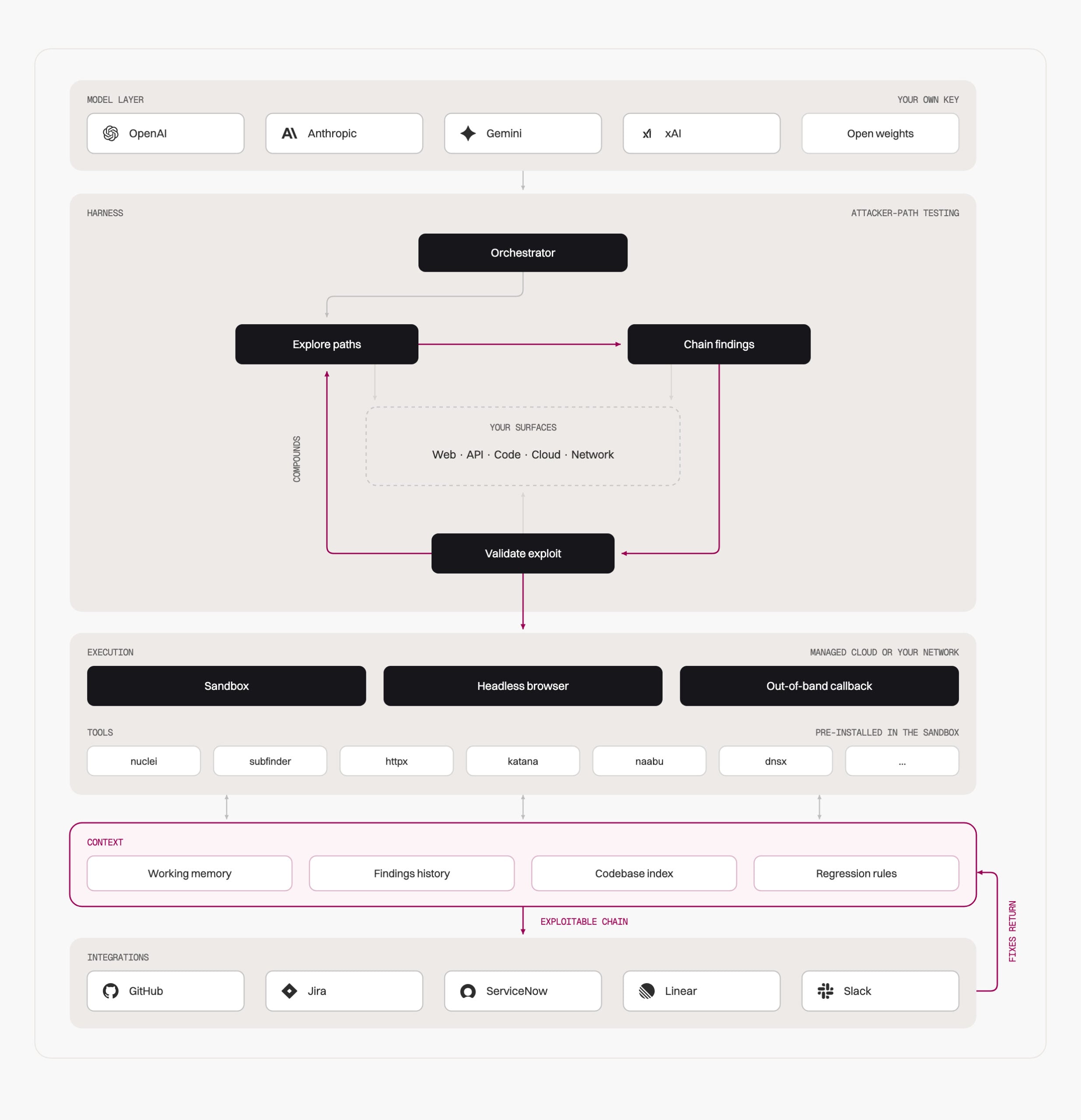
Additionally, Neo 1.0 adds integrations with DevOps tools and platforms such as GitHub, Jira, Confluence, Slack, Linear, application programming interfaces (APIs), webhooks, and the Model Context Protocol (MCP).
Based on an open source project, ProjectDiscovery, in addition to using Neo to detect, validate and route vulnerabilities to the responsible developer, also provides access to Nuclei, an open-source vulnerability scanner driven by customizable YAML templates to detect misconfigurations and exploits. Also included are tools such as Subfinder for discovering subdomains, an httpx tool to probe HTTP, a web crawling tool dubbed Katana, and a port scanning tool known as Naabu.
Collectively these components provide the foundation for an open source ProjectDiscovery ecosystem that already includes more than 100,000 practitioners, making it less costly to discover and remediate vulnerabilities using an autonomous security testing and penetration platform that continuously generates alerts in real time or can be used to run tests at scheduled intervals, said Sharma. Relying on code scanning tools is no longer enough, he added. Instead, there needs to be an entire tool chain in place that not only identifies vulnerabilities but also makes it simpler to identify which vulnerabilities can be reached and actually abused, noted Sharma. Otherwise, DevSecOps teams will soon find themselves overwhelmed by the number of false positives that are generated by AI models, he added.
As artificial intelligence (AI) models advance to the point where discovering vulnerabilities and creating exploits becomes trivial, DevSecOps teams now more than ever need to be able to discover those vulnerabilities before software is deployed in a production environment. The challenge is that, historically, the cost of applying AI to test code has been too high for many organizations to adopt, said Sharma.
In fact, organizations need to realize that application security in the AI era is not just a technical issue but more importantly requires new processes to be defined and embraced that go beyond simply asking an AI model to identify vulnerabilities in source code, he added.
Mitch Ashley, vice president and practice lead for software lifecycle engineering at the Futurum Group, said the truth is there has never been a shortage of vulnerability findings. DevSecOps teams drown in them and burn triage time sorting real threats from noise. Neo validates what it finds, then routes the exploitable issues to the developer who owns the code. The scan-and-fix cycle was built for human code at human speed. AI writes and exploits faster than weekly scans keep up, so testing now has to run where code gets created, he added.
It’s not clear how long it will be before there is a full-blown vulnerability crisis, but it’s apparent DevSecOps teams are running out of time. Technical debt that has been kicked down the proverbial road for years now needs to be rapidly reduced because many more cybercriminals will have access to more advanced models in a matter of weeks. Each DevOps team will then need to determine at what rate to remediate vulnerabilities in existing applications versus opting to replace legacy applications with ones that are, hopefully, more secure.
In the meantime, however, DevSecOps teams, while continuing to hope for the best, would be well-advised to start preparing for the worst-case scenario as soon as possible.

Frequently Asked Questions
What is ProjectDiscovery Neo?
Neo is an autonomous security testing platform that uses AI to identify, validate and help route exploitable vulnerabilities to the developers responsible for fixing them.
What is new in Neo 1.0?
Neo 1.0 adds consumption-based cloud pricing along with integrations for tools and platforms including GitHub, Jira, Confluence, Slack, Linear, APIs, webhooks and MCP.
How does Neo reduce vulnerability alert noise?
Rather than simply identifying potential flaws, Neo attempts to validate whether vulnerabilities are reachable and exploitable before routing them for remediation.