

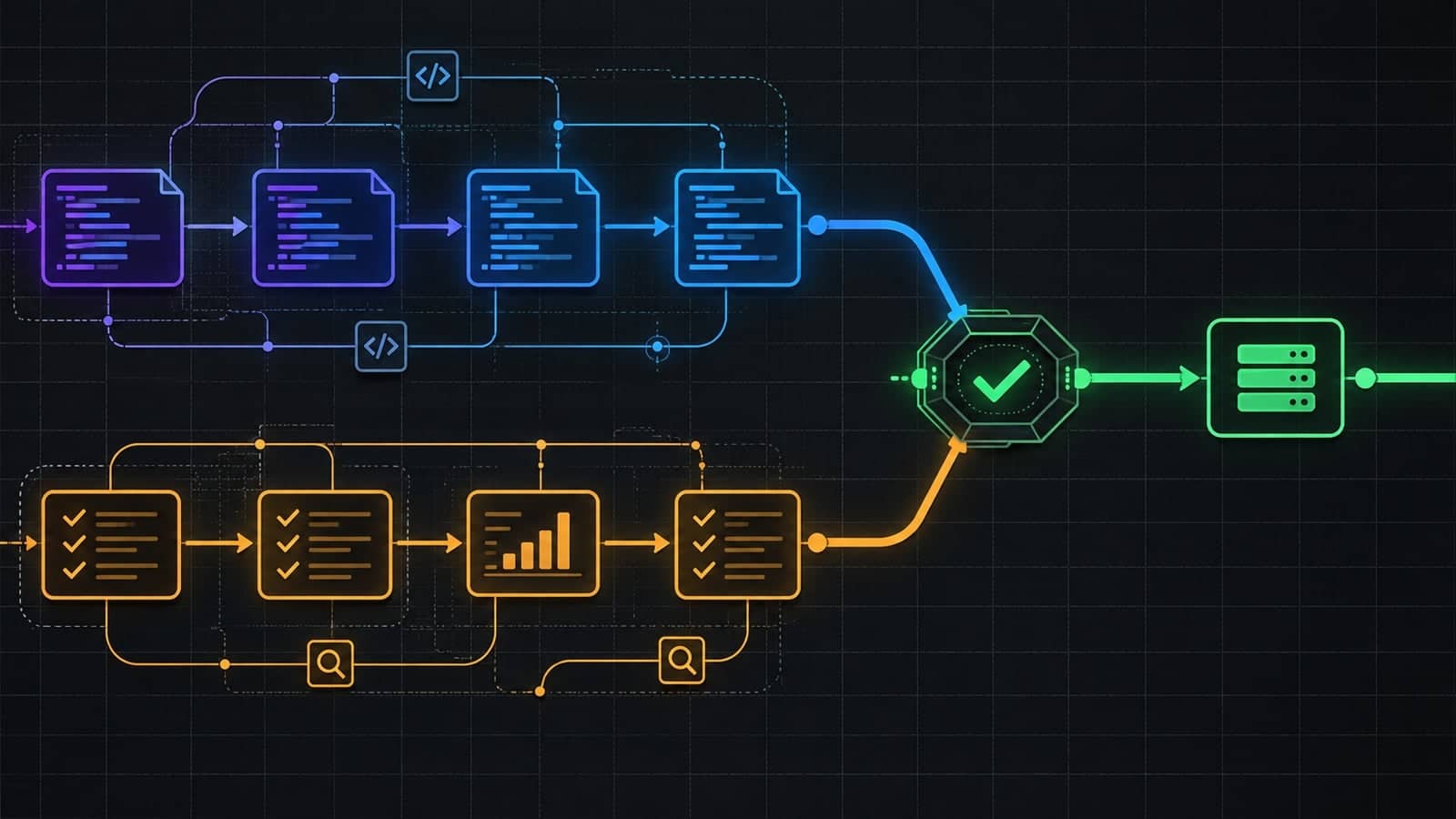
A test can pass while confirming the wrong behavior. If the same assumption shapes both an AI-generated implementation and the tests written to check it, a successful run may offer little evidence that the user’s requirement was understood. The distinction matters when teams use coding agents to accelerate delivery: checking that code behaves as written is different from establishing that it does what the business intended. Independent validation needs a place in that workflow.
David Colwell, vice president of AI and machine learning at Tricentis, explores that problem with Alan Shimel. Colwell argues that a coding agent can reproduce its own mistaken assumptions in the tests it generates, much as a developer can overlook an assumption embedded in an implementation. He proposes separate testing agents and testing pipelines that work from user stories, organizational context and requirements. Their job is to challenge the result against those inputs, not simply verify that the generated code is internally consistent.
Colwell frames this as the return of familiar software engineering disciplines rather than an escape from them. Checks for quality, security, integration and release readiness still matter when an agent produces the code. In the approach he describes, a coding agent can use independent test feedback before deployment, reducing the need to diagnose every problem from production logs afterward. He argues that earlier validation can improve delivery speed and reduce wasted model calls, but those are benefits teams would need to establish in their own pipelines.
The review handoff changes as well. Instead of asking a reviewer to reconstruct whether a feature meets its requirements, Colwell wants the change to arrive with understandable evidence, including passing tests, traceability and demonstrations of the intended behavior. Code review can then address implementation quality without serving as the only check on whether the right thing was built. That does not make a generated test suite conclusive proof of correctness. It makes the source of the requirements, the independence of the checks and the evidence attached to a release explicit parts of the delivery process.


Alan Shimel is founder, CEO and editor-in-chief of Techstrong Group, a Futurum company, and a member of Futurum's executive leadership team. A technology entrepreneur, media executive and industry commentator, Shimel has spent more than three decades building businesses, communities and media platforms serving enterprise technology professionals, including co-founding StillSecure, a network security company, and the DevOps Institute, a DevOps certification and training body. At Techstrong, he leads a portfolio of media brands including DevOps.com, Security Boulevard, Cloud Native Now, Techstrong AI, Techstrong IT, Digital CxO, Platform Engineering, Techstrong Semi and Techstrong TV, along with a growing portfolio of events, educational programs and digital communities. With more than 25 years of experience in cybersecurity, Shimel is a familiar voice in the space and was an early advocate of the DevOps movement, helping bring DevOps practices into mainstream enterprise technology. His work today spans cybersecurity, DevOps, cloud-native technologies, artificial intelligence, semiconductors and digital transformation, and he hosts popular programs including Techstrong Gang, Shimmy Says and Still Cyber, After All These Years. He holds a Bachelor of Arts in Government and Politics from St. John's University and a Juris Doctor from New York Law School.