

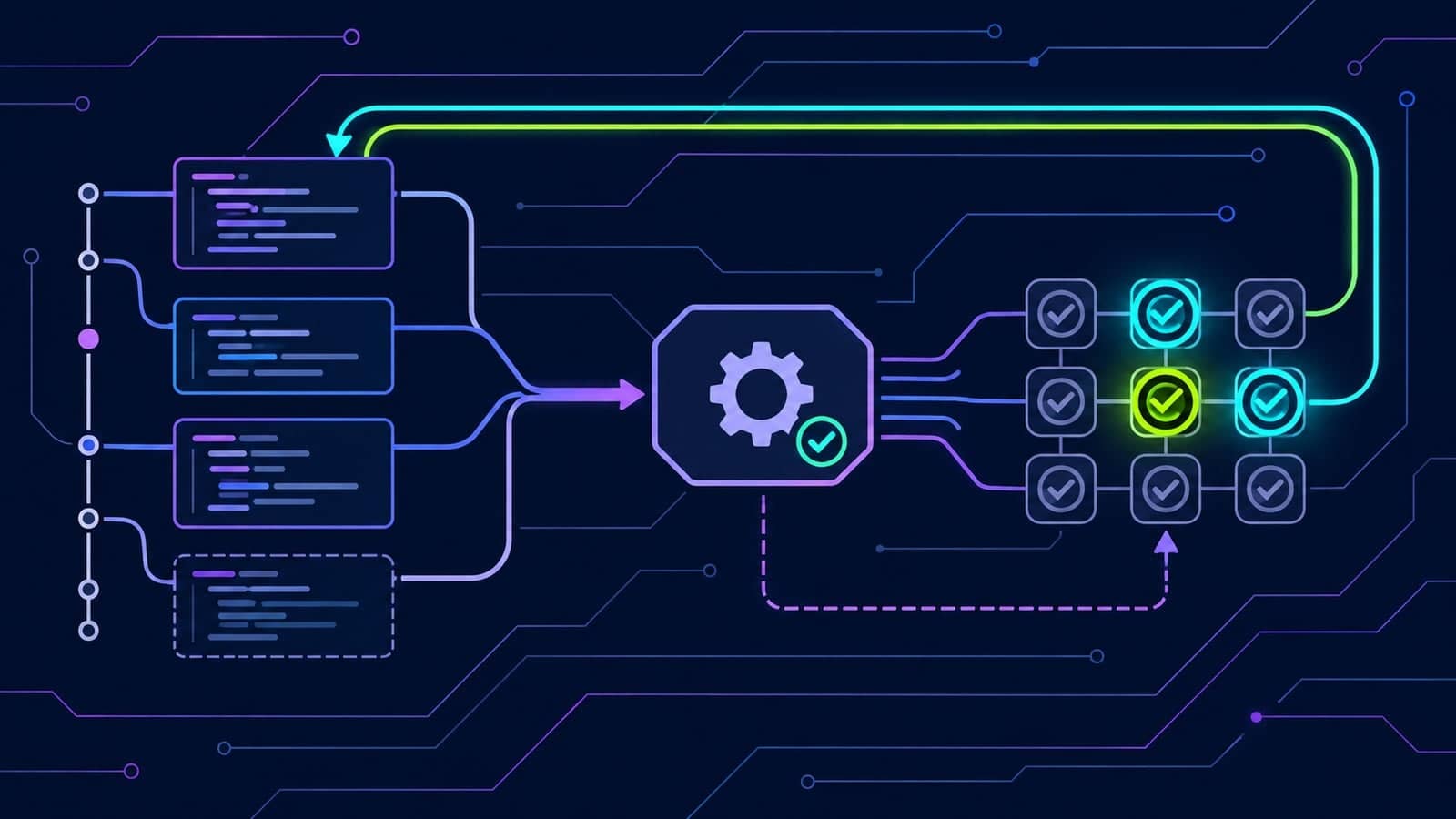
Waiting until a pull request reaches CI can leave a coding agent several steps removed from the feedback it needs. A faster implementation is not necessarily a faster release if tests, reviews and handoffs still arrive at the old pace. The question for delivery teams is where to place validation so an agent can correct its work before a change builds up more downstream effort. That makes the feedback loop, not just code generation, an important part of AI-assisted development.
Rob Zuber, CTO of CircleCI, joins Alan Shimel to explain how that shift is changing testing and continuous integration. He describes moving feedback traditionally delivered by CI directly to the coding agent, including full or targeted testing depending on the situation. Zuber argues that earlier, useful feedback can help agents reach a satisfactory result with fewer turns and fewer model calls. Rather than wait for a later pipeline stage to reveal a problem, the agent can use that evidence while it is still working on the change.
The approach also changes what teams ask CI to do. In Zuber’s account, it should establish which checks ran against the exact version being delivered and preserve a record of the results, rather than serve as the first place the complete system comes together. CircleCI’s smarter testing capability selects tests affected by a change and distributes the work to shorten the wait for results. Zuber presents that as a way to limit unnecessary compute as AI-assisted development increases the volume moving through delivery pipelines.
The conversation puts those changes in the context of a widening gap between organizations building autonomous software factories and those still struggling to release safely. Both groups need confidence in what they ship, along with observability and the ability to correct a bad deployment quickly. Zuber’s argument is not that speed makes those disciplines optional. It is that testing has to become a tighter part of the work itself, while CI retains the evidence teams need to understand what was validated and why a release was allowed to proceed.


Alan Shimel is founder, CEO and editor-in-chief of Techstrong Group, a Futurum company, and a member of Futurum's executive leadership team. A technology entrepreneur, media executive and industry commentator, Shimel has spent more than three decades building businesses, communities and media platforms serving enterprise technology professionals, including co-founding StillSecure, a network security company, and the DevOps Institute, a DevOps certification and training body. At Techstrong, he leads a portfolio of media brands including DevOps.com, Security Boulevard, Cloud Native Now, Techstrong AI, Techstrong IT, Digital CxO, Platform Engineering, Techstrong Semi and Techstrong TV, along with a growing portfolio of events, educational programs and digital communities. With more than 25 years of experience in cybersecurity, Shimel is a familiar voice in the space and was an early advocate of the DevOps movement, helping bring DevOps practices into mainstream enterprise technology. His work today spans cybersecurity, DevOps, cloud-native technologies, artificial intelligence, semiconductors and digital transformation, and he hosts popular programs including Techstrong Gang, Shimmy Says and Still Cyber, After All These Years. He holds a Bachelor of Arts in Government and Politics from St. John's University and a Juris Doctor from New York Law School.