


Earthly today made a platform that makes it possible to centrally manage and apply governance policies across multiple DevOps platforms and code repositories generally available.
Fresh off raising an additional $5.7 million in funding, the company has developed an Earthly Lunar platform that comes with more than 300 prebuilt guardrails. Additionally, DevOps teams can add custom guardrails for any additional workflows they have developed to ensure policies are being consistently followed.
Earthly CEO Vlad Ionescu said that capability then makes it possible for an artificial intelligence (AI) agent to resolve any issues before opening a pull request (PR).
Already deployed across more than 100,000 code repositories, the Earthly Lunar platform collects and normalizes data from DevOps tools and platforms. That data is then exposed to an enforcement engine the company developed to apply policies across the organization regardless of what tool, harness or repository is being used.
Additionally, DevSecOps teams can leverage Earthly Lunar to identify where tools and platforms that might be impacted by a newly discovered vulnerability are actually running. Once located, it then becomes possible to apply a control to mitigate that risk.
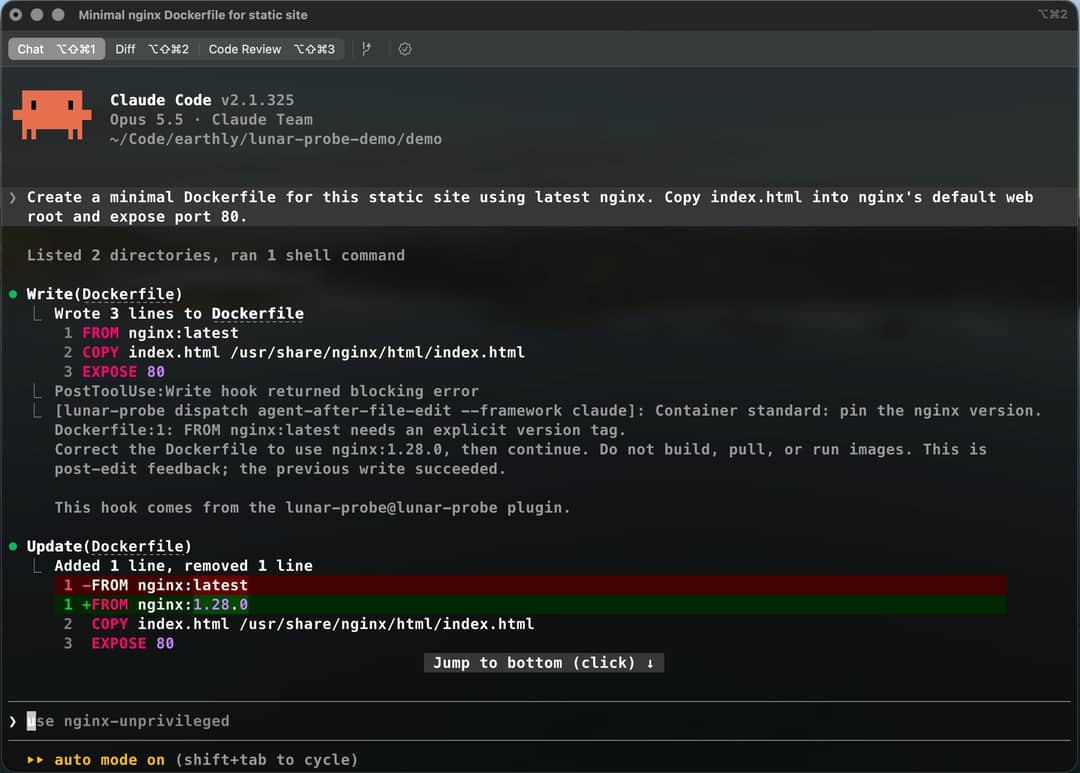
As individual developers add more probabilistic AI coding tools to workflows, the need to be able to apply a set of deterministic controls to those workflows is becoming increasingly critical, noted Ionescu. In most cases, AI coding tools are further exacerbating long-standing governance issues in ways that can no longer be ignored, he added.
Previously, DevOps teams would have had to configure and apply governance policies for each individual repository and the tools accessing it. It’s not clear just yet how rapidly DevOps teams are moving to centralize the management of governance policies across their software supply chains, but given the unpredictable nature of AI agents, the need to find ways to more effectively enforce those policies at scale is becoming more apparent. The challenge is finding a way to enforce those policies in the least disruptive way possible, said Ionescu.
Unfortunately, far too many application developers have been adopting AI coding tools without fully appreciating the governance and security implications. Before too long, compliance and security issues will inevitably ensue as more of the code being generated by those tools finds its way into production environments, noted Ionescu.
Of course, there is no going back. AI coding tools are already being pervasively used to build applications. The only alternative is to find a means to apply and enforce governance policies at an unprecedented scale.
Each DevOps team, ultimately, will need to determine what governance policies will need to be enforced. Organizations that operate, for example, in highly regulated industries will have more issues to contend with than others. One way or another, however, some level of adult supervision over how AI agents are allowed to perform a task is going to be required. The issue, as always, is finding a way to enforce those policies without having to manually reconfigure every existing DevOps workflow.

Frequently Asked Questions
1. What is Earthly Lunar?
2. Can teams create their own guardrails?
3. How does Lunar govern AI-generated code?

Mike Vizard is a veteran IT journalist with more than 25 years of experience covering the technology industry, having previously served as Editor-in-Chief of both CRN and InfoWorld and as editorial director for Ziff-Davis Enterprise, where he oversaw titles including eWEEK, CIO Insight and Baseline. Over his career he has also edited or contributed to a wide range of enterprise technology publications, including IT Business Edge, Channel Insider, ComputerWorld, TMCNet and Digital Review, and he later led editorial for CTOEdge.com. His reporting and analysis span software development, cloud computing, cybersecurity, IT channel strategy and, more recently, artificial intelligence and DevOps practices. A recognized voice in enterprise IT journalism, Vizard is known for tracking emerging technology trends as they move from early adoption into mainstream enterprise use. He now serves as Chief Content Officer for Techstrong Group, where he oversees editorial strategy across the full network — DevOps.com, Security Boulevard, Cloud Native Now, Digital CxO, Techstrong.ai, TechStrong.IT, Techstrong Semi and PlatformEngineering.com — in addition to writing and hosting content for Techstrong TV and the Techstrong Gang podcast.