
DevOps.com

  • Latest
    • Articles
    • Features
    • Most Read
    • News
    • News Releases
  • Topics
    • AI
    • Continuous Delivery
    • Continuous Testing
    • Cloud
    • Culture
    • DataOps
    • DevSecOps
    • Enterprise DevOps
    • Leadership Suite
    • DevOps Practice
    • ROELBOB
    • DevOps Toolbox
    • IT as Code
  • Videos/Podcasts
    • Techstrong.tv Podcast
    • Techstrong.tv Video Podcast
    • Techstrong.tv - Twitch
    • DevOps Unbound
  • Webinars
    • Upcoming
    • On-Demand Webinars
  • Library
  • Events
    • Upcoming Events
    • On-Demand Events
  • Sponsored Content
  • Related Sites
    • Techstrong Group
    • Container Journal
    • Security Boulevard
    • Techstrong Research
    • DevOps Chat
    • DevOps Dozen
    • DevOps TV
    • Techstrong TV
    • Techstrong.tv Podcast
    • Techstrong.tv Video Podcast
    • Techstrong.tv - Twitch
  • Media Kit
  • About
  • Sponsor
  • AI
  • Cloud
  • Continuous Delivery
  • Continuous Testing
  • DataOps
  • DevSecOps
  • DevOps Onramp
  • Platform Engineering
  • Low-Code/No-Code
  • IT as Code
  • More
    • Application Performance Management/Monitoring
    • Culture
    • Enterprise DevOps
    • ROELBOB
Hot Topics
  • Azure Migration Strategy: Tools, Costs and Best Practices
  • Blameless Integrates Incident Management Platform With Opsgenie
  • OpenAI Hires 1,000 Low Wage Coders to Retrain Copilot | Netflix Blocks Password Sharing
  • Red Hat Brings Ansible Automation to Google Cloud
  • Three Trends That Will Transform DevOps in 2023

Home » Latest News Releases » IBM announces Elyra AI Toolkit, a set of AI-centric extensions to Jupyter Notebooks

IBM announces Elyra AI Toolkit, a set of AI-centric extensions to Jupyter Notebooks

By: Deborah Schalm on April 29, 2020 1 Comment

Recent Posts By Deborah Schalm
  • Exabeam Reinvents Security Analytics with Fusion XDR and Fusion SIEM Cloud Products to Address Security Needs at Scale
  • New Study Reveals Importance of Optimized Strategy for the Selection, Support, and Maintenance of Open Source Software
  • Applitools Integrates With Rally for Fast and Automated Bug Management
More from Deborah Schalm
Related Posts
  • IBM announces Elyra AI Toolkit, a set of AI-centric extensions to Jupyter Notebooks
  • Elyra reaches 1.0.0
  • Learn a Bit About AI
    Related Categories
  • Latest News Releases
    Related Topics
  • ibm
  • Jupyter notebooks
Show more
Show less

Elyra AI Toolkit is a new open source project that extends the JupyterLab user interface to simplify the development of data science and AI models.

By Luciano Resende
Published April 29, 2020

TechStrong Con 2023Sponsorships Available
Jupyter Notebooks are now the open standard for data science and artificial intelligence (AI) model development. In keeping with our commitment to open source and the Jupyter community, in particular, IBM is proud to announce Elyra, a set of open source AI-centric extensions to Jupyter Notebooks, and, more specifically, the new JupyterLab user interface.The initial release of Elyra includes:
  • Notebook Pipelines visual editor
  • Ability to run notebooks as batch jobs
  • Hybrid runtime support (based on Jupyter Enterprise Gateway)
  • Python script execution capabilities within the editor
  • Notebook versioning based on Git integration
  • Reusable configuration for runtimes

We’re excited to announce Elyra and help evolve the Jupyter ecosystem with new tools for AI model development.

“I’m excited to see IBM engaging with the Jupyter and scientific open source communities with their ongoing contributions in this area. As much as AI tools rely on vast amounts of data and computational resources, the human in the loop remains the critical element for both asking the right questions and making decisions responsibly. That’s where Jupyter plays a role, and I’m delighted to see new tools like Elyra that will help AI workflows within the Jupyter ecosystem.” — Fernando Pérez, Project Jupyter co-Founder and co-Director

Notebook pipelines

Building an AI pipeline for a model is hard. Breaking down and modularizing a pipeline is harder. A typical machine and deep learning pipeline begins as a series of preprocessing steps followed by experimentation, optimization, and, finally, deployment. Each of these steps represents its own unique challenge in implementation, execution, scheduling, and operation when bringing deep learning models from development to production.

Elyra provides a visual editor for building Notebook-based AI pipelines, simplifying the conversion of multiple notebooks into batch jobs or workflows. By leveraging cloud-based resources to run their experiments faster, the data scientists, machine learning engineers, and AI developers are then more productive, allowing them to spend their time using their technical skills.

The following image shows the Elyra Canvas component that enables the pipeline visual editor. The Canvas user interface was originally developed as part of IBM Watson Studio and is now being open sourced as part of Elyra. So, existing IBM Watson Studio and IBM SPSS Modeler users should feel comforable with Elyra.

Elyra Canvas

Elyra also extends the Notebook UI to simplify the submission of a single Notebook as a batch job, as the following image shows.

Batch job

Hybrid runtime support

Elyra takes advantage of the work that we’ve done with Jupyter Enterprise Gateway to enable Jupyter Notebooks to share resources across distributed clusters such as Apache Spark, Kubernetes, and OpenShift.

It simplifies the task of running the notebooks interactively on cloud machines, so you can use the power of cloud-based resources that enable the use of specialized hardware such as GPUs and TPUs.
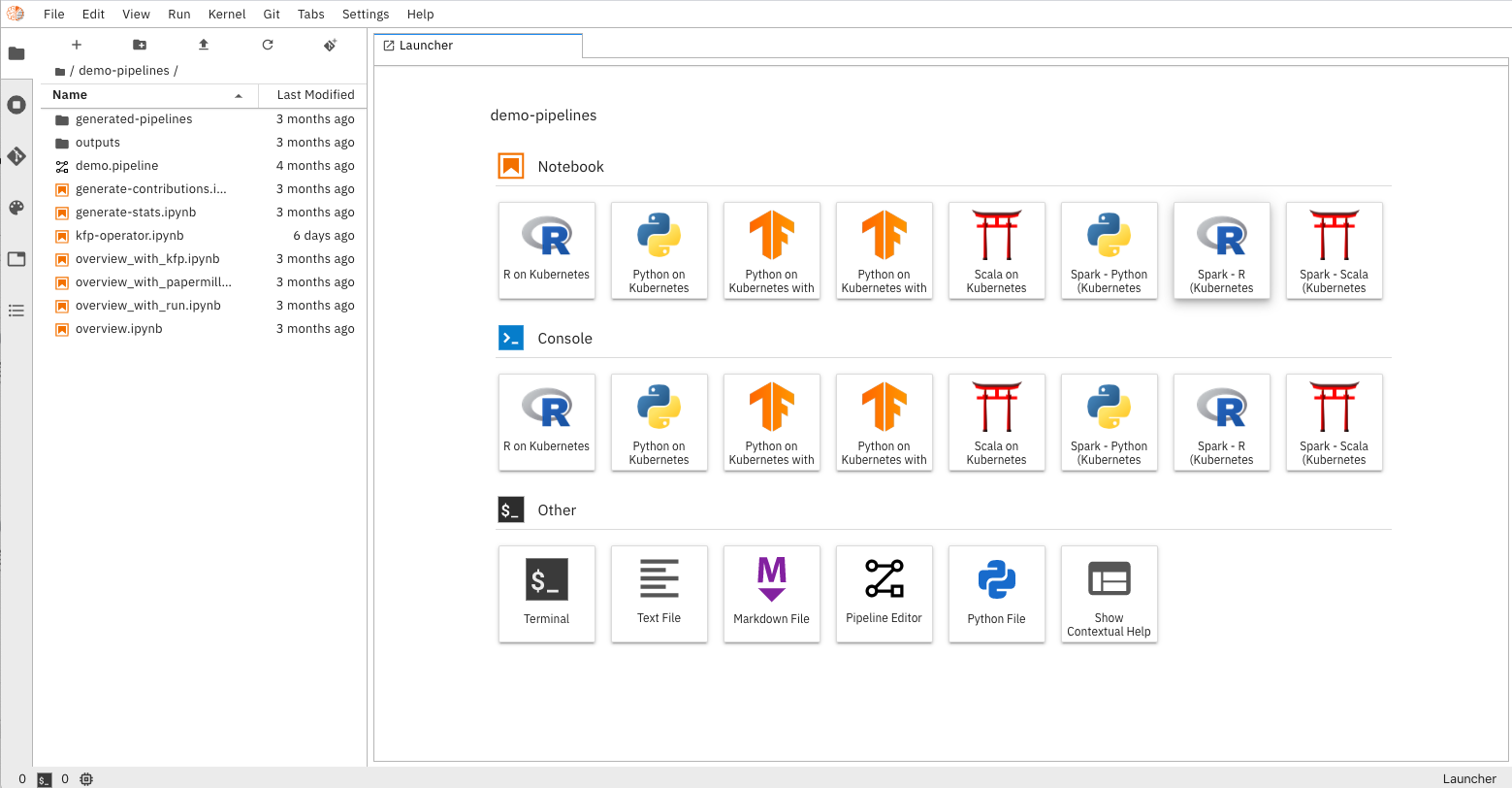
View of main page of AI Workspace

Python script execution support

Leveraging the hybrid runtime support, Elyra exposes Python Scripts as first-class citizens, allowing users to locally edit their scripts and execute them against local or cloud-based resources seamlessly.

Process diagram

Versioning based on Git integration

The integrated support for Git repositories makes tracking changes easier, allowing users to roll back to working versions of the code, backups, and, most importantly, sharing among team members. This collaborative working environment fosters productivity.
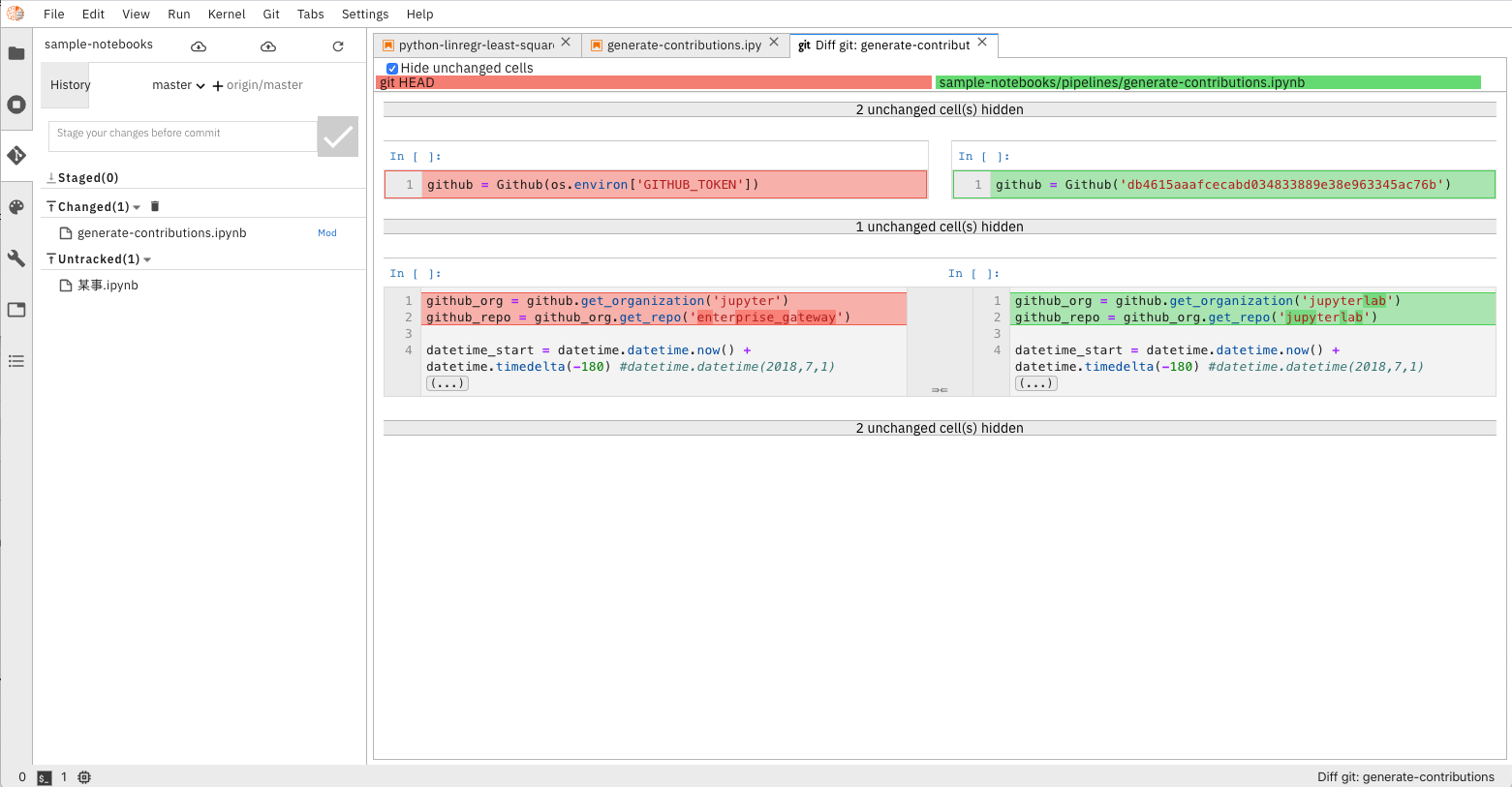
Process diagram

Reusable configuration for runtimes

Elyra introduces a ‘shared configuration service’ that simplifies workspace configuration management, enabling things like information around accessing external runtimes to be configured once and shared across multiple components.

Elyra and IBM Watson Studio

IBM recently announced new releases of IBM Cloud Pak for Data and Watson Studio which added JupyterLab as a richer way to work with Notebooks, in addition to classic Jupyter Notebooks. The current version of Watson Studio already provides versioning based on Git integration and is continuing to work with the open source community to incorporate other Elyra extensions.
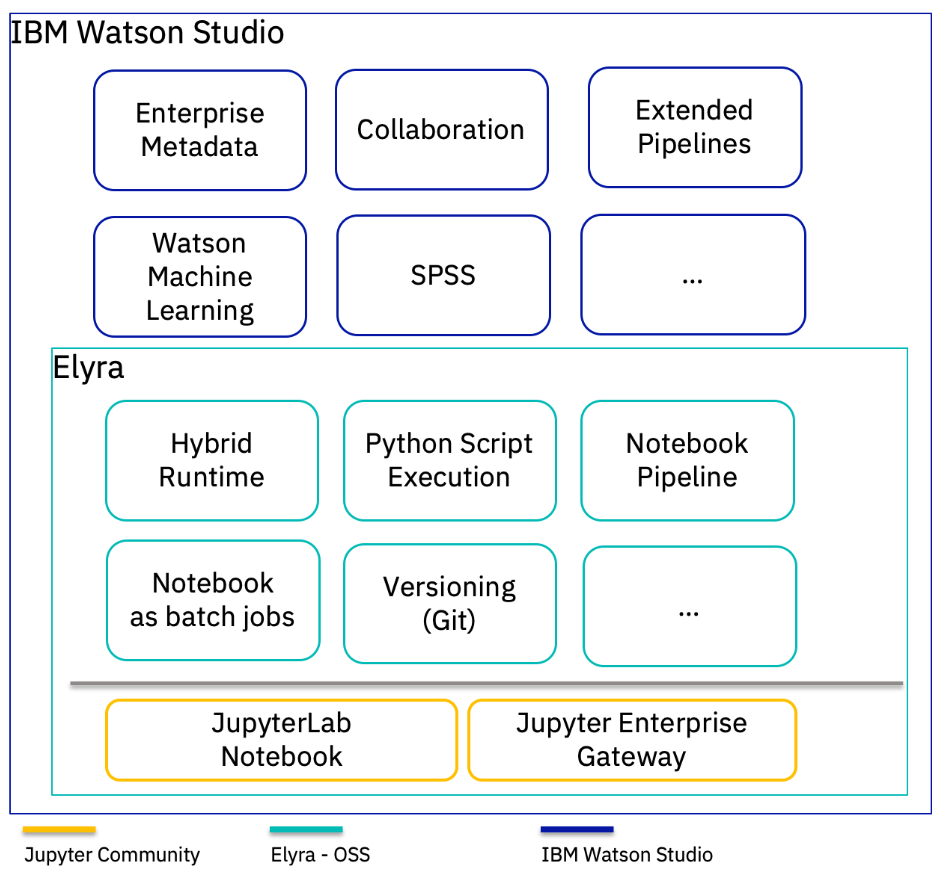
Process diagram

Summary

Building on a Jupyter Notebooks foundation, the de facto tool for data scientists, machine learning engineers and AI developers, Elyra provides a toolkit designed to help around model development tasks complexity.

Previously, the work on Jupyter Enterprise Gateway addressed the challenges around scaling enterprise workloads, and now Elyra addresses the challenges of making workload development easier. In addition, IBM is contributing to TensorFlow, PyTorch, Spark, KubeFlow, KubeFlow Pipelines, ONXX, and Egeria to address an even broader set of enterprise data and AI development challenges.

We would love for you to get involved with the project. Read our contributing guidelines, create new issues if you have questions, suggestions for new features or in case of any problems. We also welcome contributions via GitHub pull requests.


Related

Filed Under: Latest News Releases Tagged With: ibm, Jupyter notebooks

« Former Jive CEO, Netflix’s CHRO and Five9’s CFO Join JFrog’s Board of Directors
Why You Can’t Have DevOps Without Test Automation »

Techstrong TV – Live

Click full-screen to enable volume control
Watch latest episodes and shows

Upcoming Webinars

Automating Day 2 Operations: Best Practices and Outcomes
Tuesday, February 7, 2023 - 3:00 pm EST
Shipping Applications Faster With Kubernetes: Myth or Reality?
Wednesday, February 8, 2023 - 1:00 pm EST
Why Current Approaches To "Shift-Left" Are A DevOps Antipattern
Thursday, February 9, 2023 - 1:00 pm EST

Sponsored Content

The Google Cloud DevOps Awards: Apply Now!

January 10, 2023 | Brenna Washington

Codenotary Extends Dynamic SBOM Reach to Serverless Computing Platforms

December 9, 2022 | Mike Vizard

Why a Low-Code Platform Should Have Pro-Code Capabilities

March 24, 2021 | Andrew Manby

AWS Well-Architected Framework Elevates Agility

December 17, 2020 | JT Giri

Practical Approaches to Long-Term Cloud-Native Security

December 5, 2019 | Chris Tozzi

Latest from DevOps.com

Azure Migration Strategy: Tools, Costs and Best Practices
February 3, 2023 | Gilad David Maayan
Blameless Integrates Incident Management Platform With Opsgenie
February 3, 2023 | Mike Vizard
OpenAI Hires 1,000 Low Wage Coders to Retrain Copilot | Netflix Blocks Password Sharing
February 2, 2023 | Richi Jennings
Red Hat Brings Ansible Automation to Google Cloud
February 2, 2023 | Mike Vizard
Three Trends That Will Transform DevOps in 2023
February 2, 2023 | Dan Belcher

TSTV Podcast

On-Demand Webinars

DevOps.com Webinar ReplaysDevOps.com Webinar Replays

GET THE TOP STORIES OF THE WEEK

Most Read on DevOps.com

New Relic Bolsters Observability Platform
January 30, 2023 | Mike Vizard
OpenAI Hires 1,000 Low Wage Coders to Retrain Copilot | Netflix Blocks Password Sharing
February 2, 2023 | Richi Jennings
Jellyfish Adds Tool to Visualize Software Development Workflows
January 31, 2023 | Mike Vizard
Cisco AppDynamics Survey Surfaces DevSecOps Challenges
January 31, 2023 | Mike Vizard
Five Great DevOps Job Opportunities
January 30, 2023 | Mike Vizard
  • Home
  • About DevOps.com
  • Meet our Authors
  • Write for DevOps.com
  • Media Kit
  • Sponsor Info
  • Copyright
  • TOS
  • Privacy Policy

Powered by Techstrong Group, Inc.

© 2023 ·Techstrong Group, Inc.All rights reserved.