

Sponsored Content
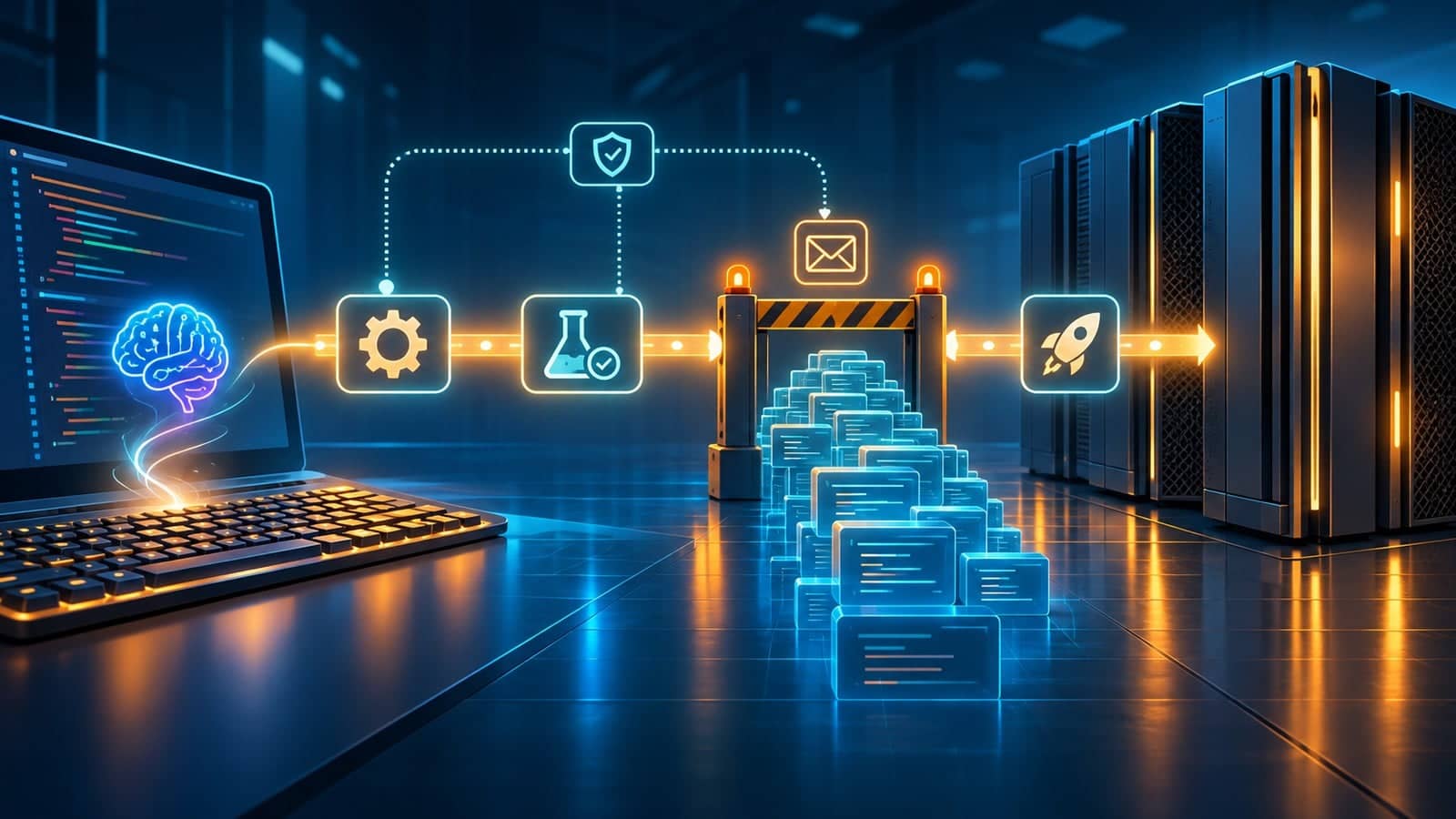
Here’s an experience that will sound familiar to anyone who has shipped a change to a z/OS application. A developer edits the code and submits a build. The build is more or less automated, but once it’s done, the developer must send an email asking for approval, and the change sits there.
Nothing in that sequence is broken, exactly. The approval is the right control, and the person reviewing it is probably the right person. But the change has stopped moving. AI help at the developer’s keyboard will not get it moving again.
During a recent webinar I hosted on mainframe software delivery, Vijay Namasevi, Area VP of R&D at BMC Software, described this small scene, capturing what I think is an important finding from a recent Techstrong PulseMeter poll we fielded of 145 mainframe software delivery professionals. Though AI has arrived on the mainframe. It hasn’t made it very far down the pipeline.
Broad Adoption, Short Reach
In the poll, 86% of organizations reported use of AI somewhere in mainframe software delivery. However, most of that use sits at the developer’s keyboard. 57% of organizations apply AI to code generation or developer assistance while only about a quarter use it to automate deployment, security, and compliance. AI is following the path of least integration.
A developer can adopt a coding assistant without rewiring anything downstream. But testing, deployment, and compliance are a different matter. There, AI must work inside shared systems, approval chains, and evidence requirements, and on the mainframe those rarely sit in one place. Nearly half of respondents still run manual or legacy delivery processes, often alongside more modern ones.
Where the pipeline isn’t automated and instrumented, AI has very little to attach to beyond the development environment.
The gains at the coding end are real. My longstanding argument has been that these ultimately are gains in quality rather than speed, Vijay made the point that AI is helping developers understand old, sprawling applications well enough to change them with confidence, which matters on a platform where the person who wrote a program may have retired a decade ago. Better understanding means better changes, more review cycles, and fewer surprises: a clear quality benefit.
There’s a side effect, though. When developers produce good changes faster, every slow step after them becomes more visible. Vijay said testing is now “popping up” as a challenge for many of his customers at BMC, largely because test automation was so often the last priority. AI exposed a bottleneck that was already there.
Security as Both Priority and Barrier
The second finding that stood out is a kind of dichotomy. Security and compliance rank near the top of the list of strategic priorities (38% of organizations), and near the top of the list of barriers too (37%), behind only legacy applications and processes.
For regulated, high-consequence workloads, that makes sense. The useful question at that point is where the controls sit. When I put that to Vijay, he said the trouble lies less in the controls themselves than in whether they live inside the delivery process or alongside it. The emailed approval step I described above is living alongside the delivery process.
The poll suggests most organizations haven’t acted on this yet. Asked what will speed up mainframe delivery over the next 12 to 18 months, 71% of respondents pointed to more automation, more AI, or better tool integration. Only 11% picked governance and compliance automation. Compliance is still treated as a condition to satisfy rather than a lever for speed.
This view will be hard to sustain, though. If AI increases the volume and pace of code changes while the controls stay outside the pipeline, organizations will simply build a longer queue of changes waiting for someone to answer an email.
The Hardest Problems Sit in the In-Between
Asked which area is hardest as delivery responsibilities expand, respondents split almost evenly among integrating security, coordinating across tools and teams, and operationalizing AI. Each of those crosses a boundary: development to security, one toolchain to another, a model’s output to a governed release. That looks much more like an orchestration problem than a problem in any single stage.
Service orchestration on mainframes is, generally speaking, harder than it is elsewhere. A COBOL change rarely stands alone because it may depend on copybooks, call other programs, bind to Db2, and run under CICS. Git has become useful common ground for mainframe and distributed developers, with branching, pull requests, and code review. But Git doesn’t compile COBOL, promote load modules through controlled environments, or restore the prior production version when a deployment fails. Those jobs belong to the pipeline. The major distributed CI/CD platforms, which have spent the past year adding AI agents and in-pipeline SBOM generation, generally don’t reach z/OS at all.
What Controls Inside the Pipeline Look Like
BMC’s product to address this scenario is the BMC AMI DevX Code Pipeline, which aims to provide an intelligent, governed software delivery platform for the mainframe. Code Pipeline handles mainframe build, promotion, and deployment, whether source code lives there or in an enterprise Git repository, and plugs into the CI/CD orchestrators teams already run. Two of its newer capabilities put controls inside the pipeline.
The first is an MCP (Model Context Protocol) server that lets coding assistants such as GitHub Copilot, Cursor, or Claude Code request pipeline operations like checkout, compile, promote, and deploy from inside the IDE session. Those requests run through the same APIs, approvals, and audit trail as any developer-initiated action. It’s human-in-the-loop by design, to provide experienced supervision of agents that tend to scale whatever process they operate in, healthy or not. Mainframe workloads are a poor place to learn the dangers of that.
The second is SBOM generation for mainframe components inside the pipeline, in CycloneDX format, covering programs, copybooks, and called subprograms. The scenario it addresses is familiar: a CVE is disclosed, and the auditor wants a list. With component records already in hand, that becomes a query instead of a scavenger hunt, which matters more as DORA and the EU Cyber Resilience Act raise expectations for component inventories.
Getting Past “Five Times Shy”
None of this is a tooling problem alone. In my experience, the biggest barriers to modernization are usually institutional and cultural, and mainframe teams have good reasons for caution. Anyone who has managed these applications for long has been burned by an ambitious automation initiative. In the critical business of managing the mainframe, you aren’t twice shy after something like that, you’re five times shy!
But too much caution leads towards two opposing mistakes: waiting for a perfectly unified plan; or moving fast and assuming the controls will catch up. (Vijay described one customer that spent a full year consolidating tools before starting anything else and is now building on AI from that base. That is quite a delay to begin innovating.) What matters, as Vijay put it, is a clear modernization goal rather than fixing tool fragmentation for its own sake. Moving fast on updating software delivery tools with AI without any significant assessment of existing tools carries the obvious risks of duplicative, outdated, or conflicting processes and increased complexity. A typical enterprise should generally do better running both tool clean-up and updating controls in parallel.
I’d add one caution of my own: AI can make fragmentation worse. It’s very good at working around messy toolchains, which makes it tempting to stop worrying about cleaning them up. That is a swifter road to paralyzing technical debt.
Where to Start
Based on the poll and my conversation with Vijay, it seems best for mainframe delivery leaders to focus on four things.
Baseline the actual current process mix. Document where processes are manual, where CI/CD is standardized, and where delivery crosses tools and teams. Most organizations run more than one model, and the right next step differs for each.
Find the “emailed” approvals. Look for the points where changes wait on a handoff, and make policy checks, approvals, and audit evidence outputs of the pipeline itself.
Decide how AI-produced work gets reviewed before you scale it. Define how AI-generated code, tests, and pipeline changes will be traced and approved with the same rigor as human work. Then extend AI past the editor.
Measure outcomes, not activity. Track lead time for changes, automation coverage, change failure and rework rates, policy compliance, and cross-tool handoffs.
Interest in mainframe process modernization isn’t in doubt. The question is whether organizations will orchestrate automation, AI, and control as one system or keep advancing each on its own track. That answer will decide the degree to which AI’s gains at the developer keyboard consistently reach production.


Guy is the CTO at Visible Impact, responsible for positioning, GTM, and sales guidance across technologies and markets. He has decades of field experience describing technologies, their business and community value, and how they are evaluated and acquired. Guy’s specialty areas include AI, DevOps/cloud-native/12-factor, enterprise applications, application integration, Big Data, governance-risk-compliance, containerization, virtualization, HPC, CPUs-GPUs, xPUs, and systems lifecycle management. Guy started his technology career as a research director for technology media company Ziff Davis, with stints at PC Magazine, eWeek, and CIO Insight. Prior to joining Visible Impact, he worked at Dell, including postings in marketing, product, and technical marketing groups for a wide range of products, including engineered systems, cloud infrastructure, enterprise software, and mission-critical cloud services. He lives and works in Austin, TX.