
In many enterprises, middleware is where the real work happens. The application may be the face, but the reality runs through Apache and IIS at the edge, Tomcat in the web tier and critical runtimes such as Oracle WebLogic Server (WLS) and IBM WebSphere Application Server (WAS) behind them. When these layers degrade, users experience it as ‘the system is down’, even if the application code hasn’t changed at all.
The problem is that middleware is often operated as fixed infrastructure: Hand-configured, slowly patched and protected by process rather than engineering controls. Meanwhile, modern delivery expectations are the opposite: Ship more frequently, rotate certificates and secrets, tighten security baselines and scale on demand. If your middleware estate is a collection of snowflakes, every one of those expectations increases risk.
Resilient middleware isn’t achieved by buying ‘high availability’. It’s achieved by making the stack predictable: Declarative configuration, automated delivery, validated change and fast recovery.
Why Traditional Middleware Operations Become Fragile
Across Tomcat, WLS, WAS, Apache and IIS, the failure patterns are remarkably consistent.
1. Configuration Drift Becomes Permanent
Over time, drift becomes ‘how we operate’. JVM flags get copied from a wiki. Apache rewrite rules are tweaked during incidents. IIS bindings vary across servers. WLS/WAS domains accumulate one-off changes. Environments diverge, and troubleshooting becomes archaeology.
2. Change Control Optimizes for Approval, Not Safety
Slowing down changes may not just reduce the number of deployments, but it may also decrease confidence and increase batch size. When teams deploy rarely, rollback is stressful and patches get delayed. That’s not safe — it’s deferred risk.
3. Observability Is Inconsistent
Middleware incidents often show up as saturation, not a crash:
- Rising 502/503 rates at Apache/IIS
- Tomcat/WLS/WAS thread pools exhausted
- Connection pools are waiting and timing out
- GC pauses are turning into latency spikes
If each platform emits different logs and metrics (or none at all), MTTR becomes dominated by guesswork.
The Core Move: Treat Middleware Configuration as a Versioned Product
The biggest reliability jump comes from a simple posture change:
Stop treating ‘what’s on the server’ as the truth. Make Git the truth.
In practice, this means:
- YAML as the declarative configuration model (by environment and tier)
- Ansible is the execution engine that applies configuration consistently
- Templates that render platform-native configs (Apache, IIS, Tomcat, WLS, WAS)
- Promotion through environments via the same automation, not different procedures
You are not trying to make every platform identical. You are trying to make your operating model consistent.
A Practical Reference Architecture
A simple model that works in heterogeneous estates:
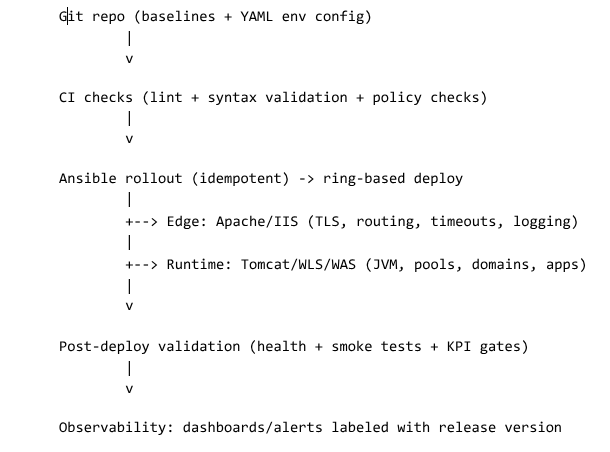
How Ansible + YAML Improves Resilience Across the Stack
1. Drift Control and Reproducibility
Define what ‘correct’ looks like in YAML — timeouts, TLS policy, JVM baselines, pool sizing — and have Ansible enforce it. When someone makes an emergency manual change, it becomes visible as drift and is either reverted or captured properly via a pull request.
The operational benefit is large: If you can rebuild a node from code, you can recover faster and scale without fear.
2. Safer Patching and Baselines
Middleware estates become risky when patching is rare. Automation makes patching routine:
- Ring-based rollout (non-prod -> small prod subset -> full prod)
- Standardized pre-checks (ports, disk, cert validity, dependency reachability)
- Standardized post-checks (health endpoints, login flows, upstream handshakes)
- Clear rollback to the prior known-good release
This approach is especially important for TLS changes (cipher updates, protocol hardening) that frequently impact Apache/IIS first and ripple inward.
3. Failure Mode Discipline (Not Hope)
A resilient middleware layer has explicit failure semantics. At the edge (Apache/IIS):
- Enforce bounded timeouts; avoid infinite hangs
- Use consistent keepalive and upstream settings
- Ensure clean degradation behavior (503 with clarity versus random timeouts)
- Standardize logging and correlation identifiers At the runtime (Tomcat/WLS/WAS):
- Set thread pools to avoid unbounded queuing
- Size and validate connection pools to prevent global stalls
- Standardize JVM baselines and observe GC behavior under load
- Ensure predictable startup/shutdown to support rolling changes
None of this requires new tooling. It requires standard defaults and automation-backed enforcement.
Progressive Delivery for Middleware: Control the Blast Radius
Most large middleware incidents caused by change share the same flaw: The change was applied everywhere at once.
Your middleware pipeline should support:
- Canary/Rings: Update one node, validate, then continue
- Gated Promotion: Promotion requires passing validation, not just completing a run
- Halt Conditions: Error rate or latency thresholds stop rollout
- Rollback: Revert configuration release tags quickly and predictably
Even classic middleware estates — without service meshes or sophisticated traffic shaping — can do this effectively by rolling node by node and validating at each step.
Anonymized Outcomes You Can Expect
In a mixed estate (Linux/Windows) operating Apache, IIS, multiple Tomcat clusters and a combination of WLS and WAS domains, adopting YAML-defined configuration and Ansible-driven rollout delivered typical, defensible outcomes over two quarters:
- Middleware change failure rate reduced from the high teens to the mid-single digits.
- Median MTTR was reduced by roughly half due to standardized signals and version correlation.
- Patch latency was reduced materially by shifting to a ring-based, validated rollout.
- Drift-driven incidents declined sharply once manual configuration stopped being ‘invisible’.
Your numbers will differ, but the direction is consistent when you remove drift and make rollback real.
A Simple Framework to Start Tomorrow
- Choose one tier (edge or runtime) and codify a baseline in YAML.
- Automate deployment with Ansible until it is idempotent.
- Add validation gates (syntax + health + KPI checks).
- Roll out in rings and prove rollback under controlled conditions.
- Standardize observability so incidents correlate to changes quickly.
Do not wait for a perfect enterprise program. Middleware resilience compounds.
Conclusion: Resilient Middleware is an Automation Outcome
Tomcat, WebLogic, WebSphere, Apache and IIS can be stable at scale — but not as snowflakes. Resilience comes from repeatability: Configuration as code in YAML, Ansible-driven enforcement, progressive delivery to limit the blast radius and observability that makes failures diagnosable quickly.
If you want middleware that supports modern delivery rather than blocking it, treat the platform like a product: Version it, test it, deploy it safely and practice recovery. That is what DevOps looks like when it matters.