

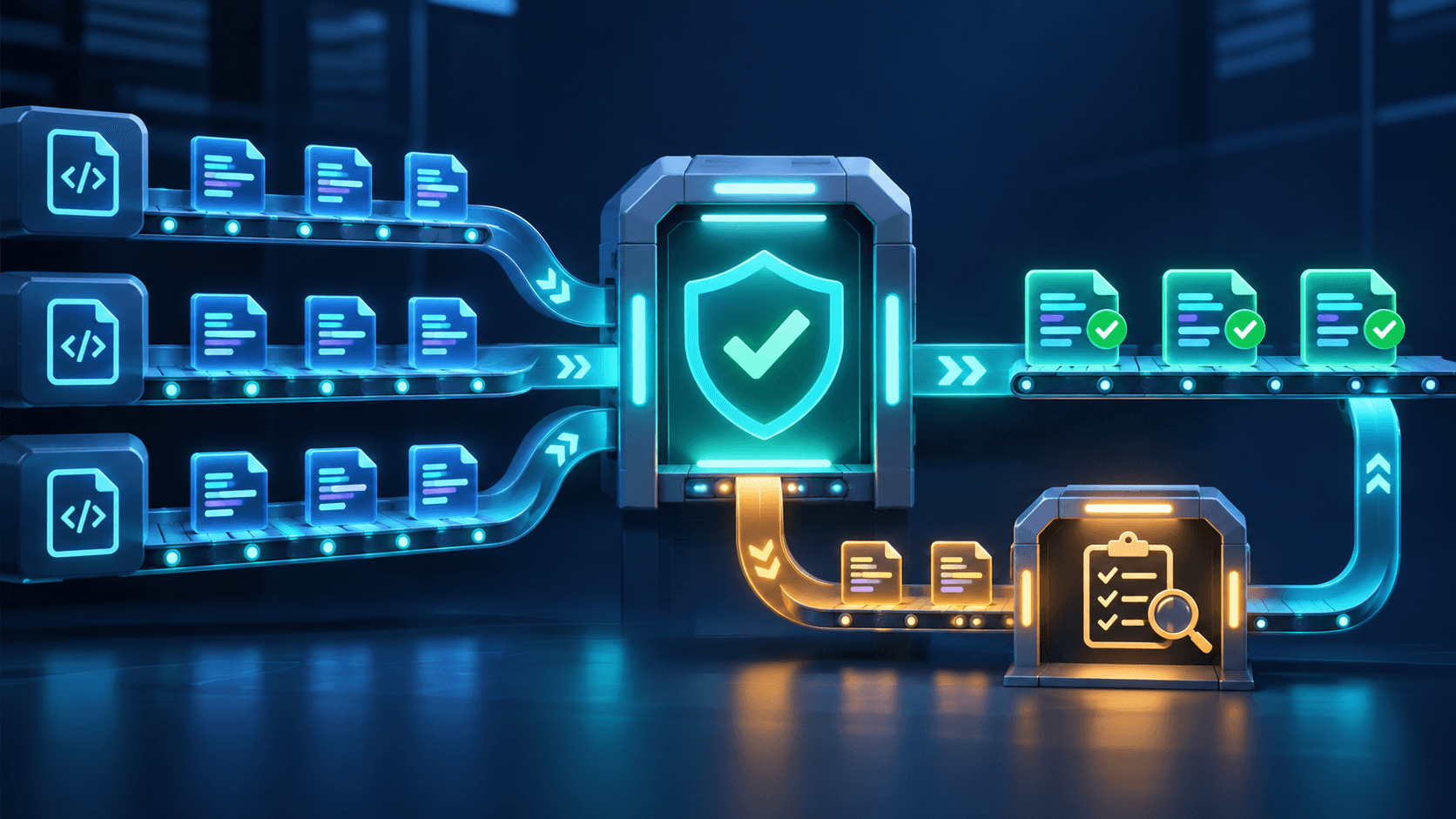
AI coding agents solved one problem and created another. Developers can now generate code far faster than their teams can review it. The pull request queue has become the new constraint.
Anthropic wants to move that constraint. This week, the company launched Claude Ship in beta, a set of agents that review GitHub pull requests, fix what’s broken, and, where a team’s rules allow, approve changes without a human.
Most teams require a person to approve every change. That works when people write every line. It breaks down when agents write most of the code. Anthropic says that’s already the case on its own Claude Code team, where Claude writes most of the code, and the team wanted everything after the PR to move just as fast.
Claude Ship has three parts. Code Review, already generally available, checks pull requests against the codebase, verifies and categorizes its findings, and posts the results to the PR.
PR Steward, in beta, works through failing CI checks, merge conflicts, and reviewer feedback, whether that feedback comes from Code Review, another tool, or a teammate. After each push, it comments with what it changed and how to undo it. Developers steer it by commenting @claude and halt it with @claude stop. PR Steward can’t approve or merge anything.
Claude Approvals, also in beta, is the bigger shift. A team writes an approval policy as a file in the repository. Think of it as a smarter CODEOWNERS file. The policy can let routine changes through automatically and route riskier ones to a human. It can factor in Code Review results or custom classifiers written in natural language. Existing GitHub permissions and branch protection rules still decide what can merge.
For individual developers, a new /ship command in Claude Code and the desktop app pushes a change, opens the PR, runs the review, and works through feedback and failing checks.
Mitch Ashley, vice president and practice lead for CIO & Technology Buyers and Software Lifecycle Engineering at The Futurum Group, sees the pressure building. “Code review is now the limiting factor in AI-assisted software delivery,” he said. “Agents open pull requests at machine speed, but review capacity still scales one hired engineer at a time, and the backlog of unverified code grows every sprint.”
DORA’s 2025 State of AI-assisted Software Development report found the same pattern. AI adoption now correlates with higher delivery throughput, but it’s also exposing downstream bottlenecks in testing, code review, and quality assurance.
Anthropic is offering its own numbers as evidence the approach works. On the Claude Code team, merged pull requests more than doubled from June to September, while the share of reverted PRs fell by more than 40%. Those are first-party figures. Anthropic itself cautions that Claude Ship’s impact wasn’t isolated, and that its review is one layer in a broader process.
That broader process shows how Anthropic expects teams to use Claude Approvals. In an engineering post last month, the Claude Code team described a risk-tiered model. Low-risk changes, such as documentation or internal features behind feature flags, need no human approval. Medium-risk changes need one person. High-risk changes need two. Sensitive areas, including CI workflow files, always get human oversight. Review loops are capped at three rounds, because an agent author and an agent reviewer can otherwise keep each other busy indefinitely.
Anthropic’s rollout advice is cautious. Pilot Code Review on one repository. Run PR Steward manually. Put Claude Approvals in observe-only mode before branch protection requires its sign-off.
There are practical limits. Claude Ship works only with GitHub for now. It’s available on Claude Team and Enterprise plans and billed on tokens, with admins setting monthly spend limits per repository. A policy that triggers Claude reviews still generates charges in observe-only mode, even when nothing gets approved. Organizations using Zero Data Retention, the HIPAA configuration, or customer-managed encryption keys can’t use it. Eligible Enterprise customers can claim at least $10,000 in promotional credits through January 15, 2027.
Ashley said the shift changes where people apply their judgment. “Agent approval moves human judgment upstream, from signing off each change to writing the policy that decides which changes need a person,” he said. “CTOs and CISOs answer for that policy file, so watch whether it gets the same review, testing, and audit trail as production code.”
That’s the right lens for DevOps teams. The hard question isn’t whether an agent can review code. It’s which changes your organization is willing to let through without a person.
That’s a policy decision, not a tooling decision. Claude Ship puts the policy in a repo file, where it can be versioned, reviewed, and audited. But the file is only as good as the thinking behind it. Teams that have never written down what makes a change risky will need to do that first.
The accountability doesn’t move, either. Whoever configures the policy owns what it approves, and so does the organization behind them. An agent approving a change is still the team approving it.
For teams already buried in agent-generated PRs, Claude Ship deserves a pilot. Start in observe-only mode. Compare its calls against what your reviewers would have done. Track reverts and incidents as your guardrail. If the numbers hold, widen the policy. If they don’t, you’ve learned where your rules need work before anything reaches production.


Tom Smith (C. Thomas Smith III) is a veteran digital analyst and content strategist who spent more than four years as a Research Analyst at DZone.com (part of Devada), where he conducted thousands of interviews with technology executives and authored roughly 1,500 articles that generated more than 10 million page views across topics including AI/ML, Agile, APIs, cloud computing, DevOps, IoT, Java, Kubernetes, microservices, and security. He holds an MBA in Marketing from Duke University's Fuqua School of Business and a B.A. in Political Science from Duke. Smith later worked as a content strategist and technical writer at Cognizant, including stints on Google's Bard (now Gemini) and Meta's AI Business Assistant (MAIBA) "seed" content teams, where he helped train and evaluate large language models. Over his career, he has interviewed more than 4,000 technology executives across AI, cloud, data, security, and storage sectors. He now writes independently through Insights From Analytics and is a contributing writer across multiple Techstrong Group properties, including DevOps.com, Digital CxO, Cloud Native Now, PlatformEngineering.com, and Techstrong.ai, where he covers AI agents, enterprise AI infrastructure, and emerging developer tools.